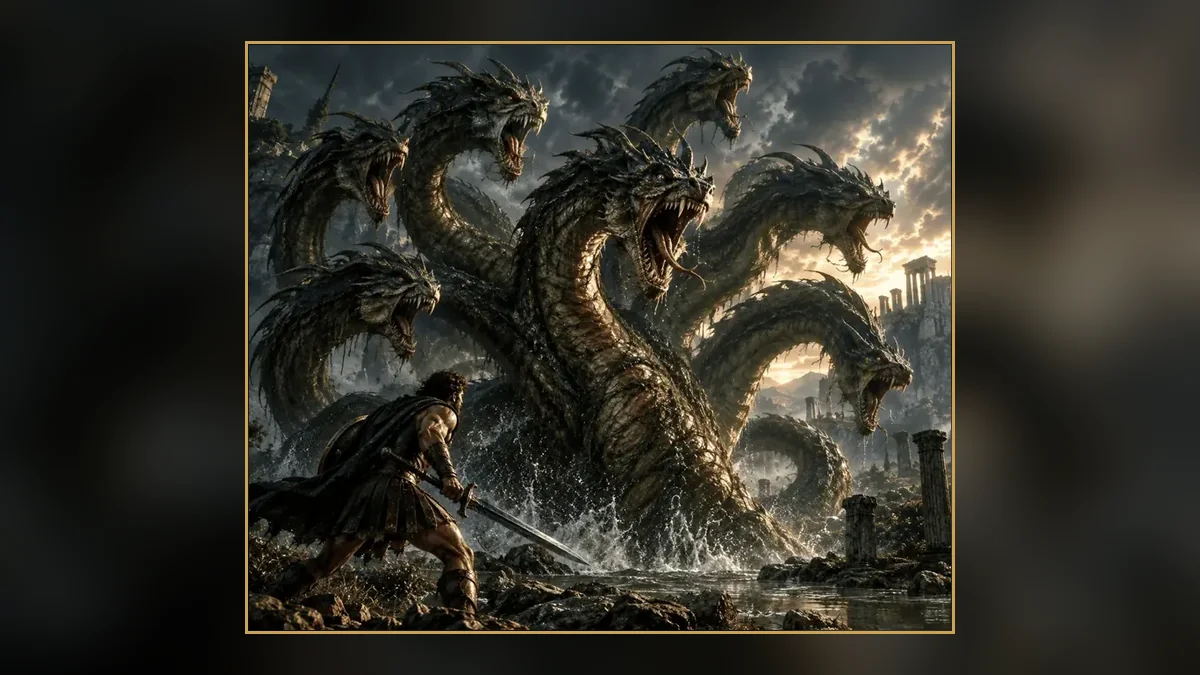
The Hydra has become a metaphor for any problem that gets worse when you attack it. Politicians use it, engineers use it, and anyone who has ever tried to stamp out a rumour has felt it. That is a fair use of the story, as far as it goes. But if you go back to the Greek sources, the Hydra turns out to have a cause that most retellings leave out, and once you notice it, the creature stops being a puzzle about strength and becomes something more uncomfortable.
A snake with a sponsor
Here is what Hesiod says. In the Theogony, Echidna bears a murderous Hydra at Lerna, and Hesiod adds that the goddess Hera raised it, filled with an unquenchable anger against the might of Heracles. In the very next breath, he gives us the outcome: Heracles, the son of Amphitryon, together with Iolaus, destroyed it with the pitiless bronze, and Athena guided the plan.
Every part of that summary is worth keeping. The monster has a mother, a nurse, a target and a grudge. Hera's hostility to Heracles is the oldest thing in his story. She harassed his mother Alcmene, she sent snakes to his cradle, and later she drove him mad. The Hydra is simply one of the instruments of that campaign, a pet raised to a purpose. It was not a wild animal that Heracles happened to meet. It was a weapon, with a patron, aimed at one man.
The swamp at the edge of things
The place matters too. Lerna is a stretch of marsh and springs in the Argolid, near Argos, and it had a reputation. Pausanias, who visited it in the second century CE, describes the spring of Amymone and a great plane tree beside it, under which the Hydra was said to have been reared. He also describes the Alcyonian Lake, a small round pool that the locals insisted was bottomless. According to them, Dionysus had gone down through it to bring his mother Semele back from the dead, and Nero, he adds, once tried to measure its depth with a rope and failed.
That makes Lerna one of the places where the Greeks thought the world was thin. Its mysteries of Demeter were celebrated there too. A water-snake guarding a hole into the underworld, in a marsh full of springs: the whole location is a ring of boundaries. And hydra is simply the Greek word for a water-creature, from the word for water. The monster is named for the swamp that holds it.
How many heads
Everyone knows the Hydra has many heads, but nobody in antiquity agreed on how many. Hesiod does not give a number. The best-known version, in Apollodorus, says nine, with eight of them mortal and the middle one immortal. Virgil, in the Aeneid, puts a Hydra with fifty gaping throats at the gates of Tartarus. The count drifts upward as the story passes through different poets.
Pausanias, never one to take a good story on trust, has a comment on this. He says that the poet Peisander gave the Hydra many heads to make the monster more frightening and his own poem more impressive. As far as Pausanias was concerned, the real animal was a very large snake with an incurable bite, and the heads were an invention. I find that irresistible, because it means the Hydra's heads grew in the telling. The monster that multiplies when you cut it also multiplied when you narrated it. Even the story obeys its own rule.
The fight
Apollodorus gives the full battle. Heracles and his nephew Iolaus drive to Lerna in a chariot. Heracles finds the Hydra on a hill by the springs and fires burning arrows into its den until it slithers out. He grabs it, but it wraps itself around one of his feet and holds on. He smashes at its heads with his club, and every time he knocks one off, two grow in its place.
Then it gets worse. Hera, watching, sends help for her creature in the form of an enormous crab, which pinches at Heracles's foot. He stamps it dead, and calls for Iolaus. This is the turning point. Iolaus takes up a burning brand, and as Heracles cuts off each head, Iolaus sears the stump before a new one can form. With the fire, the regrowth stops. The last head, the immortal one, Heracles cuts off and buries beside the road that runs through Lerna, under a heavy rock. Then he slits open the body and dips his arrows in its gall, which makes them deadly.
Note the details. The first strategy, brute force, fails and makes things worse. The second, force plus fire, succeeds, but only because there are two people. And the one part that cannot be killed is not destroyed. It is buried and marked.
The crab, incidentally, is the most underrated figure in the story. It is a tiny, ordinary creature, sent in as a distraction, and it is crushed without a second thought. Hera was said to have rewarded it by setting it in the sky as the constellation Cancer, which seems the least the goddess could do.
My reading: a grudge that grows back
This is where I step away from the ancient sources and offer an interpretation. Put the three facts together: the Hydra is fed by Hera's anger, it grows when you attack it, and it can only be stopped by a cooperative method that goes to the root. That is a very exact description of a grudge.
Think about how a long-running hostility works. Strike back at someone who is angry with you, and you rarely end the matter. You give them two new reasons for hating you. A feud is a Hydra: every blow you land produces a pair of fresh grievances. The monster only gets bigger as long as it is nourished, and in Hesiod, the nourishing is done by someone who will not let go of her anger. Hera feeds it, and so it grows.
The solution the story offers is not to hit harder. It is to cauterise, to stop the wound from reopening, and for that Heracles has to call for help. The strongest man in Greece cannot finish this one by himself, which is precisely why his king later refuses to count it. And the stubborn core of the problem, the immortal head, is not solved at all. Some parts of any old grievance cannot be killed. They can only be put under a rock beside a road, with everyone agreeing where the rock is.
The labour that did not count
Here is a small piece of bureaucratic comedy. When Heracles returns, Eurystheus rules that the Hydra does not count towards the ten labours he had been set, because Heracles did not do it alone. Iolaus had lit the fires. Together with the Augean stables, which were disqualified on other grounds, that ruling forces two extra labours onto the list, and that is how ten became twelve.
Consider the irony. The lesson of the Hydra is that you cannot solve some problems by yourself, and the official response is to punish the hero for learning it. I do not think the Greeks missed that. Eurystheus is a petty king who does not understand what he has just been told.
What was in the gall
And now the part that most retellings forget. The Hydra did not stop being dangerous when she died. Her gall was in Heracles's arrows, and those arrows are the most lethal weapons in the cycle. A stray one wounds the centaur Chiron, who is immortal and so cannot die, and in agony he trades his immortality away to escape the pain. Another kills the three-bodied giant Geryon. Much later, when the centaur Nessus tries to assault Heracles's wife Deianira, Heracles shoots him with a poisoned arrow, and the dying centaur gives her a cruel gift. He tells her to keep a little of his blood as a love charm.
Years later, when Deianira fears she is losing her husband, she soaks a shirt in that blood and sends it to him. The blood is mixed with the Hydra's venom. Heracles puts on the shirt and the poison eats into his skin, and the only way out for him is the pyre on Mount Oeta.
In other words, the Hydra kills Heracles in the end. It takes a long time, and it passes through a centaur and a wife and a gift, but the thing he thought he had beaten returns through the one door he left open. A grudge that grows back, indeed. You can win the fight at Lerna and still be carrying the poison decades later, in your own quiver, in your own marriage, in a shirt that was meant as an act of love.
What she is for
If I had to say what the Hydra is for, I would say she belongs to the family of problems that outlive their solution. Most of Echidna's children are one-off dangers: a lion, a hound, a riddle. The Hydra is the one whose defeat leaves a residue, a rock by a road, a poison on an arrow. She is the Greek acknowledgement that some victories are only the beginning of a longer account, and that the person who cuts the last head off is not necessarily the person who pays for her.
Comments
Sign in to join the conversation.