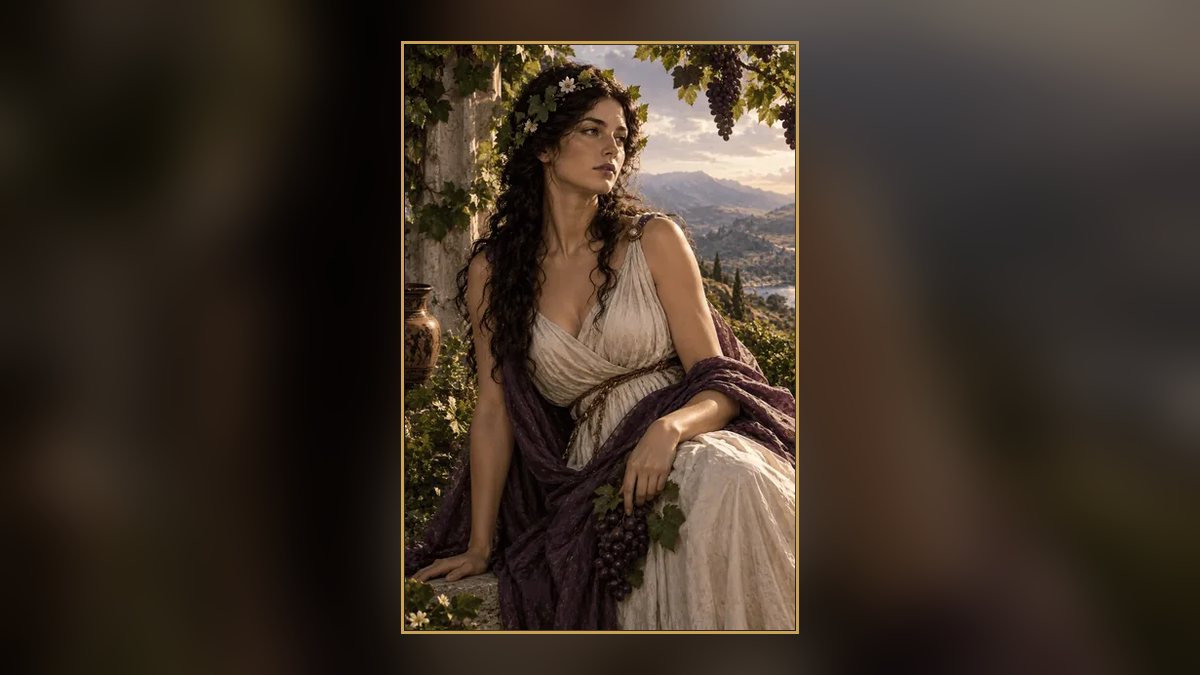
There is a question hiding inside the myth of Semele, and it is not the one people usually ask. The usual question is whether she was foolish. A young woman is told by a trusted old nurse to demand that her lover show himself in his real form, she does so, and the result kills her. It is easy to say she should have known better. But I have never been satisfied with that reading, because it lets everybody else off the hook. The god who swore the oath, the goddess who set the trap, and the city that later called her a liar all get to walk away. So here is my approach. I want to treat Semele as the one person in the story who asked an honest question, and to look at what the myth does to people who do that.
A princess of Thebes
Semele belongs to the first family of Thebes. Her father was Cadmus, the foreigner from Phoenicia who sowed the dragon's teeth and founded the city. Her mother was Harmonia, the daughter of Ares and Aphrodite, a name that means exactly what you think. Think about that pairing for a second. Her parents embody conquest and concord, two forces that do not often share a house. And the family history is already marked by serpents, exile and strange gifts from the gods. Semele grows up in a house that has seen how the divine behaves when it enters human life.
She has sisters, Ino, Autonoe and Agave, and a nephew named Pentheus, the son of Agave, who becomes king later on. These names matter more than they seem to, because Semele's story ends inside a larger Theban tragedy. When we get to the end of this article, we will find the whole family paying for what they did to her.
The lover in the dark
The usual tellings say Zeus fell in love with her and came to her in secret. The details differ from poet to poet, but the shape is steady: the god visits her unseen. What matters is that Semele has a lover whose identity she cannot verify. He says he is Zeus. She has no way to check. In a world where gods really did take on disguises and mortal women really were deceived, that is a genuine problem. A man who claims to be a god is either telling the truth or running one of the oldest cons there is.
This is the part I think gets lost. Semele is not being greedy. She is being careful. She is pregnant, she is about to bring a child into the world who will either be a god's son or a scandal, and her whole community will judge her accordingly. Of course she wants to know. Anyone in her position would.
Hera in a nurse's dress
Enter Hera. The queen of the gods is, as ever, furious about a rival, and in Ovid's retelling she takes the form of an old nurse named Beroe, a woman Semele trusted, and whispers the idea. How do you know he is really Zeus? Many women have been fooled by men who used a great name. Ask him to come to you as he comes to his wife, in all his majesty. Then you will be sure.
I want to be fair to Hera here, even though she is the villain of the piece. The advice is not even technically a lie. The suggestion is sensible on its face. It only becomes lethal because of what Hera knows and Semele does not: a mortal body cannot survive the full presence of the king of the sky. Hera's weapon is a perfectly reasonable request. That makes her one of the most efficient schemers in the whole mythology, because she never has to say anything false.
The oath that cannot be taken back
Now the trap closes. Semele goes to Zeus and asks him for a favour, not saying what it is. He is in a generous mood, and he swears to grant it. In most tellings he swears by the Styx, the river of the underworld, which is the oath that even the gods cannot break. Only then does she tell him what she wants.
Look at what has happened. Zeus is the god of oaths. In the cult he was the one who punished anyone who swore falsely. Here, he is caught inside one of his own sacred promises, and the god who enforces them for everyone else has to enforce this one against himself. In Ovid he actually tries to talk her out of it, but the oath has already been sworn. There is no reading of the story in which Zeus is acting freely at this point. He is as stuck as she is.
So he comes. He puts on, according to some writers, a reduced version of his glory, the least he can manage, and it is still too much. Lightning is not a weapon he is carrying. It is what he is. Semele is struck, and her chamber catches fire, and she dies.
The child in the fire
What follows is one of the stranger rescues in the myths. Semele is six months pregnant, and the unborn child is still alive. Zeus snatches the baby from the flames and sews him into his own thigh, carrying him there until the term is complete. When the time comes, Dionysus is born from his father's body, which is why the Greeks called him the twice-born. Hermes then carries the newborn off to be hidden with Semele's sister Ino and her husband Athamas, the first of many hiding places in the boy's strange childhood.
I have always found it telling that Zeus carries two children in this way, Athena in his head and Dionysus in his thigh, and both are marked by an unusual birth. These are the two gods who most shape human culture, craft and strategy on one side, wine and ecstasy on the other. They are the gods who sit on the boundary between divine and mortal experience, and in both cases the birth is a bit of a miracle, and a bit of an escape.
The tomb that kept smoking
Now we get to the part I promised, the Theban aftermath. Euripides' play The Bacchae, first staged in Athens just after his death, opens with Dionysus himself arriving in Thebes. And where does he stand when he speaks? Beside his mother's tomb. The god tells us that the ruins of her house still smoulder with the fire of Zeus, and that the family built a shrine to mark the spot. Cadmus has fenced the place off and planted vines around it. Even after all those years, there is a memory of flame in the ground.
The reason Dionysus has come is that Thebes refuses to believe in him. Semele's sisters had spread a story that she was never loved by Zeus at all. They said she had a mortal lover, lied about it to cover her shame, and Zeus struck her down for the lie. It is a cruel slander, because it turns her death into proof against her. The whole conflict of the play comes from this: Thebes denies the mother, so Thebes denies the son. Pentheus, the young king, tries to arrest the new god and ban his rites. The consequences, I will not spoil them for anyone who has not read the play, are some of the worst in Greek tragedy.
So the myth does not stop with the lightning. The fire is only the beginning. The real damage is done afterwards, by a family that preferred a comfortable lie to a dangerous truth.
The descent and the rise
Dionysus does not leave his mother where she fell. In the tradition recorded by Apollodorus and by Pausanias, he descends into the underworld, going down through a lake at Lerna in the Argolid, and brings her up. He then takes her to Olympus. She receives a new name, Thyone, which has been connected to a Greek verb for rushing or raving, a very Dionysian kind of name.
Pindar, much earlier, already knew the idea. In an ode he says that Semele, who died in the thunder, now lives among the Olympians. And Hesiod, in the last lines of the Theogony, says that she bore an immortal son as a mortal woman, and that now both of them are gods. The tradition is consistent on this point. The woman who was killed by seeing the truth is eventually given a place among the beings who can bear it.
That is the line from Semele's card in this game: raised to Olympus. I think it is the most important part of the story. The myth does not simply punish her curiosity. It vindicates it. The thing she wanted to know was true, he really was Zeus, and the child she carried really was a god.
What the story is about
If you ask me, the myth is about the cost of certainty. Semele wanted to see the truth directly, instead of taking someone's word for it, and the Greeks understood that such wanting can be dangerous. Their religion was full of limits on how close a mortal could come to a god. Teiresias is blinded. Actaeon is torn apart for seeing Artemis. Here a woman sees the sky as it really is and burns.
But the Greeks also did something unusual with her. They did not treat her as a warning alone. They gave her a son who became a god of their own festivals, a tomb in Thebes that was visited for centuries, and a rise to Olympus. In the end she is the mother of joy, the epithet on her card, and the joy is not a consolation prize. It is the whole point of Dionysus, a god of wine and music who exists because someone once insisted on knowing what was real.
Comments
Sign in to join the conversation.