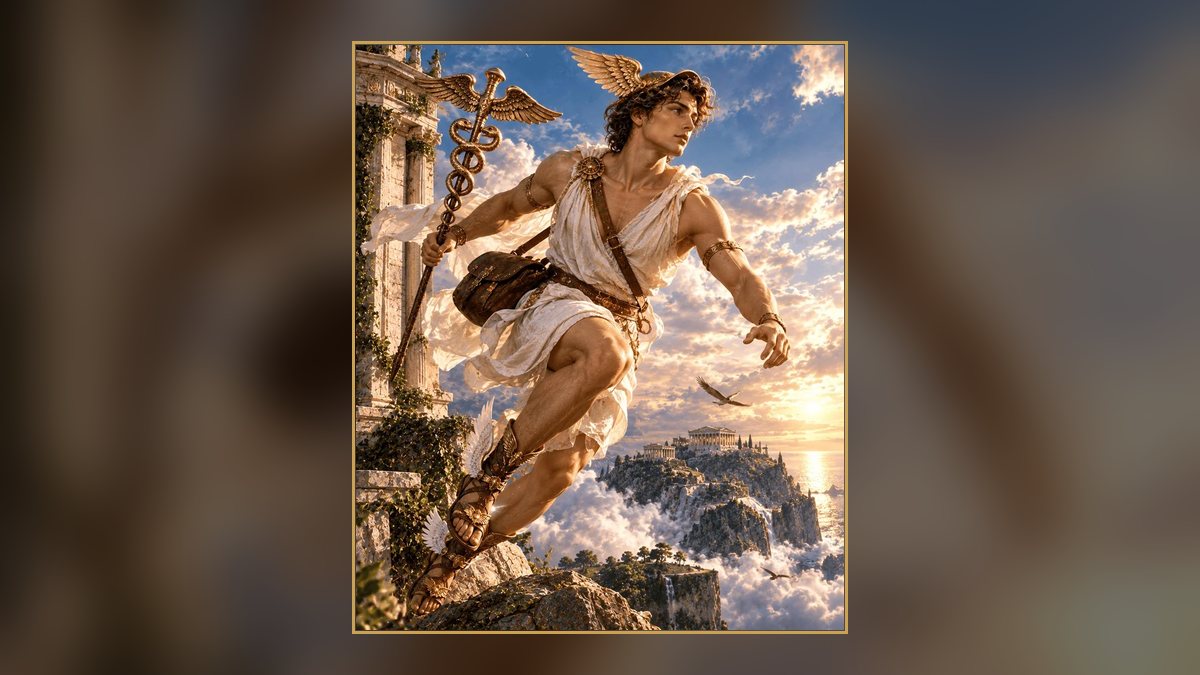
Most gods in Greek myth are tied to a place or a power. Zeus has the sky, Poseidon has the sea, Demeter has the grain. Hermes has a job description that reads like a joke: messenger, thief, trader, herald, guide of the dead, patron of travellers, protector of boundary stones, inventor of the lyre. What do those have in common? I spent a while trying to answer that, and my conclusion is that Hermes is the god of anything that moves from one place to another. Goods, words, souls, ideas, stolen cattle. If it crosses a line, he is probably involved.
A baby with a plan
The Homeric Hymn to Hermes tells the story of his birth, and it is gloriously shameless. Hermes is the son of Zeus and the nymph Maia, born in a cave on Mount Cyllene in Arcadia. By the time the sun was up on his first day he was already out of his cradle. He found a tortoise at the cave mouth, scooped out its shell, stretched strings across it and made the first lyre. He sang a song about his own parents as he tested it.
Then, in the evening of the same day, he went on a walk. He wandered all the way to Pieria and stole fifty cattle belonging to his half-brother Apollo. The details are what make it brilliant. He made the cattle walk backwards so their tracks pointed the wrong way. He put on odd sandals made of bark and branches to disguise his own footprints. He roasted two of the animals and divided the meat into twelve portions, one for each of the Olympian gods, which, since he counted himself among them, was a bold way to claim a seat at the table. And then, notably, he did not eat any of it, although he was hungry. He had apparently already decided that a god does not need to.
Anyone reading this story today is meant to be amused and a bit alarmed. A newborn is outwitting a major deity within hours. That is the first lesson about Hermes: he is not strong in the sense that Ares or Heracles is strong. He is quick, inventive and unembarrassed.
The trial on Olympus
Apollo, who has the gift of prophecy, tracked down the thief without much trouble, and the dispute went before Zeus. This is where the Hymn is funniest. Baby Hermes, lying in his cradle, denies everything with a perfectly innocent face. He insists he has never even heard of a cow. Zeus laughs out loud at the nerve of it, and then orders both brothers to go and find the cattle together.
The solution comes through music. Apollo hears the lyre and is enchanted. He wants it more than he wants the cattle. Hermes hands it over, and in exchange Apollo gives him the herd and later a golden staff. In other versions Hermes also receives the caduceus, the rod with twin snakes that becomes his symbol. The two gods end the story on friendly terms, and Hermes ends up as the god who negotiated his way out of a crime into a promotion.
That outcome tells you something about how the Greeks saw cleverness. They did not simply admire it as a trick. They saw it as a kind of exchange. Hermes steals, but then he offers something better, and everybody walks away with a deal. The line between thief and trader is thin, and he is the god standing exactly on it.
The messenger who is never late
His best-known job is that of herald. Winged sandals and a winged hat make him fast, and the Greeks imagined him carrying the will of Zeus over land and sea. But look at how this works in practice. When the gods need something done that requires crossing a boundary, whether it is the world of the gods and the world of mortals, or the surface of the earth and the cave of a nymph, Hermes goes.
In the Odyssey he is sent to tell the nymph Calypso to release Odysseus after seven years. He also appears to Odysseus on the island of Circe and gives him a herb called moly, which protects him from her enchantments. In the Iliad, in one of the most moving scenes in the whole epic, Hermes guides the old king Priam through the Greek camp at night so that he can ransom the body of his son Hector from Achilles. The god takes the form of a young man, calmly walking an old king through enemy lines. It is a kind of gentleness we do not associate with the cunning thief.
The guide of souls
His role as psychopomp, the one who leads the dead to the underworld, is the one that gets the least attention and probably deserves the most. After death, Hermes escorts the souls down to the entrance of Hades. In the Odyssey, the souls of the murdered suitors follow him down in a squeaking, fluttering crowd like bats in a cave.
If you take my theory seriously, this fits perfectly. Death is the greatest crossing, and Hermes is the god of crossings, so of course he leads the way. He is the only Olympian who moves freely in both worlds. He can visit Hades and come back, which, as Hades himself would tell you, is not a privilege many are allowed. In that role he is neither frightening nor cruel. He is the friendly escort at the hardest part of the road, and that, I think, is a deeply humane way to picture an inevitable event.
Markers, boundaries and the herm
One more piece completes the picture. All over Greece, people set up stone pillars called herms, with a carved head of the god on top and a phallus below, standing at crossroads, doorways, boundaries between properties and along roads. They worked as signposts, as protective charms and as marks of ownership. Travelers touched them for luck.
The herms in Athens became the centre of a scandal in 415 BC, just before a huge naval expedition to Sicily, when many of them were found with their faces smashed in a single night. The city was in uproar and suspected a conspiracy against the democracy. It shows how seriously the Greeks took these simple pillars. They were not a joke or a curiosity. They stood for safe passage, for the continuity of the roads and the neighbourhood, and an attack on them felt like an attack on the city's luck.
The god of commerce and wit
Because he watches over exchange, Hermes was also patron of merchants and of anyone who works by talking: heralds, diplomats, orators, and, yes, thieves. The Greeks saw no great contradiction there. Trade involves persuasion and sometimes deception, and a good bargain feels a little like a theft that both parties agree to. He was also credited with inventions such as the alphabet in some traditions, along with music and measurement. Whatever helps information move gets assigned to him.
The same idea applies to language itself. The word "hermeneutics", the study of interpretation, comes from his name, because explaining a message from one mind to another is also a crossing. When someone translates a text or explains a difficult idea, they are acting a little like Hermes, standing between two sides and carrying meaning over.
Why such a restless god mattered
Here is what I take from all of this. The Greek world was full of small city-states, islands, mountain passes, harbours and borders. Life depended on people moving through that landscape safely, whether they were traders, messengers, pilgrims or soldiers. A god who protected movement, who knew every road and could talk his way past any guard, was not a minor figure in that world. He was infrastructure.
That is also why he never settles down in the stories. He has no great temple city, no famous throne. He is always on the way somewhere. The moment you think you have found Hermes, he has already left for the next errand, with a smile and possibly your purse. It makes sense for a god whose entire nature is the space between one place and another.