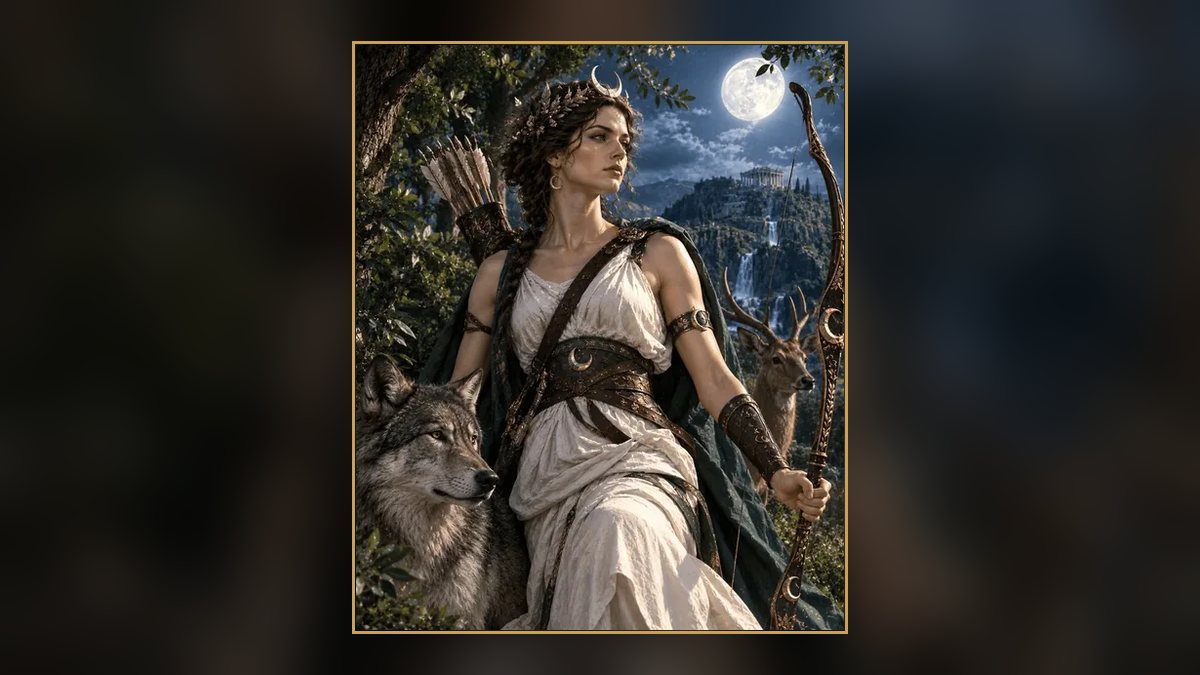
Artemis has a reputation for being cold. The cold goddess, the virgin with the bow, the one who turns men into stags if they look at her wrong. I think that reputation is too simple, and I think it misses the thing that actually connects her stories. Line them up and a pattern shows itself. Every time Artemis does something terrible, someone has just claimed what was not theirs to claim. A body, an animal, a boast, a prize. She is not a goddess of anger in general. She is a goddess of the unclaimed, and her violence is what happens when somebody tries to own it.
What she asked for
Start with the little scene in Callimachus's hymn to her, which I find charming. Artemis is a small child sitting on her father's knee, and Zeus asks what she would like. She says she wants to stay unmarried forever. She wants a bow and arrows, a short tunic so she can run, sixty young nymphs as companions and twenty more to look after her dogs and her boots. She wants all the mountains, and just one city, wherever she likes. And she asks to help women in labour.
Read that list again. It is not a wish list for a cold goddess. It is a list for someone who wants to be left alone with the wild places and the creatures in them, and who takes on one single job for people, which is looking after women at the moment of birth. She was born herself in a hard labour, in fact. The stories say she and her twin Apollo were born on Delos, and that Artemis arrived first and then helped deliver her brother. She came into the world already working as a midwife.
The mistress of animals
Her oldest title in Greek is something like Potnia Theron, mistress of the beasts. She protects young animals and she hunts, which looks like a contradiction until you realize that it is the same attitude. Hunting in her world is a relationship, not a conquest. You take what you need, you show respect, and you do not take the cub from its mother. The Greeks had a lot of rituals that sound like this, where hunters offered the first catch back to the goddess.
That is the key to the story of Agamemnon at Aulis. The Greek fleet is ready to sail for Troy and the winds will not blow. The seer says Artemis is angry. One reason given is that Agamemnon killed a sacred deer and boasted that not even the goddess could have done better. The cure, in the tragedians' versions, is the sacrifice of his own daughter Iphigenia. Whatever you make of that, look at the cause: a man took something from the wild that belonged to her and said it was his to take.
The list of the punished
Now run through the others and see what they have in common.
Actaeon, in the most famous telling, comes across Artemis bathing in a spring while out hunting, and for that he is turned into a stag and torn apart by his own dogs. Some versions say he boasted he was a better hunter than she was. Either way, he treated her as something to be seen or measured against.
Callisto, one of her companions, is seduced by Zeus. The versions argue over who punishes her, whether Hera or Artemis, but she ends up as a bear. This one is tragic, because Callisto did nothing except be taken by someone more powerful. Artemis's attitude here is the hardest part of her to defend, and I will not pretend otherwise.
Orion, according to the Odyssey, is killed by Artemis on the island of Ortygia, and the poem does not say exactly why. Later stories say he tried to force himself on her, or boasted he would kill every animal on earth. Niobe, in the Iliad, brags that she has more children than Leto, and Apollo and Artemis kill them together. The method is arrows in both cases, quick and from a distance.
In each of these, someone treats a person or a creature or a goddess as a thing they can own, see, or surpass. I am not claiming that makes her justified. Several of these deaths are plainly disproportionate. I am saying that the logic of her anger is consistent, and that it is worth noticing because it is a stranger logic than "she hates men."
The goddess who got slapped
My favourite counter-image is in the Iliad. During the gods' fight at Troy, Artemis taunts her brother Apollo for backing away from a fight with Poseidon, and then she turns on Hera too. Hera is furious, grabs her wrists with one hand, rips the bow off her shoulder with the other, and boxes her ears with it, laughing, while the arrows spill out. Artemis runs off in tears like a frightened dove and climbs into her father's lap. Zeus, amused, asks who hurt her.
This is the same goddess who kills Niobe's children. It does not make her harmless. It makes her something more human than the myth's chill suggests: a young goddess, nearly a girl in that scene, who is brave until someone bigger hits her. The poet does not hide it. I think he loves her a little for it.
The girls at Brauron
Outside the stories, what the Greeks actually did for Artemis tells us a lot. At her sanctuary at Brauron, near Athens, young girls spent time in a ritual called the arkteia, which means roughly acting the bear. A character in Aristophanes's Lysistrata says she was a bear at Brauron as a child. The rite seems to have marked girls as they approached adulthood, and the bear is a wild thing about to be brought into a household.
That fits the pattern too. Artemis stands at the border where a girl who belongs to no one is about to belong to a husband. She watches over that crossing and is partly the one who makes it permissible. She also looks after women in childbirth, and the Greeks said that when a woman died in labour, it was one of Artemis's gentle arrows that did it. The same goddess who protects the delivery also takes the woman, and both are described in the same breath.
A goddess who cannot interfere
The last scene I want to mention is from Euripides' Hippolytus. Hippolytus is Artemis's most devoted follower, a young man who worships her, avoids Aphrodite and gets destroyed for it. At the end, he is dying, and Artemis appears to comfort him. She is distraught and honest. She tells him that she could not step in, because it is the custom among the gods that none of them works against another's will. She promises to take revenge on a favourite of Aphrodite's in return.
It is a heartbreaking passage because it shows a goddess who has plenty of power and still cannot help the person she loves. The rules of the divine world bind her, and the best she can do is show up at the end and hold his head. That stuck with me the first time I read it. She protects the edge of things, but she cannot protect it from other gods.
So when you see her image, the bow and the deer and the crescent, I would suggest not reading coldness in it. Read watchfulness. She is the one standing guard over everything that does not yet belong to anyone, and the stories are very clear about what happens to people who forget it.