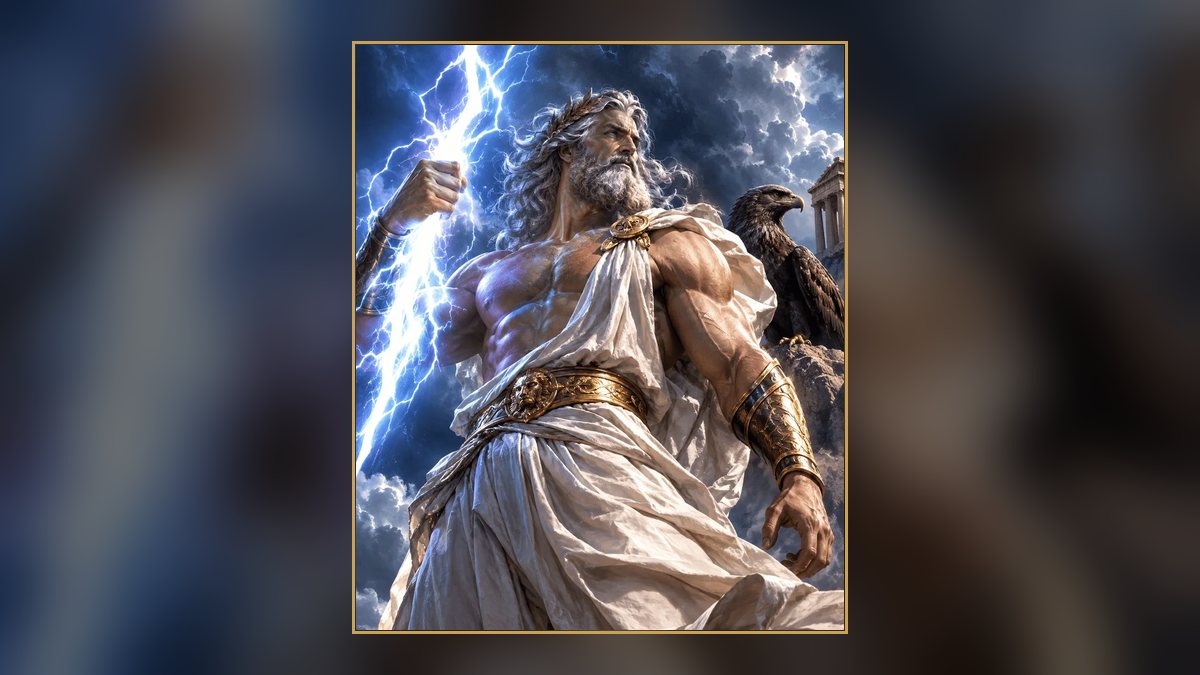
Ask most people how Zeus became king of the gods and you get one answer: he had the thunderbolt, so he won. It is a tidy answer and it is only half true. Take the lightning away and you still have the story of a youngest child who survived a father determined to eat him, which is not a normal start for a ruler. My reading, and I want to be upfront that it is a reading and not scripture, is that Zeus did not win because he was the strongest being on the field. He won because, again and again, he understood what other people needed and offered it before they asked.
A father who swallowed the future
Cronus had taken the sky from his own father, Uranus, with a sickle his mother Gaia put in his hand. A prophecy then followed him around: one of his own children would do to him what he had done to Uranus. So he did what a frightened man with absolute power does. He swallowed every child at birth. Hestia, Demeter, Hera, Hades and Poseidon went down one after another into the dark of his own body.
Rhea, his wife and sister, reached her limit with the sixth. When Zeus was born she wrapped a stone in cloth and handed it over, and Cronus swallowed it without looking. The baby was raised in a cave on Crete, fed on the milk of the goat Amalthea and watched over by nymphs, while armed attendants called the Curetes clashed spears against shields so the crying would never carry.
Notice what that childhood teaches. Zeus grows up knowing that power makes people paranoid, and that paranoia is a weakness you can work on. He also learns that nobody survives alone. A goat, some nymphs, a mother and a crowd of noisy dancers kept him alive. Hold on to that, because it explains most of what he does later.
The drink and the long war
When he was grown, Zeus found help in Metis, a Titaness whose name means cunning, the practical kind of intelligence. She prepared a potion that made Cronus sick, and he vomited up the stone first and then the five siblings, fully grown and furious. Nothing had aged in the dark.
The war that followed is called the Titanomachy, and the old accounts say it ground on for ten years. The Titans held Mount Othrys, the new gods held Olympus, and neither side could break the other. This is where I think the real Zeus shows himself. Instead of charging harder, he went looking for allies in the one place nobody wanted to visit.
Deep in Tartarus sat the Cyclopes and the Hundred-Handers, giant brothers whom Uranus and then Cronus had locked away because they were too frightening to have nearby. Zeus let them out. The Cyclopes, grateful, forged his thunderbolt, Poseidon's trident and the helmet of darkness that Hades would wear. The Hundred-Handers started hurling boulders three hundred at a time, and the Titans were buried under the barrage.
Put the two kings side by side. Cronus met powerful creatures and caged them. Zeus met powerful creatures and asked what they wanted. I find it hard to call that luck. It looks like a working theory of rule: strength you lock up will eventually be used against you, and strength you free tends to stand with you.
Some of the older generation never fought him at all. Prometheus came over to the Olympians early, and a few other Titans stayed out of the war. The ones who lost were chained in Tartarus, and who took the job of guarding them? The Hundred-Handers, former prisoners. Even his prison staff came from the other side of the wall.
Dividing the world by lot
After the victory the three brothers drew lots, at least in the version told in the Iliad. Zeus got the sky, Poseidon the sea, Hades the underworld, and the earth and Olympus were held in common. People skip past how strange this is. Cronus had taken everything and kept it. Zeus, fresh from a world war, rolls dice with his brothers and lives with the result.
The sharing has limits, of course. In the Iliad Poseidon grumbles loudly about being treated like a junior, and Zeus reminds him who is older and stronger. But the arrangement holds across generations of stories, and that stability is an achievement in its own right. A ruler who can make rivals feel like co-owners rarely has to fight them.
The prophecy he did not ignore
Here is the story that shows how well he learned from his father. Zeus's first wife was Metis, the same clever Titaness who had helped him. An oracle warned that her second child would be stronger than its father. Zeus knew exactly how that sentence ended in his family, and he did not wait around. He tricked Metis into shrinking herself and swallowed her whole.
Yes, he copied his father's worst move, and I will not pretend it is flattering. But look at the result. Cronus swallowed children and got a rebellion. Zeus swallowed an adviser and got her mind. Some time later he was struck by a terrible headache, someone split his skull open with an axe (Hephaestus in most tellings), and out stepped Athena, fully armed and shouting a war cry. The wisdom he had absorbed came back as a daughter who stayed loyal instead of a rival who came for the throne.
You can read this as a story about male power swallowing female power, and many people do, with good reason. You can also read it as a story about what a ruler does with dangerous knowledge: crush it, or bring it into the family. Both readings hold at the same time.
Typhon, the last storm
One challenger remained. Gaia, angry about the fate of her Titan children, bore her last and biggest son, Typhon, a monster so tall his head scraped the stars, with a hundred serpent heads and the voices of every animal. In some versions the other gods ran to Egypt and hid in animal shapes. Zeus stayed and fought.
He did not win cleanly. According to Apollodorus, Typhon seized him, cut out the sinews of his hands and feet and hid them in a cave, leaving the king of the gods helpless. Hermes and the goat-god Aegipan stole the sinews back and fitted them to Zeus again. Then Zeus returned to the fight, finished the monster and pinned him beneath Mount Etna, which is why that mountain smokes.
I like this episode because it shows a limit. Zeus can lose a round. He needs the clever and the minor to save him. And he still wins the second one. The king the Greeks pictured was not a god who never fell. He was one who could get up.
The uncomfortable half
No honest article about Zeus can skip the other side of him. The stories give him a long list of lovers and unwilling partners, and the consequences land on women and children: Io turned into a cow, Callisto into a bear, Semele burned up by his full glory. His wife Hera spends centuries punishing the victims instead of him. Ancient writers were not blind to this. Euripides has characters who openly ask whether a god can be both just and behave like this.
My own take is that the Greeks carried two Zeuses in the same body. One was the guardian of oaths, hospitality and justice, the Zeus who punished a guest for abusing a host and a man for breaking a sworn promise. That one was worshipped at real altars. The other was the Zeus of storytelling, the restless aristocrat who does whatever the plot needs, and sometimes he was there for entertainment and sometimes for critique. It is a bit like the gap between how we describe a monarch in a legal document and how we gossip about one over dinner.
Why he still works as a character
Strip off the lightning and the eagle and what is left is a very modern idea: leadership as survival plus coalition building. Zeus escaped a father who ate the future. He recruited the imprisoned. He divided the world by lot instead of keeping it. He learned to fear the right prophecy, and he lost a fight and got back up.
That is not the story of the strongest god. It is the story of the best connected one, with a thunderbolt as a very persuasive tiebreaker. Next time someone tells you Zeus won because of his lightning, ask who forged it for him, and why they were willing to.