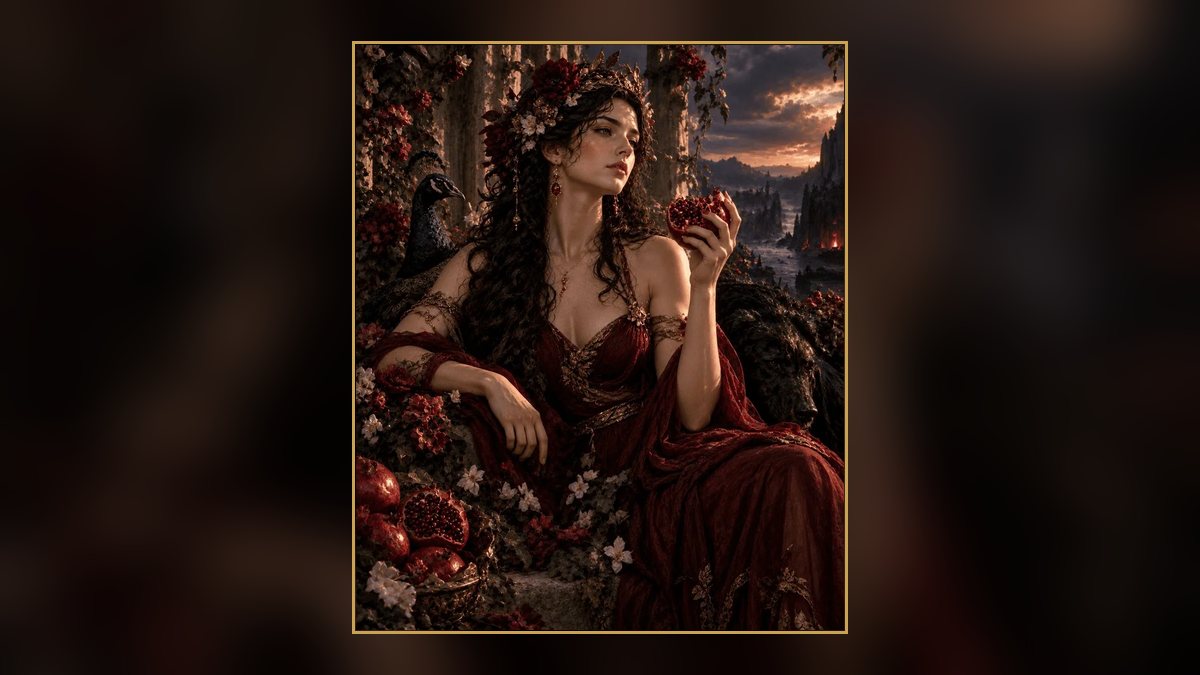
Persephone's story is usually told as a tale about the seasons: the girl goes underground, winter comes, the girl returns, spring arrives. That is fine as far as it goes. But if you read the oldest full version, the Homeric Hymn to Demeter, which dates to around 600 BC, the seasons are almost a side effect. What the poem is really interested in is how an impossible situation gets settled. Nobody wins. Everybody gives something up. I have come to think of it as the Greek myth of the first compromise.
The meadow
The Hymn opens with a picture of a girl, Kore, which simply means maiden, picking flowers with her friends in a meadow. She reaches for a narcissus, one the earth has produced specially to attract her, a flower with a hundred blossoms whose scent makes the whole sky laugh. The ground opens. Hades drives up in his chariot, grabs her and takes her below. Her scream carries to the mountaintops and the bottom of the sea, and only two beings hear it: Hecate, from her cave, and Helios, the sun, who sees everything.
One detail that people tend to skip is that Zeus had agreed to this. He had given Hades permission to take her, without telling her mother. The Hymn says so plainly. So the first fact of the story is that the girl was handed over by her own father, and that nobody asked her. I think the poem knows exactly how bad that is, and the rest of it is a long dramatisation of the damage.
What Demeter does
Demeter does the one thing she can. She withdraws her gifts. She wanders the earth for nine days with torches, neither eating nor washing, until Helios finally tells her what happened. Then she disguises herself as an old woman and arrives at Eleusis, where she sits by a well and is taken in as a nurse in the royal household. And while she is there she tries to make the king's baby son immortal by holding him in the fire at night, until his mother sees it and screams.
Meanwhile, the earth is dying. Demeter has forbidden the seeds to sprout. Humanity is starving, and that is the real pressure on Zeus, because if everybody dies, nobody is left to bring sacrifices. The most powerful god in the world is forced to negotiate with a single grieving mother, because she has found the one lever that matters. That, to me, is the political heart of the story: the weak party wins leverage by refusing to cooperate.
The pomegranate
Zeus sends Hermes to bring Persephone back, and Hades agrees with surprising calm. He tells her she may go. But before she leaves, he offers her a pomegranate seed, and she eats it. The Hymn says he made her swallow it by stealth, and the poem is deliberately unclear about whether she realised what it meant. There is a Greek and widespread folk belief that anyone who has eaten the food of the dead cannot completely leave. The seed is a legal hook.
The solution is a bargain. Persephone will spend a third of the year below, in the Hymn's version, and the rest above with her mother. Later authors give her half the year. Neither extreme is exactly fair. She is not freed, she is not abandoned, and she is not even consulted. What she gets is a schedule.
I find that realistic in a way I did not expect from a myth. Most real disputes do not end with a clear winner. They end with a calendar. You have the kids on weekends. The land is shared in rotation. And the thing that was taken is partially returned, and the part that is not returned becomes a permanent feature of the world.
The question the poem refuses to answer
Here is the thing I keep noticing. The Hymn never really says whether Persephone wanted to be there, or came to want it. In the poem she is at first miserable. When she comes back to her mother, she says Hades tricked her. But later versions, and the hints in other poems, suggest that she grew into the role of queen. In the Odyssey, she is the formidable ruler of the dead, the one who sends up and calls back the ghosts. Odysseus is afraid of her, not of Hades.
That change over time is, I think, one of the most interesting aspects of her character. She is not one person in the stories. She is two, and the Greeks seem to have been perfectly comfortable with that. She is the daughter and the queen. She is the one who is taken and the one who rules. The myth lets both of those things be true at once, without trying to turn one into a lie.
Eleusis
The most important result of the story is not found in the myth itself but in a ritual. At Eleusis, a small town near Athens, there was a festival every year known as the Mysteries. Thousands of people from across the Greek world and later the Roman one went there to be initiated. What actually happened inside the hall is still not known, since the participants kept their oaths for more than a thousand years, which is one of the more remarkable feats of secrecy in history.
What we do know is that the central promise was about death. Initiates believed they would have a better fate after dying. The Hymn says that those who have seen these rites are blessed, but those who have not will never have the same lot, even in the shadows below. Think about what that means for the story. A girl is taken into the underworld and returns every year. That is the model the initiates were hoping for. If Persephone can go down and come back, then maybe a mortal can too.
Other stories that cluster around her
The poets liked to give her small side stories. In one, Hades has an affair with a nymph named Minthe, and Persephone, in a rage, tramples her into the ground, where she becomes the mint plant. In another, Aphrodite hides the infant Adonis in a chest and gives him to Persephone for safekeeping. Persephone opens the chest, sees how beautiful he is and refuses to give him back. Zeus has to settle it, and the result is yet another divided calendar: a third with Aphrodite, a third with Persephone, a third of his own choosing.
Orpheus is the best known. When his wife Eurydice dies of a snake bite, he goes down to the underworld and plays his lyre for the rulers of the dead. Persephone is moved, according to the later tellings, and persuades Hades to allow Eurydice to follow him back to the light, on one condition. In every case, she is the one who has the capacity to be moved. She is the soft entry point to a very hard kingdom.
What I take from her
Persephone is often presented as a symbol of innocence lost, and I understand why. But if I am reading the Hymn fairly, the more important theme is what happens after something terrible has been done and cannot be undone. The poem does not offer a reversal. It offers a settlement, which means a lasting agreement in which everyone accepts a permanent loss. Every year when the leaves fall, the Greeks said, this is the price. And every year when the first green shoots appear, they said, this is what the price bought.