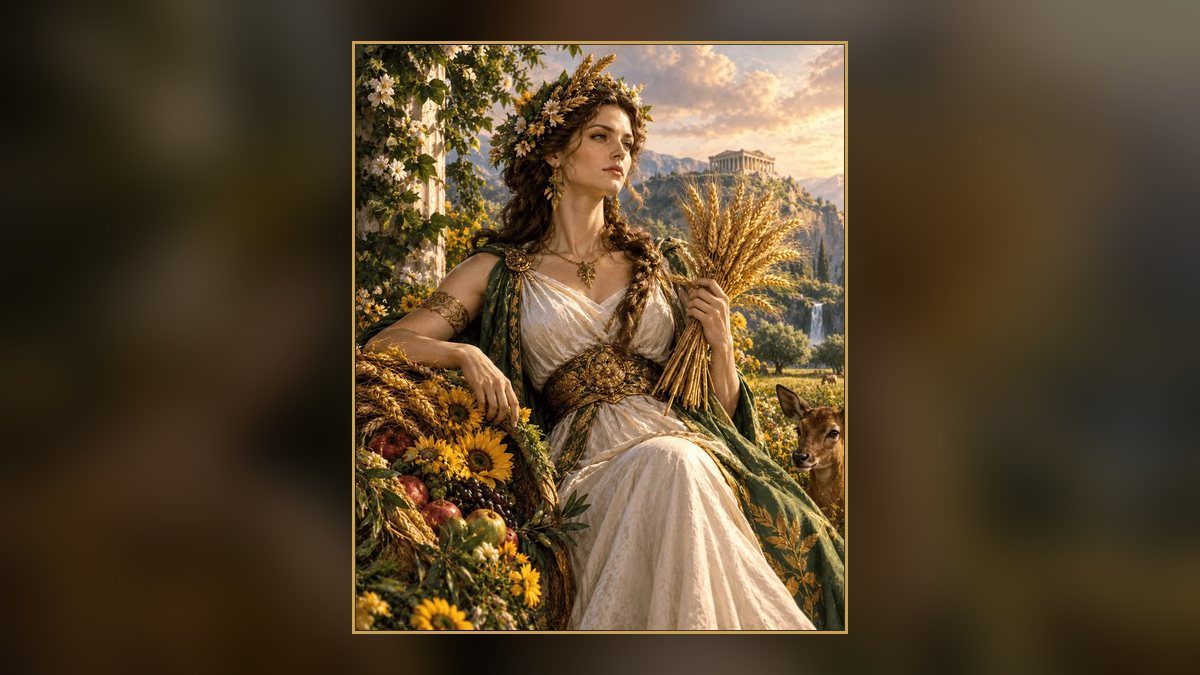
Most retellings of the Persephone story treat Demeter as the sad mother. She loses her daughter, she wanders, she weeps, she eventually gets her back for part of the year. That is the version that explains the seasons and it is fine as far as it goes. But if you read the oldest full account, the Homeric Hymn to Demeter, a different woman turns up. She is stubborn, resourceful and extremely dangerous, and what she does is not really grieving. She goes on strike. My claim in this article is that the Hymn is one of the earliest stories in any language about the power of withholding labour, and that it says something startling about how the Greeks thought gods and humans needed each other.
The old woman at the well
Start with how she moves through the world. After Hades takes Persephone, Demeter searches for nine days with torches and neither eats nor washes. Eventually Helios the sun tells her the truth, and that Zeus agreed to it. Her reaction is to leave Olympus altogether. She does not storm the gates. She disguises herself as an old woman and goes down to live among mortals.
She arrives at Eleusis and sits by a well, where the daughters of the local king, Celeus, find her. She gives them a false name and a false story, and they take her home, where their mother Metaneira asks her to nurse the baby boy, Demophon. Demeter refuses the wine she is offered and asks for a drink of barley, water and mint. That detail matters. It is the recipe of the kykeon, the drink that initiates later shared at Eleusis.
Her disguise nearly slips in one scene I like very much. She is sitting silent and grieving, and a woman named Iambe, a servant, makes jokes until the goddess smiles. A later version attaches an even cruder gesture to a figure called Baubo. Either way, laughter is what breaks the first crack in her grief, and the Greeks remembered that in their festivals, where ritual jokes and insults were part of the rites. Even at her most furious, Demeter can be reached by a joke.
The fire and the baby
Then comes the strangest episode. Demeter is nursing Demophon, and she is secretly making him immortal. Each night she rubs him with ambrosia and sets him in the fire to burn off his mortal part. Metaneira walks in and sees her child lying in the flames and screams. Demeter, furious, snatches him out and drops him on the floor. Her disguise falls away. She stands there tall and radiant and says that foolish mortals never know the good or evil that is coming to them. She could have given the boy a life that never ended. Now he will grow old and die.
I think this episode is the heart of the Hymn, and the reason is not the baby. It is the pattern. Demeter does not hold back out of spite. She wanted to give. Her gift is refused out of fear, which is a very human reason, and she loses patience. It shows us a goddess whose whole nature is generosity and what she is like when it is rejected.
The strike
Demeter orders the people of Eleusis to build her a temple, and she sits inside it, furious and grieving, and does the most terrible thing a god of grain could do. She makes the earth stop growing. The Hymn says she causes the most dreadful year for humans, that the ground would not send up a single seed, that oxen pulled ploughs in vain.
Now look at what the poem says next, because this is the line I keep coming back to. The Hymn states plainly that she would have wiped out the whole human race with starvation, and that the gods would then have lost their honours and their sacrifices. Zeus sees it coming. That is why he acts.
Stop on that. The king of the gods gives in not because a mother is sad, but because the arithmetic is bad. If humans die, nobody burns offerings. Nobody builds altars. Olympus is a household with no one to feed it. The poem, quietly, admits that the gods depend on mortals as much as mortals depend on them.
That is a remarkably bold idea to find in a hymn meant for worship. Divine power is not just a one-way flow. It is an exchange. People work, grow and sacrifice, and the gods are honoured. Break that circuit and the whole structure of the world is in trouble. Demeter did not argue her case. She simply stopped doing her job until Zeus had to listen.
Zeus tries everything
What follows is almost comic. Zeus sends Iris to talk to her, and she refuses. He sends one god after another with gifts and honours, and she refuses them all, saying she will not go back to Olympus nor let the earth bear fruit until she sees her daughter. Finally he sends Hermes to the underworld to fetch Persephone. Hades agrees, and gives her the pomegranate seed on the way out, which is the clause that binds her to return for part of every year.
Rhea, Demeter's own mother, is the one who persuades her to end the strike, and once she has her daughter back, Demeter lets the fields grow again. Then she does something the Hymn clearly treats as important. She teaches the leaders of Eleusis her rites, the Mysteries, and she sends the young prince Triptolemus out with grain to teach farming. The Mysteries, the poem adds, promise that those who have seen them will have a better fate after death.
So the goddess who wins her bargain by withholding turns the settlement into a gift. Grain, ritual, hope for the afterlife. All of it comes out of a labour dispute.
The other side of the goddess
If you want to know that Demeter is not safe to cross, Callimachus gives us a grim example centuries later. A man named Erysichthon cuts down trees in her sacred grove to build a banquet hall, even after the goddess, disguised as her own priestess, asks him to stop. She curses him with a hunger that nothing can satisfy. He eats everything in the house and sells his daughter over and over to pay for more food, and ends up chewing on himself.
This is the same goddess, doing exactly what she did to the whole world in the Hymn, only to one man. The thing she gives, grain and plenty, is the thing she takes away.
She also had a women's festival, the Thesmophoria, held every autumn, which men could not attend. Women camped for days, fasted, and threw piglets into pits so that the remains would feed the soil. It is a tradition tied to fertility and to a kind of authority women held in the Greek religious calendar. Demeter was theirs in a way most gods were not.
So what kind of goddess is she?
I think the easiest mistake with Demeter is to see only the nurturing side. She is the goddess of grain, of bread, of the plain domestic work of eating. That is also a power with teeth. Everything depends on it, and she knows it.
The Hymn does not frame her as a victim who gets rescued. It frames her as the only member of the family who found a way to make Zeus lose an argument without using force. When someone tells you that the gods run the world, remember that, in the oldest story we have, one of them stopped the harvest and the rest of the gods suddenly remembered who was feeding them.