The Argonauts are the Greek all-star team. Heracles, Orpheus, Castor and Pollux, Atalanta in some versions, the sons of the north wind, Peleus, Telamon, a helmsman who could read the stars. And over them all, as captain, a man named Jason, who isn't as strong as Heracles, isn't as clever as Odysseus, and has no special gift that anyone can name. The longer I read the story, the more I think that is the entire design. Jason's talent is not doing things. It is getting other people to do them.
The errand
Start with why he goes. Pelias, who seized the throne of Iolcus from Jason's family, was told by an oracle to beware a man with one sandal. Jason arrived at the city having lost a sandal while carrying an old woman across a river, who was Hera in disguise. Pelias, alarmed, set him a task he thought would kill him: bring back the golden fleece from Colchis, at the far end of the Black Sea.
It was a political assassination dressed up as a quest. Pelias sent his rival into the unknown and expected him not to return. Hera, who had a grudge against Pelias for neglecting her cult, took Jason's side. And so the project begins with a cynical king, a vengeful goddess, and a young man who has no real plan.
The talking ship
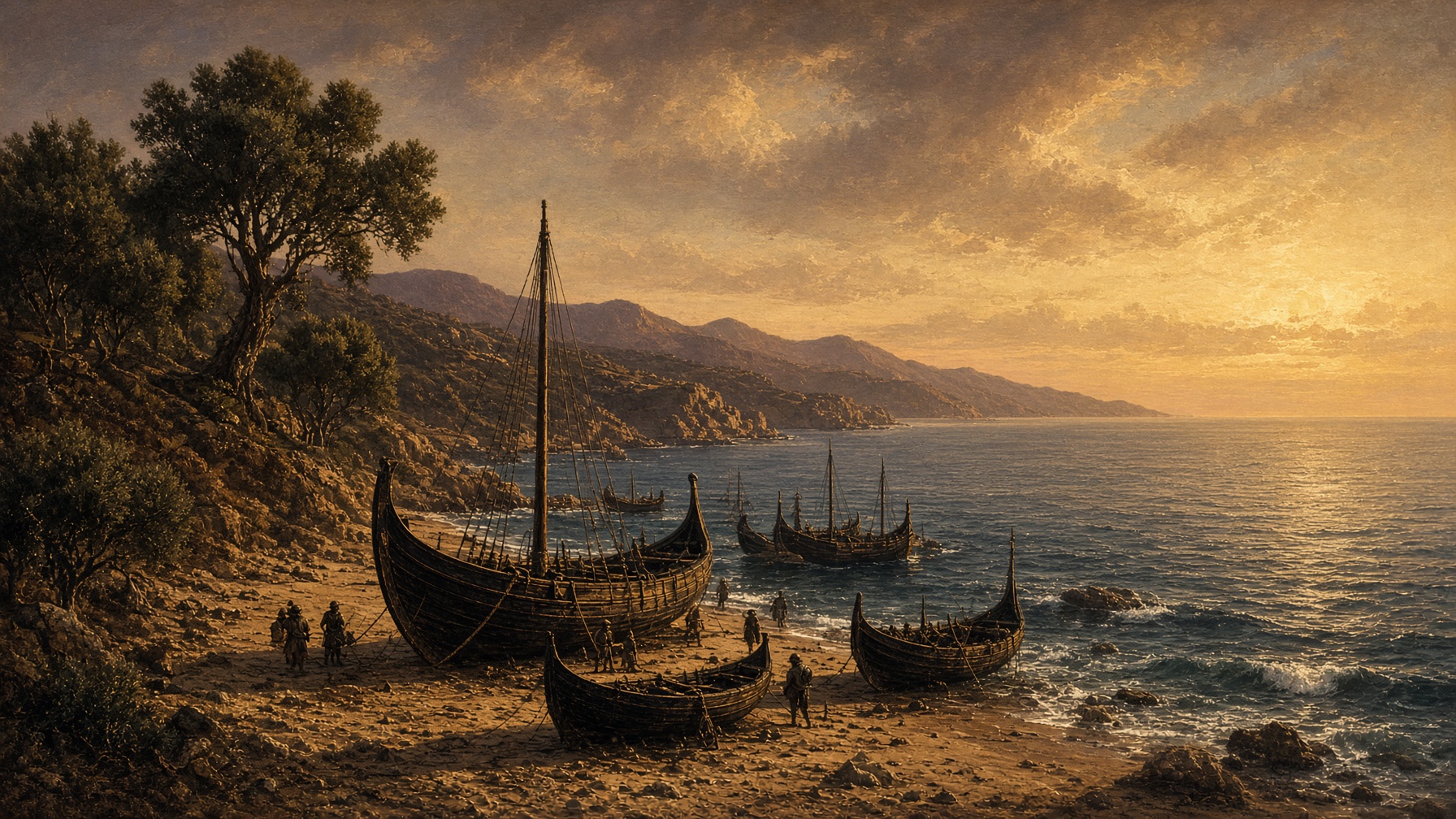
The Argo was built by Argus with help from Athena, who is said to have put into its prow a beam of oak from the sacred grove of Dodona, the oracle of Zeus. The beam could speak. The ship, in other words, carried an oracle in its bows. Later writers treated it as the first great ship, the original vessel of exploration, the one that opened the sea to human traffic.
I like the idea of a ship that gives advice. It means the voyage is partly guided by something other than the captain. Jason sails with a counsellor built into the timber.
The catalogue
Apollonius of Rhodes, who wrote the Argonautica in the third century BC, gives a long list of the crew. It's a roll call of heroes, each of whom has a specialty. Orpheus keeps time. Tiphys steers. Lynceus has such sharp eyes that he can see through the earth. Zetes and Calais, the sons of Boreas, can fly. Heracles is the strongest man alive. Polydeuces is the best boxer, and Castor is a horseman.
This is why I call it a team story. The poem is built around the idea that a hard task needs a range of skills, and that the person in charge is the one who assembles them. Jason's job is not to be the best at everything. It's to know who is.
And the poem is honest about it. At the start of the voyage, the crew votes for a leader, and they pick Heracles, who refuses and says Jason should do it. The strongest man on the ship turns the job down. It's a quietly modern moment: the person with the most raw power doesn't want the paperwork.
Losing the strongest
Heracles doesn't make it to Colchis. At Mysia, his young companion Hylas goes to fetch water and is pulled into a spring by nymphs. Heracles searches desperately and is left behind. The crew sails without him. It's a startling piece of storytelling, because it takes the most famous hero in Greece off the ship halfway through, and the voyage carries on regardless.
I find that remarkable. The myth is saying that the quest doesn't depend on any one person. Even the greatest hero can be lost, and the others have to manage. A weak captain with a deep bench is a better bet than a strong one with nobody behind him.
The obstacles
Along the way the crew meets a series of dangers, and nearly every one is solved by a specialist. The blind king Phineus is tormented by the Harpies, and the sons of Boreas drive them away. In return Phineus gives advice on how to pass the Symplegades, the clashing rocks at the entrance to the Black Sea. He tells them to release a dove first. Euphemus does so, and the dove flies through, losing only its tail feathers. The Argo follows, and the rocks, having failed to catch their prey, are fixed in place for good.
That's the earliest example I know of the use of a scout, a test run before committing the whole ship. It's a very practical solution. Nobody fights the rocks. They are tested, timed and passed.
The one who actually wins
In Colchis, the king Aeetes agrees to give up the fleece if Jason can complete three tasks: yoke fire-breathing bulls, plough a field and sow it with dragon's teeth, and then fight the armed men who grow from the teeth. Jason can't do any of it. Medea, the king's daughter, falls in love with him, thanks to Hera and Aphrodite arranging things behind the scenes, and offers to help.
She gives him an ointment that makes him immune to fire. She tells him to throw a stone among the earthborn men, so that they turn on each other. She puts the dragon guarding the fleece to sleep with drugs and a spell. In every case, the thing that works is her craft, not his courage. Jason wins by accepting help from the most capable person around.
This is the point I've been building to. Jason's whole career is a series of delegations. Heracles has strength, Orpheus has music, Medea has magic, the ship has an oracle, and the gods have a grudge to settle. Jason connects them. The poem presents this as a kind of heroism, and I think it is one, just not the sort we usually celebrate.
The bill
The cost comes later, and it falls on the person who did the most. Medea flees with Jason, killing her own brother Apsyrtus to delay her father's pursuit. Years afterwards in Corinth, Jason abandons her to marry a king's daughter, and in Euripides's play she takes a terrible revenge. And Jason himself, in one tradition, ends his life sitting under the old Argo, which collapses and kills him.
That last detail has stayed with me. The ship that carried him to glory finally crushes him. The leader who gave everything away is left with nothing, and the one who really made it possible is the person he betrayed.
What I take from it
So the story is not about a great man. It's about the structure of a great enterprise, and the way credit flows to the person at the top while the work is done by others. Jason gets the fleece, but the poem makes sure we know who earned it. If I had to put the moral in one sentence, I'd say that the Argonautica is the oldest account of what happens when a leader forgets who actually did the work.