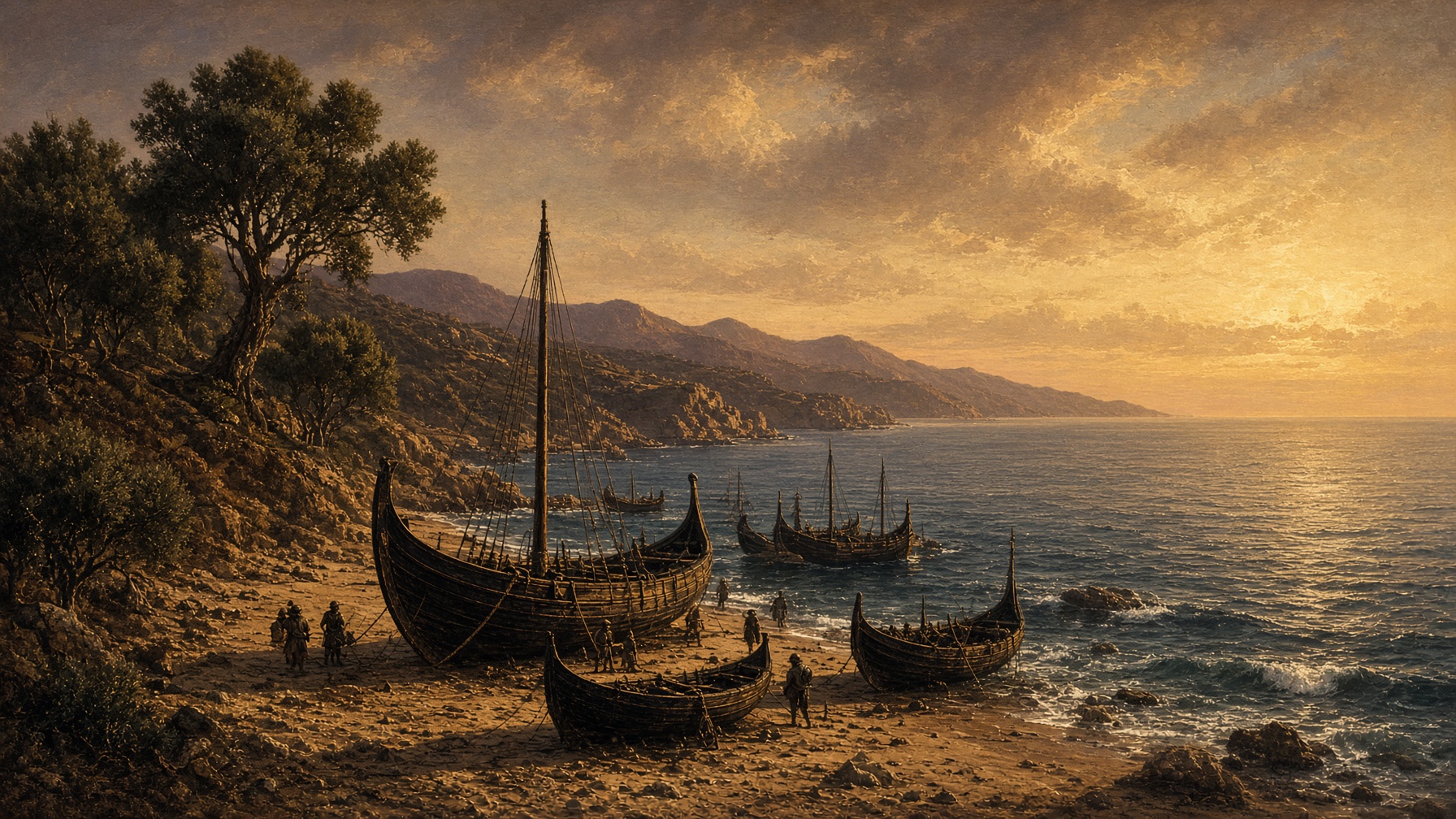
There is a puzzle in Hesiod that has bothered readers for a very long time. In Works and Days he describes five ages of humanity, and he names four of them after metals: gold, silver, bronze, iron. But between bronze and iron he squeezes in a fifth that has no metal at all. It is the race of heroes, and it breaks the pattern. The poet seems to know it. He puts them in anyway, because he couldn't leave out Thebes and Troy. That awkward insertion tells you something about how the Greeks thought of the heroic age: it was the part they were most reluctant to skip, because it was the part they most wanted to be true.
The age that doesn't fit
Hesiod's heroes are, he says, a better and more just race than the bronze people before them. They fought at seven-gated Thebes and at Troy, and many of them died. Some, though, were given a different ending. Zeus settled them at the ends of the earth, in the Isles of the Blessed, where the grain grows three times a year, and where Cronus is their king.
I find it striking that the old, defeated king turns up as the ruler of the heroes' afterlife. The Titan who couldn't let anything change ends up supervising the people who changed everything. It's an odd reconciliation, and it suggests that the Greeks saw the heroic age as continuous with the very earliest ones, not as a separate chapter.
What the heroes actually did
Here is the idea I'd like to try. Look at what heroes do, in the stories, and you notice that most of their work is cleaning up. Heracles kills the Nemean lion, the Hydra, the Erymanthian boar. Perseus beheads Medusa. Bellerophon kills the Chimera. Theseus kills the Minotaur. Oedipus answers the Sphinx. Where did all these creatures come from?
Hesiod tells us, in the Theogony. Typhon, the last great rebel against Zeus and the youngest child of Gaia, lay with Echidna, a half-woman, half-serpent, and their children are Orthrus, the two-headed dog, Cerberus, the hound of Hades, the Hydra of Lerna, and the Chimera. In other sources the Sphinx and the Nemean lion join the family. Medusa and her sisters are the daughters of the sea gods Phorcys and Ceto. Almost every famous monster is a descendant of the earliest, most elemental forces, and of the last desperate rising of Gaia against the Olympians.
So the monsters are leftovers. They are what the first two ages scattered across the landscape, the unresolved business of the primordial powers and the Titan war. Zeus could throw Typhon into Tartarus, but he couldn't recall every one of his children. They had to be dealt with by someone else, in places like Argos and Thebes, one road at a time. The heroes are the people who do that work.
The help they get, and what it costs
The gods are in these stories, but if you look closely at what they provide, it is almost always a tool. Perseus gets a sword from Hermes, a mirror-bright shield from Athena, winged sandals, a cap of invisibility and a bag to carry the head. Odysseus gets the herb moly from Hermes to protect him from Circe, and a steady supply of advice from Athena. The Argonauts have Hera's favour, a ship built with Athena's help, and, crucially, a sorceress, Medea, who betrays her own family to help Jason.
Notice the pattern. The gods don't fight the monster. They hand over the means. The risk, the pain and the exhaustion stay with the person holding the sword. And I think that is deliberate. The gods can't be killed, and so they can't really be brave. Heroes are brave because they can die, and the age depends on that difference.
The other thing the gods do is demand payment. Heracles pays with a lifetime of labour, assigned by Eurystheus because Hera drove him mad and he killed his own children. Odysseus pays with ten years of wandering for blinding Polyphemus, a son of Poseidon. Perseus, after killing Medusa, finds out that the prophecy about his grandfather was true when a discus he throws at a contest hits and kills the old man in the crowd. Everyone is helped and everyone is billed.
The ending that always arrives
The part that makes this age different is that the story is allowed to end badly. Heracles is poisoned by a shirt soaked in the blood of the centaur Nessus, which his own wife sent him in the hope of keeping his love, and he builds his own funeral pyre. Only then is he taken up to Olympus, which is the nearest thing to a happy ending in the whole cycle. Theseus is thrown off a cliff on the island of Skyros by a king who doesn't want him there. Orpheus is torn apart by the women of Thrace. Achilles, offered the choice between a long, quiet life and a short, glorious one, picks the short one.
This is where the card for this age says that heroes die and that is the point, and I'd say that is right. The earlier ages were stories about powers that don't end. This is the first age in which the main characters can't be rescued. It adds weight. Everything the hero does matters more because it is unrepeatable, and the gods who watch are, in some ways, jealous of it.
Why it looks backwards
There is one more thing about the way this age is told, and it is the reason I used the word nostalgic for it. Almost every account is told from a distance. Hesiod already treats the heroes as a vanished generation, and Homer has Nestor say that the men of his youth were far stronger than the men of today. The heroic age is always just beyond living memory. It is a time you were told about by someone older.
That fits, because I don't think the point of the age is that heroes were bigger than us. It is that they were the last people to meet the gods without an intermediary. They ate with them, fought alongside them, offended them in person. After Troy, the contact thins out. The gods become voices in dreams, signs in the entrails, oracles that speak in riddles. The heroic age is the end of the era when you could expect to run into one on the road.
What's left
And what remains is the world they cleaned. Roads you can walk, rivers you can cross, cities that were founded where a monster once lived. A Greek traveller in the classical period would pass shrines to heroes at crossroads and by springs, each marking a place where a problem was solved. The monsters were gone, the gods had pulled back, and the work of the generation in between was visible in the landscape. In that sense the heroic age wasn't a story about the past. It was an explanation of why the ground was safe to stand on.