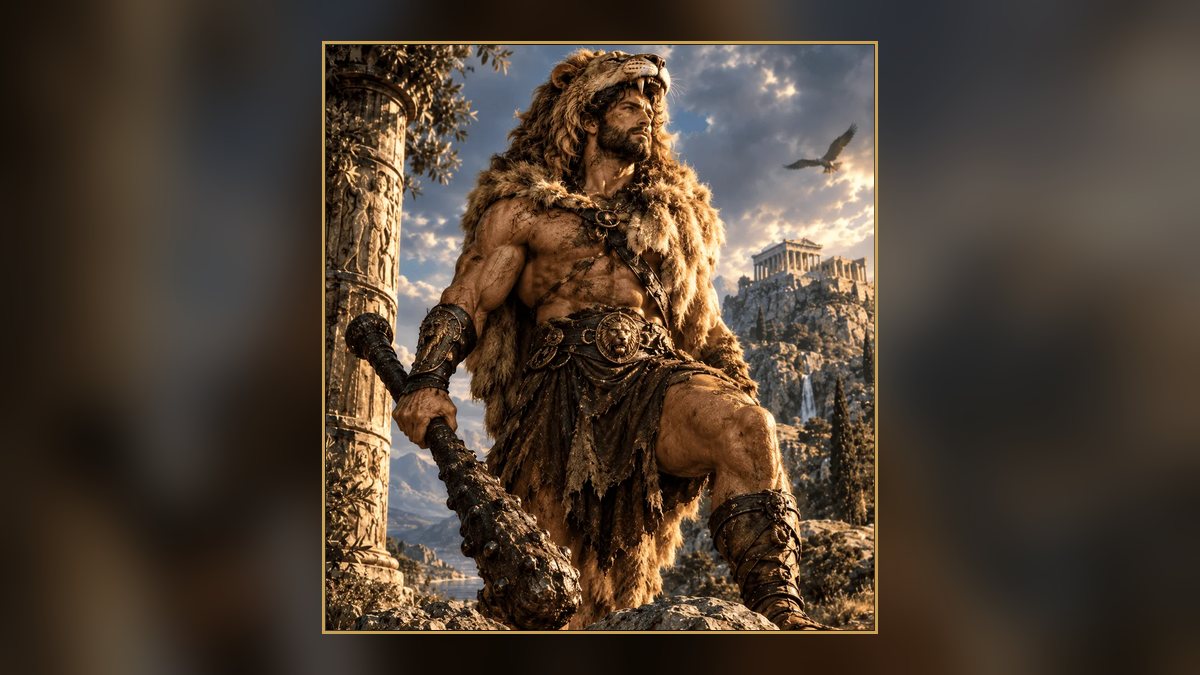
The labours of Heracles are usually told as a list of adventures. Kill the lion, kill the hydra, steal the apples, drag the dog out of the underworld. It is a good list and there is a reason it survived. But the more I read around it, the less it looks like a list of adventures and the more it looks like a solution to a problem. The problem is simple. What do you do with a man who is far stronger than anyone else and who, when his temper goes, kills people? My answer, and I will hedge that this is a reading and not a fact, is that you put him on a leash and give the leash to someone weaker than him. That is the entire structure of the labours.
A name that does not fit
Start with the name. Heracles means roughly the glory of Hera, which is one of the great ironies in all of Greek myth, because Hera hated him. He was the son of Zeus and a mortal woman, Alcmene, and Hera pursued him from the cradle. When he was a baby she sent two snakes into his bed, and he strangled them, one in each hand. His birth name, Alcides, referred to his mortal grandfather. He only got the new name later, and the Delphic oracle is credited with giving it to him, as part of the terms of his punishment.
That order of events is key. In the most detailed account, from Apollodorus, Heracles first loses his mind. Hera sends a fit of madness upon him, and in it he kills his own children and in some tellings his wife Megara. When he recovers, he is horrified. He goes to Delphi to ask how to atone and the oracle tells him to serve King Eurystheus of Tiryns for twelve years, performing whatever labours the king demands. Only then can he be purified.
Euripides gives a different order, putting the madness after the labours as a kind of crushing last blow, and honestly I find his version more painful. Either way the point is the same. The labours are penance. They are not a quest for glory. They are a sentence.
The king who hides in a jar
And who is the man who sets the sentence? Eurystheus is a minor king, and every account makes him a coward. When Heracles arrives with the Nemean lion's body on his shoulders, the king is so frightened that he hides in a bronze jar buried in the ground and gives all further orders through a herald. He does not even look at Heracles after that.
This is extraordinary if you think about it. The strongest man in the world takes orders from the weakest, and the weak man is terrified of him and has total authority. That does not describe a fair fight. It describes a system. A society finds itself with a force it cannot beat or trust. So it does not try to kill him. It gives him a master and a list of tasks, and hopes the tasks will keep him busy and far away.
Notice that Eurystheus also cheats. He refuses to count the Hydra because Heracles had help from his nephew Iolaus, who burned the stumps of the heads. He refuses to count the Augean stables because Heracles was promised payment by King Augeas. That is how a ten-labour sentence becomes twelve. The man holding the leash keeps tightening it, and Heracles, who could break the king in half, does as he is told.
The labours as a map
Look at where the tasks take him. The first ones happen at home, in the Peloponnese: the lion at Nemea, the hydra at Lerna, the hind and the boar of Arcadia, the filthy stables of Elis, the birds of Stymphalus. These are local nuisances. Wild things at the edge of known territory.
Then the targets start to move outward. The Cretan bull, the mares of Diomedes in Thrace, the girdle of the Amazon queen Hippolyta on the Black Sea. And finally the last three go to the very edges of the world: the cattle of Geryon in the far west, the apples of the Hesperides near where Atlas holds up the sky, and Cerberus himself, hauled up from the underworld.
The pattern is hard to miss. The labours begin by cleaning up the neighbourhood and end by dragging the boundary of the world closer. Each task takes something wild and pushes it back, or takes it from beyond the border into human view. If you wanted to describe how a growing Greek world understood its own expansion, you could hardly do better than to imagine a single hero walking that line again and again.
The last one is the most pointed. He is sent to fetch the guard dog of the dead, and Hades lets him take Cerberus on one condition, that he not use weapons. Heracles wrestles the beast into submission and carries it up to the light, shows it to Eurystheus, and takes it back. Even death has to submit for a moment.
What the leash does not cover
And yet it does not work. That is the part I find most interesting. Heracles keeps killing people outside the labours. In one story he murders his music teacher Linus, striking him with the lyre after a lesson goes wrong. In another, he kills a guest, Iphitus, in a rage, and has to be purified all over again. The violence keeps leaking out of the frame.
The ending is bleak. His wife Deianira, afraid of losing him, smears a love charm on his shirt that she got from the dying centaur Nessus. The charm is really poison, because Nessus had been shot with an arrow dipped in the Hydra's venom. When Heracles puts it on, it burns into his skin. He builds his own funeral pyre on Mount Oeta and climbs onto it. The labours kept the strength useful for a while, but they did not change what he was, and his story ends in the same place it began, with a household destroyed by something it did not understand.
Hero and god at once
There is one more twist, and I think it is the cleverest one. After his death, Zeus takes him up to Olympus. Hera is reconciled and gives him her daughter Hebe as a wife. The sad, bloodied hero becomes a god.
The Odyssey even splits him in two. When Odysseus visits the underworld he meets Heracles' shade, wandering with a drawn bow, while the poem says the real Heracles is among the immortals with Hebe. Herodotus, visiting the island of Thasos, reports two separate temples, one to Heracles the god and one to Heracles the hero, and he says the Greeks were wise to honour him both ways. That is a lovely way of saying that he was too big a figure to fit in a single category.
What it adds up to
So I keep coming back to the leash. Heracles is the proof that Greek storytellers knew how dangerous raw strength is and what societies do about it. You can give it a purpose. You can give it a master. You can point it outward at the monsters and hope it never turns on you. And you can build a cult around it afterwards, so that the fear turns into reverence.
That does not make him a villain. He is a man who did something terrible and then spent his life trying to make up for it, and for a time the Greeks believed it had worked. The story only goes sour at the end, when it becomes obvious that nobody ever solved the problem. They only put it on a long chain.