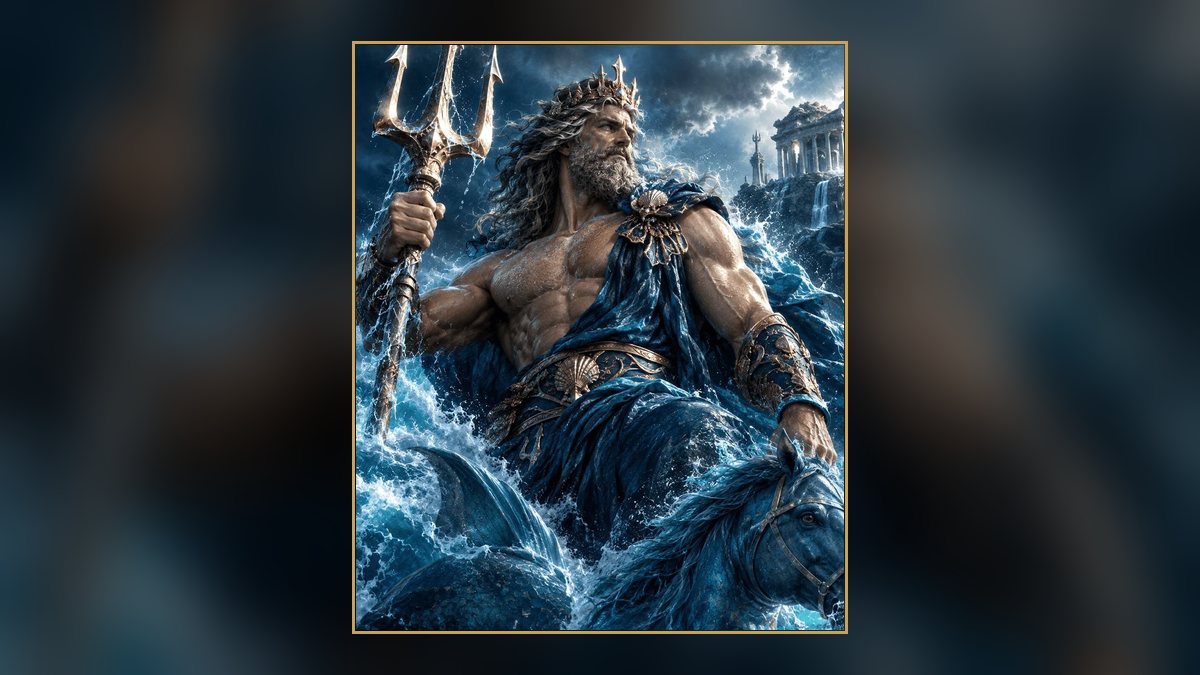
If you only knew the titles, you would assume Poseidon was the second most powerful god in the Greek world. He rules the sea, he causes earthquakes, he gave the horse to humanity, and his trident is the kind of weapon that makes mountains nervous. Then you start reading the actual stories and notice something odd. Over and over, Poseidon enters a contest for a city, loses, and storms off to flood somebody's fields. After a while I stopped treating it as a coincidence. I think the pattern is the whole point of him.
The brother who drew the short straw
The standard story goes like this. After the Titans were beaten, Zeus, Poseidon and Hades divided the world between them. In the Iliad, Poseidon says they drew lots: Zeus got the sky, Hades got the dark below, and Poseidon got the sea, while the earth and Olympus stayed common ground. It sounds fair enough, but listen to how Poseidon tells it. He is arguing with Zeus at the time, and his complaint is that Zeus is acting as though he is the senior brother and can give orders. Poseidon insists they are equals who simply received different portions.
That scene is a good snapshot. Poseidon is the god who is always conscious of rank and always slightly short of what he feels he deserves. The sea is enormous, but it is also, in Greek thinking, a place no one can build on or own. Zeus has a throne. Hades has a palace. Poseidon has a palace too, in the deep, but nobody ever visits it. His power is real and nearly useless for ruling anyone.
Contest after contest
Here is the list, and it is longer than most people realise. Poseidon competed with Athena for Athens and lost. He competed with Hera for Argos and lost, and in his fury dried up the rivers of the region. He competed with Helios for Corinth and lost, though Helios generously gave him the isthmus. He competed with Zeus for Aegina and with Dionysus for Naxos, and lost both. At Troezen the two sides gave up and agreed to share the city, which is about as close to a victory as he ever gets.
The Athens story is the one everybody tells. Poseidon struck the Acropolis with his trident and a spring of salt water appeared, which was impressive but not especially helpful to a city on dry land. Athena planted an olive tree. The citizens, or the gods acting as judges depending on the version, picked the olive. Poseidon was so enraged that he flooded the plain of Attica.
Now think about what that story is doing. The Athenians told it about themselves, and they were proud of it. The olive is a gift that needs patience: you plant it, you wait years, you press it, and it feeds you and lights your lamps for generations. A spring of seawater is a flash of power that leaves you thirsty. The city chose the slow thing over the spectacular thing. And since Athens eventually built a navy that dominated the Aegean, there is an extra irony here. They rejected the sea god's gift and then conquered the sea anyway, with timber, planning and a lot of oars.
Why would the Greeks write him that way?
This is where my own theory comes in. Poseidon represents force that cannot be argued with. An earthquake does not take votes. A storm does not listen to the pilot. A wave does not care how good your ship is. The Greeks lived on the edge of a sea that fed them and killed them in roughly equal measure, and they knew very well that there was no negotiating with it.
So what do you do with a power like that in your stories? You put it in a courtroom. You make the unarguable god stand in front of a jury and lose to arguments, to craft, to patience, to cleverness. That is a way of reassuring yourself. Every time Poseidon loses a city, the story tells the audience that human intelligence can survive the sea, that a polis built on good sense will outlast a tantrum. Poseidon is the thing the Greeks were afraid of, and the stories are how they talked back to it.
The cost is that he turns sulky and vindictive. He is the god who holds a grudge, and the grudges are always disproportionate. Argos loses its rivers. Attica floods. And in the case of Odysseus, a man loses ten years of his life.
The Odyssey is a grudge
Most readers think of the Odyssey as a story about getting home. I think it is just as much a story about one god's refusal to let it happen. Odysseus blinds the Cyclops Polyphemus, who is a son of Poseidon, and then, as he sails away, he can't resist shouting his real name across the water. That small piece of vanity gives Polyphemus what he needs to pray to his father, and Poseidon takes the request personally. From that moment he wrecks Odysseus's route at every opportunity.
What I like is that Poseidon doesn't kill him. He can't, quite, because Zeus has already decided Odysseus will get home, and Poseidon is not the sort of god who openly disobeys his brother. So he does the next best thing and makes the trip as long and miserable as he can. He destroys the raft near the island of the Phaeacians. And when Odysseus finally does arrive, the Phaeacians, who had carried him home, are punished too, with their ship turned to stone in sight of their harbour. The god who cannot win in court gets his revenge through delay and collateral damage.
Earth-shaker and horse-lord
One of his oldest titles is Enosichthon, the earth-shaker, and it may say more about his origins than the sea does. Scholars have long noticed that Poseidon's name appears on the Linear B tablets from Pylos, more than five hundred years before Homer, and he appears to be an important god there. His link to the sea may even be a later layer on top of an older identity as a god of earthquakes and horses. Greece sits on a fault line, and anyone who has lived through a quake would hardly need to be told which god was responsible.
The horse connection is the strangest part. Poseidon is Hippios, the horse god, and the myths tell of him taking the shape of a stallion to pursue Demeter, who turned herself into a mare to hide among the herds. Their child was Arion, a talking horse. In another story he produced the first horse out of the ground with a blow of his trident. A god of the sea who is also the god of horses seems like an odd combination until you picture a breaking wave. The Greeks, and later the Romans, spoke of white horses riding the surf. Whoever first made that connection had spent a lot of time looking at the water.
The walls of Troy
There is one more story that fits the pattern perfectly. Poseidon and Apollo, as a punishment from Zeus, were sent to work for the Trojan king Laomedon for a year. Poseidon built the walls of Troy. When the year ended, Laomedon refused to pay them, and even threatened to cut off their ears and sell them as slaves.
Poseidon sent a sea monster against the city. Laomedon had to offer up his daughter Hesione, and she was only saved because Heracles arrived and killed the beast, and then Laomedon cheated him as well. So Troy was cursed twice over, once by each wronged party, long before Helen ever sailed there. It also explains why, in the Iliad, Poseidon fights on the side of the Greeks. He built those walls with his own hands and then watched a king insult him. Troy was his unfinished argument too.
What he leaves behind
I come away from Poseidon thinking that he is the most human of the major gods, even though he is also the most elemental. He is proud, he is easily offended, he nurses grievances for years, and he keeps showing up at contests he is probably going to lose because he can't stand the idea of not being asked. The Greeks recognised that sort of person immediately. They knew what a powerful man looks like when he has been publicly outvoted.
And yet they kept sacrificing to him. Sailors poured wine into the sea before every voyage. Cities on earthquake lines built him temples as insurance. At Cape Sounion, on the tip of Attica, his temple still stands on a cliff above the water, where you can see it from ships long before you can see the land. The city that voted against him put his shrine where every arriving sailor would pass it. Nobody ever said the Athenians were not careful.