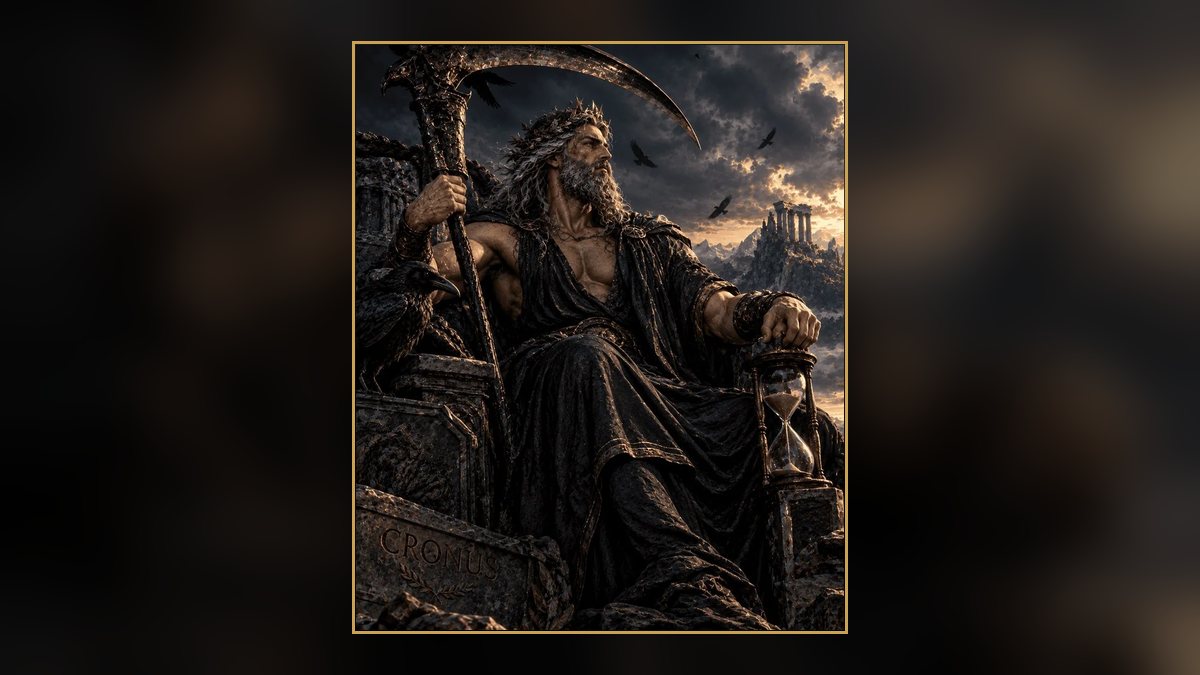
There are two Cronuses in the old sources, and they do not look like they belong together. One is the monster of Hesiod's Theogony, who castrates his own father and then eats his children one by one. The other is the king of the Golden Age, whose reign Hesiod himself, in another poem, describes as a time when people lived like gods, without sorrow, and the grain grew by itself. It always bothered me that the same person was supposed to be both. After enough rereading, I decided that he isn't two people. He is one king with one rule, and the difference is only whether you stand inside it or outside.
The sickle his mother gave him
Before he was a king he was a tool. Uranus, the sky, had been burying his children inside Gaia, the earth, as soon as they were born, because he didn't want them seeing daylight. Gaia was in agony and she made a plan. She made a sickle of grey adamant, the hard stuff of legends, and asked her sons to use it. All of them refused, except the youngest, Cronus. He waited in ambush, and when Uranus came down at night to lie with Gaia, Cronus reached out with his left hand, took hold of his father, and cut him.
The details are grim. The blood fell on the earth and gave birth to the Furies and the Giants. The severed part was thrown into the sea, and out of the foam that gathered around it came Aphrodite. I always find it striking that the goddess of love is a by-product of the first act of family violence. But the part I want you to notice is that Cronus used a tool his mother gave him and acted on a plan she designed. He didn't invent the revolt. He volunteered for it, which, if you think about it, is a smaller kind of courage and a much more dangerous kind of ambition.
The prophecy that ate him alive
Once Cronus was in charge, he heard what every usurper hears. Gaia and Uranus told him that he too was fated to be overthrown by one of his own children. So he did the thing that makes sense if you've just done it yourself. He swallowed every child Rhea bore him, as soon as it was born: Hestia, Demeter, Hera, Hades, Poseidon.
Think about the logic. Cronus knew exactly how his own coup had worked. A younger son, waiting patiently, with the help of a mother. So he removed the younger sons, and he made sure the mother's help would come to nothing. He had perfectly learned the lesson of his own success, which is the saddest and most dangerous thing a ruler can do.
And of course the lesson didn't work, because it never does. Rhea, on the advice of Gaia and Uranus, went to Crete to give birth to Zeus in secret. Cronus was given a stone wrapped in baby clothes and swallowed that instead. It's one of the funniest moments in the whole cycle: the god who learned everything from his own rebellion can't tell a rock from a baby.
The stone itself had an afterlife. Hesiod says Zeus set it up at Pytho, which is Delphi, as a sign and a wonder for mortal men. Pausanias saw a stone there in the second century AD, which the priests anointed with oil every day and wrapped in wool at festivals. So the thing Cronus mistook for his child became, in a sense, one of the most visited objects in the Greek world. There is a kind of joke in that.
The golden age
Now to the other half. In Works and Days, Hesiod describes the first race of men, the golden race, who lived when Cronus was king in heaven. They had no toil and no grief. The earth gave its fruits freely, and when they died it was like falling asleep. They became spirits who watch over mortals.
Here is what bothers me about it. It is a world without any births to be afraid of and any deaths to mourn, and where nothing is made, because everything is already provided. There are no craftsmen, no heroes, no wars, and also no discoveries. It is a perfect world and a stuck one.
And so I come to my own idea. The golden age and the swallowing of the children are the same policy. A king who is afraid of the future will try to freeze the present. In one picture, he does it by force and fills the world with fear. In another, he does it so smoothly that the people living under him are happy and never think to ask what was lost. If you were a god, you could easily have both versions going at the same time: the cheerful one for mortals, and the dark one in the family.
It would also explain why later writers found it so easy to turn him into a symbol of an old, comfortable order. The Greeks themselves sometimes ended up on both sides of this. They could miss the golden age, and they could be glad that Zeus ended it.
The festival where the masters served
There is one more detail, and it's the strangest. In Athens, at the Kronia, held in midsummer, the usual hierarchy was turned over. Slaves were permitted to feast with their masters, and in some accounts the masters waited on them. For a day, people enacted what life had been like under Cronus, when nobody ranked above anyone else.
I like this a lot because it shows how the Greeks thought of the golden age: as a holiday. Something to visit once a year, with the doors locked behind you. And it fits my reading. If Cronus's world was a place without change, then it makes sense that you could only live in it for one day before it began to feel like a trap.
What happened to him
After the Titan War, Zeus chained Cronus and the other Titans in Tartarus. That is the standard ending. But the poet Pindar tells it differently. In his second Olympian Ode, Cronus is released and rules over the Isles of the Blessed, where the best of the dead are sent to live. Zeus, in this telling, forgave him.
It is a surprising ending, and I find it consoling. The old king, who could not let anything happen, is given a small kingdom for people who have already finished. A place where nothing changes is, finally, the right job for him.
One last thing. You will often read that Cronus's name means time, and that the Greek story is really about time devouring its children. This is a later confusion between his name and the Greek word chronos, and nothing in Hesiod suggests it. But I can see why people made the mistake. A ruler who wants to keep everything as it is, and who ends up swallowed by the future he tried to stop, is a very good picture of what time does to the people who try to hold on to it.