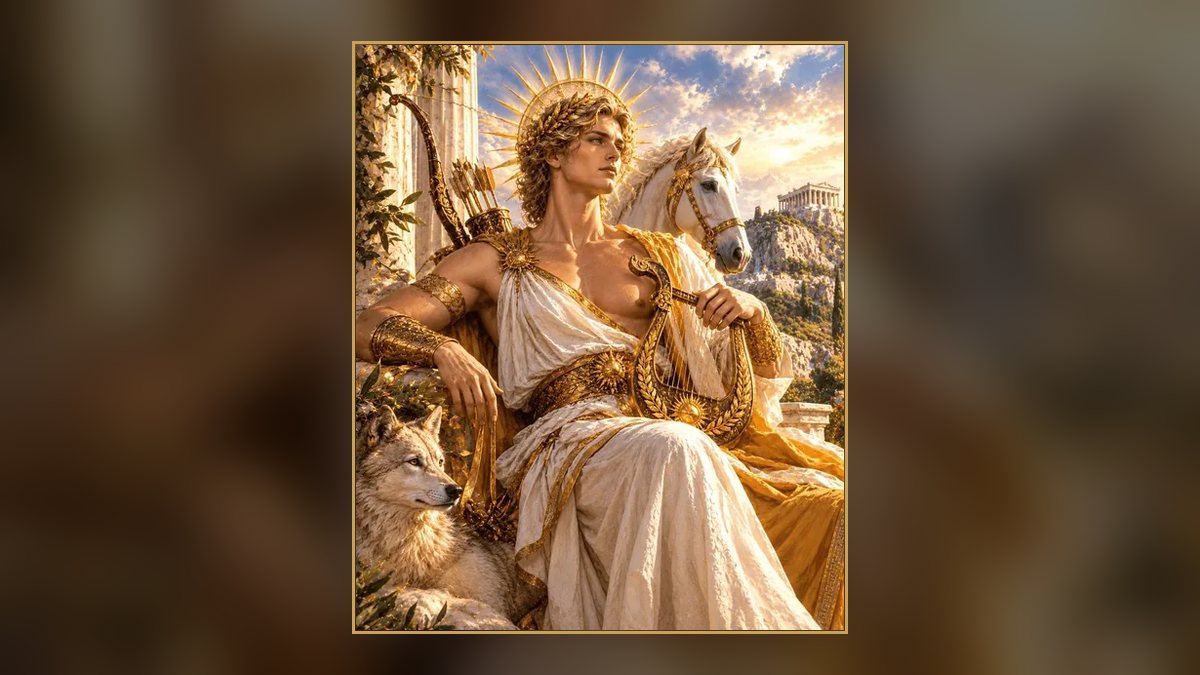
Apollo's job list is an odd one. He is the god of the bow, of prophecy, of music, of medicine and plague, of poetry, of the sun in later tradition, and of keeping things clean. I used to think of that as a random collection that the Greeks had accumulated over time. Then I noticed something that ties nearly all of them together: each one works from a distance. An arrow flies a long way. Prophecy sees across time. A lyre string makes a sound that carries across a room. A plague is a thing that arrives without anyone being seen. Apollo is the god of reach.
The arrows in the first book of the Iliad
The Iliad begins with Apollo, and it is a frightening start. A priest named Chryses comes to the Greek camp to ask for his daughter back, and Agamemnon insults him and sends him away. Chryses prays to Apollo. And the god comes down from Olympus, with his bow on his shoulder and, as Homer says, looking like the night.
He sits apart from the ships and shoots. First he kills the mules and dogs, and then the men. For nine days the funeral fires burn day and night. That is the first image of the god in the poem, a figure sitting quietly outside the camp, picking off victims one at a time, and nobody can reach him. I think the choice is deliberate. The poet is establishing what kind of power this is. It does not need to come close.
The oracle
His most important sanctuary was Delphi, built on a steep slope of Mount Parnassus, and it was the closest thing the Greek world had to a central authority. Cities consulted it before founding colonies or going to war. A priestess called the Pythia sat on a tripod over an opening in the ground and gave answers that were passed on in verse.
Think for a minute about how strange that is. The most respected institution in Greece was a place where you asked a question and received an answer from far away, from someone you could not see clearly, in words that needed interpretation. That is Apollo's whole manner, and it explains why his oracles were so famously ambiguous. When the Lydian king Croesus asked whether he should attack Persia, the answer was that if he crossed the river Halys he would destroy a great empire. He did cross, and the empire he destroyed was his own.
I don't read that as a trick. I read it as the honest nature of the thing. Apollo sees much farther than a person can, and that is exactly why what he says cannot be fully understood by someone standing where you are. You get the information, but the gap stays. Distance, in other words, works in both directions.
Two maxims, one temple
Carved at Delphi were short phrases, usually attributed to the Seven Sages. Know thyself. Nothing in excess. Both are about keeping the right distance: from your own limits, and from the edge of anything that can hurt you. The god who is himself always at arm's length tells his visitors to maintain the same kind of measure. He likes proportion, clear edges and clean lines, and that is why later generations connected him with order and reason.
When he does come close
The interesting stories about Apollo are the ones in which that distance fails. Daphne is the best known. He mocks Eros for being a small boy with a toy bow, and Eros retaliates by shooting him with a golden arrow that makes him fall in love, and Daphne with a leaden one that makes her hate the idea. She runs, and when she can't escape, she prays to her father, a river god, and is turned into a laurel tree. Apollo adopts the laurel as his emblem. It is a lovely ending and also a rather sad one, because the god of far sight ends up with a tree.
Cassandra is worse. He gives her the gift of prophecy to win her love, she rejects him, and he cannot take the gift back. So he adds a curse: she will always tell the truth, and no one will ever believe her. It is a cruel invention. He turns his own gift into a form of distance, putting an invisible wall between her and the rest of the world.
Then there is Hyacinthus, a young man he loved, killed accidentally when Apollo's discus bounced off the ground. The god weeps and makes a flower out of the blood. It is the one story in which he is simply helpless and close, and the grief is real.
The cruel side
The Greeks did not sentimentalise him. When Marsyas the satyr challenged him to a musical contest after finding Athena's discarded flute, Apollo won and flayed the loser alive. When Niobe boasted that she had more children than Leto, Apollo and Artemis shot all of them. When the Greeks made a mistake at Troy, he killed their men with plague.
What these have in common is the same coldness. He punishes from a long way off and often with a sense that the matter was settled as soon as it was spoken. The healing god and the plague god are one figure because both work the same way: something invisible reaches a person and the result follows. Apollo cures what he can reach and kills what he can reach. The distance is what makes him frightening.
The year he worked as a servant
One of my favourite details is a small story that rarely gets retold. When Zeus killed Apollo's son Asclepius, who had become so skilled at healing that he brought a man back from the dead, Apollo got revenge by killing the Cyclopes, the craftsmen who made Zeus's thunderbolts. Zeus sentenced him to serve a mortal for a year. Apollo worked as a herdsman for King Admetus of Pherae.
Everyone talks about him as the god of the lyre and the bow, but here he is, covered in dust, looking after sheep. And by every account he did the job well. Admetus's herds doubled. In some versions he even helped Admetus avoid death. A god who spends his life at a distance finds himself, for one year, in a place where he has to be useful up close. And he is good at it.
What I think he was for
If I try to say what Apollo gave the Greeks, I would say it was a way of managing fear. A lot of terrible things come from far away: disease, fate, the opinion of the gods. You can't stop them, but you can try to see them early, to measure them, to give them a form. That is what prophecy, medicine, music and archery have in common. They are ways of standing back and getting a better view of something that might otherwise swallow you.
That gives him a bright, almost clinical beauty, and a risk. The more you watch from a distance, the less you feel. The stories of Daphne, Cassandra and Marsyas all show what happens when that detachment goes wrong. I find him an unsettling god, and an honest one. He is what you become when you want to understand everything and touch nothing.