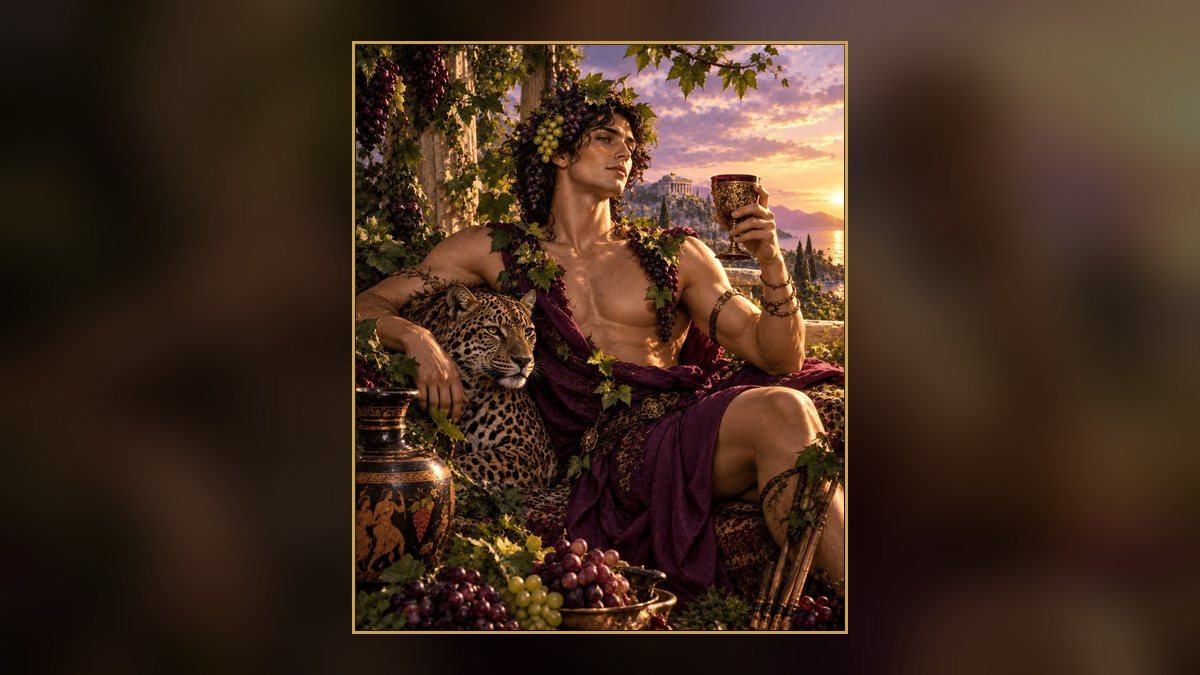
Every other major Greek god feels like he has always been there. Zeus is in the sky, Demeter is in the field, Apollo is at Delphi. Dionysus is different. In almost every story he is introduced as someone arriving. He comes from the East, or from Thrace, or from the sea, bringing a crowd of followers and a new way of living, and the local people have to decide whether to let him in. I find that structure fascinating, because it tells you that the Greeks themselves thought of him as a problem to be solved, not just a god to be worshipped.
Born twice
The origin story is already strange. Semele, a princess of Thebes, was loved by Zeus. Hera, jealous as always, disguised herself as an old woman and whispered to Semele that her lover might not really be a god. Semele made Zeus promise to show himself to her in his true form. He had sworn an oath and could not take it back, so he appeared as the lord of thunder, and the sight burned her to ash.
Zeus snatched the unborn child from the fire and sewed him into his own thigh, and a few months later the baby was born from the leg of his father. That is why Dionysus is called twice-born. I think the detail matters more than it seems. He is the only Olympian with a mortal mother, and he is born from a death. Everything about his cult is built on the idea that life and destruction are the same event looked at from two sides.
The arrival at Thebes
The most complete version of his story is a play, the Bacchae, written by Euripides near the end of his life and performed after his death. It is among the most unsettling works to survive from ancient Greece, and it is worth knowing even if you never read another one. Dionysus comes back to Thebes, the city that denied his mother, disguised as a mortal priest. The women of the city have already gone into the mountains to dance in his honour, and their king, Pentheus, is furious.
Pentheus is a man who believes in control. He wants to chain up the stranger, close the gates, send soldiers to drag the women home. And the stranger, smiling, lets himself be arrested. Then the god begins quietly to unpick the king. He talks Pentheus into dressing as a woman so that he can spy on the rites. He leads him up the mountain. And there the women, in a trance, mistake him for a wild animal and tear him apart, led by his own mother, Agave, who comes back to the city carrying her son's head on a stick, believing it to be a lion's.
Reading that, you realise that Dionysus is not punishing the king for disbelief. He is demonstrating something about the king. A man who spends all his energy denying what he wants will eventually be destroyed by it. Pentheus wants to watch. The play says that very clearly. The god simply opens the door and lets the king walk through.
The pattern repeats
Thebes is not the only city to learn the lesson. Lycurgus, king of the Edonians, drove Dionysus away with an ox-goad, and the god sent madness on him, and in one telling he killed his own son with an axe, thinking he was cutting vines. The daughters of Minyas in Orchomenos refused to join the festival and stayed home weaving, and were driven mad, and tore apart one of their children. Pirates tried to kidnap him in the Homeric Hymn, and the ship sprouted vines, the mast became a snake, the god turned into a lion, and the sailors leapt into the sea and became dolphins.
Do you notice the structure? A community refuses him, sometimes politely, sometimes with violence, and the refusal is exactly what destroys it. In every case the damage comes from inside the household. Mothers destroy their sons, fathers destroy their children. The god does not send a monster. He lets the people do it themselves. It is a very economical kind of horror.
Is he actually foreign?
Here is where it gets interesting. The Greeks said he was a latecomer, but the evidence suggests otherwise. His name appears on a Linear B tablet from Pylos, from around 1200 BC, which means he was being worshipped in Greece at least five centuries before Homer. He is not new. He is old, and the stories about foreigners and arrivals may have been invented to make sense of why such a wild cult existed inside the orderly, civilised Greek world.
That leads me to my own reading. The myths about his arrival are not history. They are a way of explaining something the Greeks already knew about themselves. Every city, however well organised, had impulses it could not accommodate: drunkenness, ecstasy, grief too large for the funeral, an urge to stop being a citizen for one night and become something else. The Greeks could have simply banned all that. Instead they gave it a god, a calendar and a place to go.
Wine, and how to drink it
Wine was the easiest of his gifts to understand, and the most carefully managed. Greeks almost never drank it neat. They mixed it with water in a large bowl called a krater, in proportions that were decided by the host at a dinner party, and a drinker who took it undiluted was considered either a barbarian or a fool. The god of wine is the god who teaches you to measure it.
One of the myths even makes the point. When King Midas of Phrygia, the one with the golden touch, hosted the satyr Silenus, Dionysus's old companion, the god rewarded him with a wish, and Midas wished for gold. In another story, Dionysus teaches a farmer named Icarius how to make wine. Icarius shares it with some shepherds, who get drunk, think they have been poisoned and kill him. The gift is a miracle and a hazard together, and you cannot have one without the other.
The god of the theatre
This is the part that changed the world. In Athens, every spring, the city held a festival called the City Dionysia, and it was there that drama was born. The tragedies of Aeschylus, Sophocles and Euripides were all written for this festival, and so were the comedies of Aristophanes. They were performed in the open air, in a theatre carved into the hillside beneath the Acropolis, with a statue of Dionysus brought in to watch.
The mask is the symbol of the god, and I think that is exactly right. An actor puts on a mask and becomes someone else. The audience knows he is not really a king or a murderer, and still they weep. That is the basic Dionysian trick: you step outside yourself, you do something terrible or impossible, and you return unharmed. The Greeks recognised that this experience was powerful enough to need a god, and they put it at the centre of their civic life.
It is also worth remembering that the plays were not light entertainment. The tragedies dealt with mothers killing children, kings destroying their own cities, people who could not see the truth until it was too late. In other words, they were exactly the sort of events that happen in Dionysus's own myths. The city sat down together, once a year, and watched itself fall apart on stage, and then went home.
Ariadne, and the end of the story
One of the gentler stories ends his legend. After Theseus abandoned Ariadne on the island of Naxos, Dionysus found her, married her and set her crown among the stars as the constellation Corona Borealis. It is a surprisingly tender ending for a god so often associated with madness, and it makes me wonder if the Greeks wanted him to be more than just a danger. He was also the one who arrives after the worst has happened.
There is a further tradition that he went down to the underworld to bring back his mother Semele, and made her a goddess under a new name. He is the god who was born from a death and refused to leave it unanswered. Seen that way, all the revelry and terror might come from the same source. He is what happens when the dead are not allowed to stay quiet. And every spring, the Greeks poured a drink and let him in, because they had already seen what happened to cities that didn't.