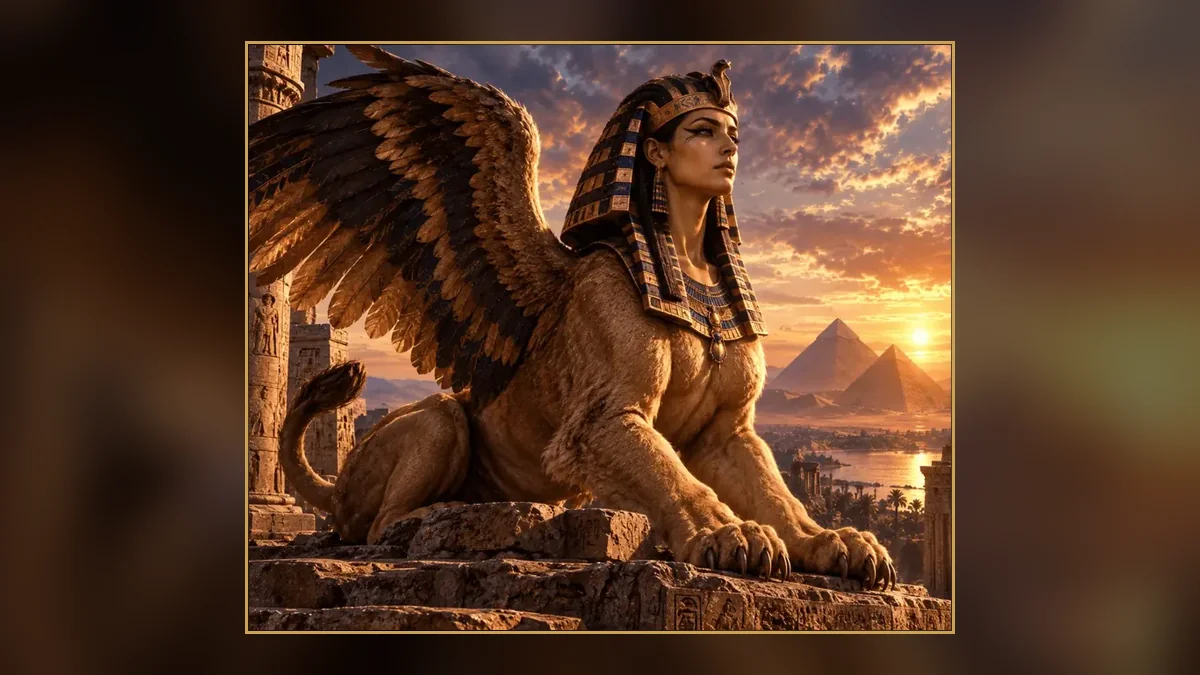
Every monster in Echidna's family is killed by someone with a weapon, except one. The Hydra needed fire, the Chimera needed a flying horse, Cerberus needed a wrestler. The Sphinx needed a sentence. She is the one monster in Greek myth who is defeated by an idea, which already makes her unusual. But I want to argue that the idea Oedipus produced was also the wrong answer, in a way he could not see, and that the whole story hangs on that.
Not the one in Egypt
First, a clarification, because the word sphinx now covers two very different creatures. The Great Sphinx at Giza is a male figure with a lion's body and a pharaoh's head, wingless and calm, carved around 2500 BCE as a royal guardian. The Greeks met such statues in Egypt and borrowed the word, but their own sphinx was a different animal altogether: female, winged, and dangerous.
Apollodorus gives the standard description. She has the face of a woman, the chest, feet and tail of a lion, and the wings of a bird. Hesiod, our earliest source, uses the Boeotian form of the name, Phix, and calls her the ruin of the Cadmeans, which is to say the Thebans. In his account she is the child of Orthrus the dog and the Chimera, while Apollodorus makes her the daughter of Typhon and Echidna. Either way she belongs to the household of monsters. The Greek name seems to have been connected in antiquity with a verb meaning to squeeze or bind tight, and that fits what she does to her victims.
The riddle
The story as Apollodorus tells it is brief. The Sphinx had learned a riddle from the Muses. She settled on a mountain near Thebes and put it to the citizens. Each time they failed to answer, she seized one of them and ate him. The riddle was: what has one voice and becomes four-footed, two-footed and three-footed? The Theban regent Creon, desperate, announced that whoever solved it could have the kingdom and the widowed queen. Oedipus, a stranger, answered: man. The Sphinx threw herself from the acropolis, and Oedipus became king.
The wording most of us know, about a creature that walks on four legs in the morning, two at noon and three in the evening, is actually a later polish. An older verse form, quoted by the ancient writer Athenaeus, speaks of a creature with two feet and four feet and three, the only one of all that live on earth, in the air and in the sea that changes its nature. And it adds a strange line: when it walks on the most feet, it is slowest and weakest. The riddle is a little bleaker than the version on the postcard. It is about change and fragility, and about a being whose power is greatest on two legs and lowest on the most.
A plague with a cause
Why was she in Thebes at all? Greek writers did not just let monsters appear. In several accounts she is sent by Hera, as a punishment for the crime of Laius, the former king, who had abducted a boy named Chrysippus while a guest in the house of Pelops. A city that harbours a man who has violated hospitality and a family has to pay, and the Sphinx is the bill.
Remember what comes next in the story. Laius has already been killed, on a road, by a stranger. That stranger is Oedipus, who does not yet know that he has just killed his own father. So the Sphinx arrives at a city that is carrying an unsolved murder, and it is the murderer who walks into town and ends the plague. Thebes is rescued by the one man who is the source of its deeper trouble. The monster is the first symptom of a sickness the city does not yet know it has.
The snatcher
Before we get to Oedipus, we should look at what the Sphinx was to ordinary Greeks, because the riddle story is only part of her. In the early centuries she is above all a figure of death. Archaic vase-painters love to show her crouched on a rock, or on a column, with a young man in her grasp. She appears on grave stones in Athens, perched on top of the monument, looking out over the cemetery. The Naxians dedicated a colossal sphinx at Delphi around 560 BCE, set on a slender Ionic column rising some ten metres above the sanctuary, as though she were a lookout for the god.
Many scholars see her as one of a group of Greek snatchers, like the Harpies and the Keres, who carry off the young and explain why people die before their time. She is the answer to a question every parent asked: where did he go? Something took him. In that light, the Theban story is not a neat folktale about a riddle. It is a local explanation for a plague of vanished young men, and I suspect the riddle was added later as a literary frame, a way of letting a city feel it had a chance.
Oedipus and his foot
Now to the man who answered. His name is Oidipous, which means swollen foot, and he got it because as a baby his ankles were pierced and bound so he could be left on a mountain to die. He had a damaged foot from the first week of his life. He is a man for whom the number of legs is a personal matter.
Look at the answer he gives. He says man, a creature that crawls as a baby, walks as an adult and takes a staff in old age. The Sphinx is defeated. But think about how the play ends. In the later Oedipus at Colonus, the old Oedipus is blind, wandering, and leaning on a staff and on his daughter Antigone. He is the riddle's third leg. The man who solved the puzzle turns out to be the demonstration of it. All the stages the Sphinx described are in his own life, in a compressed and terrible form.
My reading: the answer he could not read
This is where I offer an interpretation that is mine and not an ancient one. Oedipus answers the riddle in the generic. Man, he says. Humankind in general. It is an answer from outside, the response of someone solving a puzzle about other people. It is entirely correct and entirely impersonal.
And what he does not do, what he cannot do, is hear that the riddle is also about him. Think of how many ways it could have been. A man with a swollen foot, who does not know who his parents are, who has a murder in his past that he cannot see, is asked what changes shape over a lifetime and what is weakest on the most feet. He answers promptly and brilliantly, and gets the whole thing right except for the one piece he needed: himself. Later in Sophocles's play, he reminds the prophet Tiresias that he stopped the Sphinx by using his wits, not by reading omens from birds. It is his proudest boast. It is also the beginning of his downfall, because the man who knows all about human beings in general is the man who does not know who he killed at the crossroads.
That is why the story echoes the famous inscription at Delphi, know yourself. The Sphinx is a test of exactly that, and Oedipus passes the exam on paper and fails it in life. He gets full marks for the abstract question and zero for the personal one. The riddle is correct. It just was not about humanity. It was about him.
The only monster that dies of being understood
One more oddity. The other children of Echidna are defeated by force. The Sphinx throws herself off a cliff. Nobody pushes her, nobody strikes her. She dies the moment her question is answered, as if the question were the only thing holding her together. In the logic of the story, a riddle is a contract. As long as nobody solves it, it has power over a city. Once it is solved, the contract is void, and the creature that depended on it has nothing left.
I find that quietly profound. Most of the monsters of myth stand for something that cannot be reasoned with: appetite, storm, rage, death. The Sphinx is the only one who invites reasoning, and the only one who lets herself be reasoned out of existence. But Thebes pays for the clever solution later, in a plague worse than the first one, because the riddle she posed was the shallower of two. The real question was not what walks on three legs. It was who killed the king.
What she is for
So the Sphinx is a monster built to be answered, and the answer turns out to be an incomplete one. She sits at the junction between the old kind of danger, which kills you, and a newer kind, which tests you. She stands on her rock above a city and asks it to say what it is, and the city answers confidently and gets it half right. I suspect that is why she has outlasted nearly every other creature of the Greek bestiary. Everyone, in the end, is still being asked the same thing.
Comments
Sign in to join the conversation.