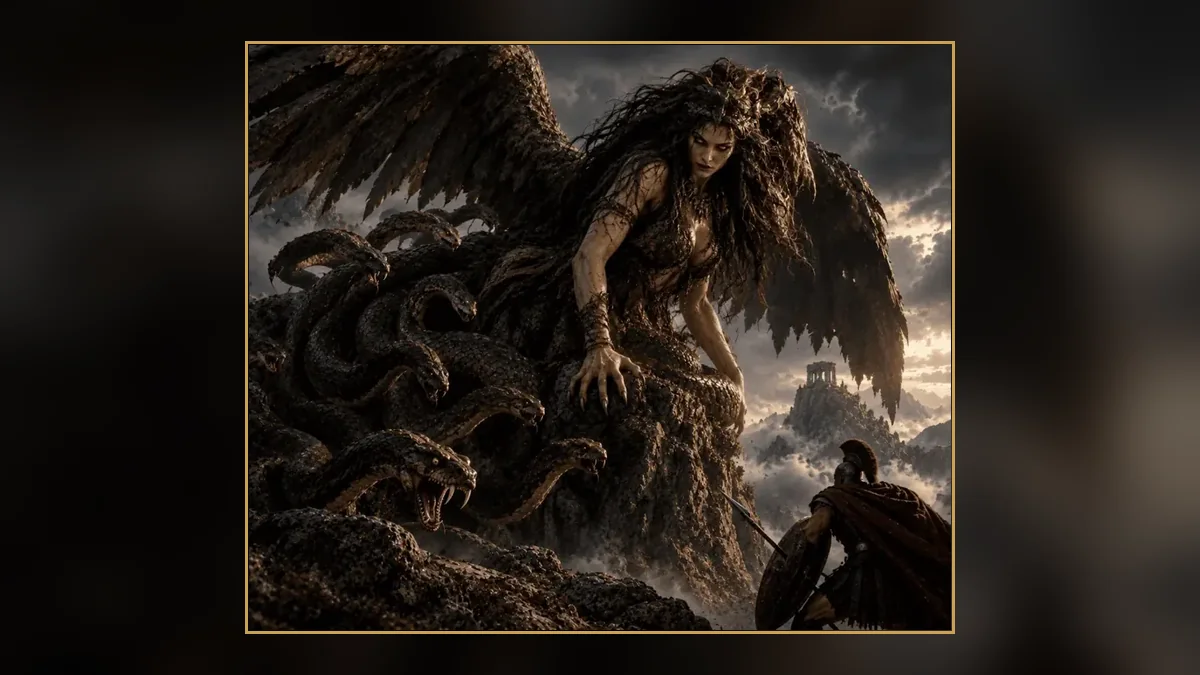
She is usually introduced as the Mother of Monsters, and then everyone moves on to the children. That is a pity, because the ancient sources have more to say about Echidna than the title suggests, and the little they say is odd in ways that are worth slowing down for. She is one of the very few monsters the gods deliberately looked after. She is also the only one of her family whose story reaches all the way to the shores of the Black Sea. Let us take her seriously for once.
A woman to the waist
Hesiod gives her the most careful portrait. In the Theogony she appears in the monstrous brood of the sea-powers Phorcys and Ceto, listed in the same catalogue as the grey sisters and the Gorgons. She is a nymph above, with bright eyes and fair cheeks, and a vast speckled snake below, one that eats raw flesh. Her name is the Greek word for viper, so you could just as well call her Lady Adder.
Her parentage is not settled. Hesiod's wording is loose enough that readers have argued about which of the sea-powers is her mother, and Apollodorus mentions a version in which she is born of Gaia and Tartarus, which would make her Typhon's sibling as well as his partner. I will follow the Phorcys and Ceto line, which is the most common one, but it is worth noticing how little the ancients cared. For a creature with such an enormous family, nobody was in a hurry to fix her origin.
A house given by the gods
Here is the detail that I think is the most important thing about her. Hesiod says she lives in a cave deep under a hollow rock, far from gods and mortals alike. And then he adds that the gods themselves assigned her that glorious house to live in. She guards the land of the Arimoi beneath the earth, and she does not die, and she does not grow old, for all her days.
Compare how Zeus treats her partner. Typhon is struck down and thrown into Tartarus or buried under a mountain. Echidna is housed. She is given an address, immortality and a job of sorts, which is to stay put. Nothing else in Hesiod's cosmos is handled quite like that. Defeated enemies are bound or buried. Echidna is retained.
This is my reading, and no ancient author spells it out, but I think the reason is practical. The Greek world of heroes runs on challenges. Heracles needs something to be Heracles against, Theseus needs a Minotaur, Bellerophon needs a Chimera, and the city of Thebes needs something terrible at its gates for a clever stranger to answer. Somebody has to keep supplying them. The gods, having settled the cosmos, quietly arranged for a reservoir of trials to remain, tucked into a cave in a country no traveller could find. A world without monsters would have been a world without heroes, and the Olympians, who loved their heroes, seem to have understood that.
The household in Arima
Hesiod says that Typhon, the terrible enemy of Zeus, is said to have joined her in love. The wording is hedged, as though even the poet found the pairing hard to believe, but every later writer treated it as settled. Homer, in a line from the Iliad that seems to have nothing to do with her, places Typhon's bed in the same land of the Arimoi, so two separate poets point to one obscure spot on the map as the home of this couple, while neither can say where it is.
Their children are the monster roster of Greek myth. Orthrus, the two-headed dog, and Cerberus, the hound of Hades, are theirs. So is the Hydra of Lerna, and the Chimera, though Hesiod's pronouns leave the Chimera's mother uncertain. In Hesiod's account Orthrus and the Chimera in turn produce the Sphinx and the Nemean Lion, while Apollodorus adds Ladon the garden dragon, the eagle that tormented Prometheus, and, later writers say, the Crommyonian Sow that Theseus killed.
Look at that list as a map instead of a family tree and something becomes clear. Every child is attached to a particular place. The Hydra belongs to the marsh of Lerna, the Lion to the hills of Nemea, the Chimera to the burning mountains of Lycia, the Sphinx to the rock outside Thebes, Cerberus to the gate of the dead, Ladon to the garden at the edge of the world, the eagle to a cliff in the Caucasus. Greek monsters are not random. They are the danger zones of the known world, marshes and passes and cliffs and fire-vents, each given a body and a story. Echidna, in that case, is the mother of the gazetteer. She is where the Greeks filed every dangerous place they knew about.
Killed in her sleep
So much for her immortality. Apollodorus, in the passage where he describes the hundred-eyed Argus, says this Argus killed Echidna as she slept. She had been snatching travellers on the road, and the watchman who never closed all his eyes at once caught her in the one unguarded hour.
The contradiction with Hesiod is plain, and I do not think it needs to be explained away. Two different kinds of story are running here. In the cosmic version, she is a permanent fixture, deathless and housed. In the local version, she is a roadside menace, a woman-snake who grabs people at a crossing and who, like any local menace, is eventually dealt with by someone. The Greeks were comfortable holding both at once. One is about what monsters are for, the other is about what happens when you meet one on the road.
One loose end I find interesting. Argus was Hera's servant, and Hera is the goddess who, in Hesiod, personally raised the Hydra and the Nemean Lion. So her household helps to kill Echidna while her own hands nursed Echidna's children. Whether anyone noticed the irony in antiquity, I do not know.
The Scythian mother
The most surprising Echidna story comes from Herodotus, who says the Greek colonists living around the Black Sea told it. Heracles, driving the cattle he had taken from Geryon, comes to the empty land of Scythia and falls asleep in the cold. When he wakes, his horses have vanished. Searching, he finds a cave and in it a creature that is a maiden down to the waist and a viper below. She admits she has the mares and says she will only return them if he lies with her. He does. She delays giving them back for as long as she can, because she wants as much of his company as possible, and then returns them. She is carrying three sons.
She asks what to do with the boys when they grow up. Heracles leaves her a bow and a belt with a golden cup at its clasp, and tells her that whichever son can string the bow and wear the belt the way he does should stay and rule, and the others must leave. Two fail and are sent away. The youngest, Scythes, succeeds, and becomes the ancestor of the Scythian kings, which is why, Herodotus says, Scythians still wear cups on their belts.
Herodotus is careful to say that the Scythians themselves told another story, so this is a Greek account of a neighbouring people. What interests me is that the Greeks gave the Scythians, a foreign nation they did not understand, the ancestress they would give to any monster: a woman who is also a viper. It is a way of saying that these people are strange, and also that they are family, since their father is Heracles. Foreignness gets translated into the vocabulary of monsters, and then softened by a hero's blood.
And there is a grim irony in it. Heracles kills the Hydra and the Nemean Lion and drags Cerberus out of the underworld, all of them children of Echidna. In this story he also fathers three more of her children. The hero who spends his labours emptying her nursery is the same man who, in a different telling, fills it.
Her name, today
There is a modern footnote. Around the turn of the nineteenth century, European naturalists gave the name echidna to the spiny anteater of Australia and New Guinea, an animal that has fur and suckles its young like a mammal but lays eggs like a reptile. It was named for the original because the animal seemed to belong to two worlds at once. She is one of the few Greek monsters whose name survives in everyday speech for a living creature, and the match is oddly good. The animal is shy, shelters in burrows and under logs, and curls up when anyone comes near.
What she is for
What I find most striking, rereading the sources, is how rarely Echidna is in the room. She has no speeches. She does not curse the heroes, bargain with them, or avenge her children. In every scene where one of her offspring is killed, she is somewhere else, in her cave, in Arima, in the dark. The monsters of Greek myth die alone, far from the woman who made them, and she is never shown hearing about it.
I do not want to push that too far, because the poets plainly did not intend a portrait of grief. But it does mean that Echidna functions almost like a piece of the landscape. She is not a character in her own story. She is the source that keeps the stories going, the deep spring from which the next trial emerges, safe in a house the gods gave her, deathless in Hesiod and killed in her sleep by a watchman in Apollodorus. The heroes keep winning, and the supply never runs out, and I suspect that was exactly the arrangement everyone wanted.
Comments
Sign in to join the conversation.