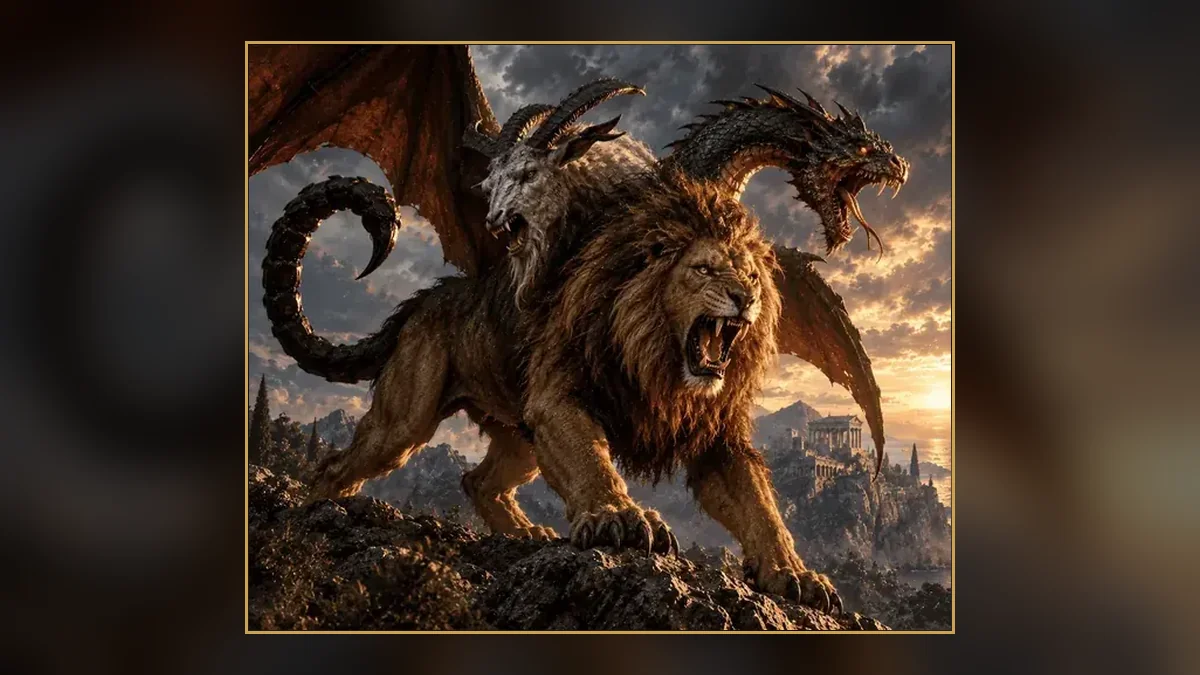
The description of the Chimera is one of the most stable pieces of text in Greek literature. Homer says a lion in front, a serpent behind, and a goat in the middle, breathing a terrible blazing fire. Hesiod repeats it in almost the same words. After that the formula never really changes. Poets passed it down the way craftsmen pass down a pattern, and every painter and sculptor after them kept the same three animals. It is worth asking why a monster so fixed in form is, in the stories, so oddly absent. For something so famous, the Chimera barely does anything. She waits to be killed, and the interesting part is who sent the man to do it.
Three animals, no category
Look at the components. A lion is a predator of the open ground. A goat is a domestic animal, the thing a shepherd looks after. A snake is a creature of holes and rocks, with a bite you do not see coming. That is more or less the full range of ways an animal could threaten a Greek farmer: it could hunt your flock, it could be your flock, or it could strike from the grass.
My own reading is that this is the point. The Chimera is what you get when you refuse to let an animal belong to a category. The Greeks sorted creatures carefully into wild and tame, beasts and cattle, things that walk and things that crawl. The Chimera is the sorting breaking down, a body that is predator and prey and poison all at once, with fire added as a final insult to the whole idea of a natural order. Nothing about her can be guarded against, because she has no single behaviour to plan around. Even the Greek word suggests it. A chimaira is simply a she-goat. The most dangerous monster in Lycia is named after the harmless animal in the middle of her body.
The burning mountain
There is a real place behind this. On the south-western coast of Turkey, in what was ancient Lycia, near the ruins of the city of Olympos, a hillside has been on fire since antiquity. Flames come out of vents in the rock all along the slope, burning day and night without fuel that anyone can see. Today it is called Yanartas, the burning stone, and visitors walk up at night to see the fires. Natural gas seeping from the rock is the modern explanation, and it ignites on contact with air.
The ancients noticed it too. The Roman writer Pliny describes a flame in Lycia that burns day and night, which water makes stronger and which can only be put out by earth or hay. The old name for the spot is Mount Chimaera. Later writers tried to explain the monster through the mountain. Servius, a commentator on Virgil, says that the summit was full of lions, the middle slopes were pastures for goats, and the foot of the mountain was infested with snakes, so the three parts of the beast were the three zones of a single hill. That sounds more like a tidy rationalisation than an ancient memory, but the real fire is in the ground and the real monster is attached to it. A body of fire in the earth got a body of animals to go with it.
A letter nobody wanted to deliver
The Chimera's first appearance in literature is in Book 6 of the Iliad, and she turns up inside a family history. The Trojan ally Glaucus is facing the Greek hero Diomedes on the battlefield, and before they fight, Diomedes asks who he is. Glaucus answers with a long genealogy, and at the heart of it is his grandfather Bellerophon.
Bellerophon, Glaucus says, was a man of great beauty and courage who served at the court of King Proetus in Argos. Proetus's wife Anteia fell in love with him, and when he refused her she told her husband that Bellerophon had tried to seduce her. Proetus believed her, but he could not bring himself to kill the young man, because the two men had shared his table and roof. So he did something cleverer. He sent Bellerophon to his own father-in-law in Lycia, King Iobates, carrying a folded tablet with deadly signs scratched on it. The man was carrying his own death warrant and did not know.
Iobates welcomed him and feasted him for nine days, sacrificing an ox each day. On the tenth, he asked to see what the visitor had brought. He read the tablet, and its instruction was to have the bearer killed. Like Proetus, Iobates could not murder a man he had just fed. So he gave him a task instead: go and kill the Chimera, a thing of divine descent, not human, which no one had ever managed to kill.
The polite way to kill a guest
This is the scene I think about every time the Chimera comes up. Hospitality, xenia, was one of the most sacred obligations in the Greek world. To kill a man at your table was an offence against Zeus himself. And yet two kings, in two cities, want the same man dead. What they do is pass him down a chain. Proetus will not do it, so he delegates to Iobates. Iobates will not do it, so he delegates to a monster.
The Chimera is a legal device. She is the third link in a chain of people each trying to keep their hands clean. An execution that no one performs, because the creature sent for the purpose is a natural disaster rather than an act of the king. It is the Greek version of an old trick: if you want someone killed and cannot be seen doing it, send them somewhere dangerous and let the danger do the work. The story is much more interesting if you do not see the Chimera as the villain. She was the loophole.
Who raised her
The Chimera also has something unexpected in the Iliad: a foster father. Later in the poem, a minor passage about the Trojan war mentions Amisodarus, a king of Lycia, who reared the Chimera, a bane to many men. So in Homer she is not a wild thing born in a cave. She was brought up, in a household, by a named ruler of the region. I find that striking, because it makes her a local institution, almost a piece of royal property, like a dangerous animal kept by a lord and unleashed when useful.
Hesiod gives her a family that is less human. She is part of the brood of Typhon and Echidna, and in the grammar of the poem she in turn becomes the mother, with the dog Orthrus, of the Sphinx and the Nemean Lion, though the pronouns are loose enough that readers have argued about it for centuries. Whichever way you read it, she sits in the middle of the monster family tree, with the Hydra and Cerberus as her siblings and the great plagues of Thebes and Nemea as her children.
Killed from above
How does Bellerophon win? Homer says only that he trusted the portents of the gods and killed her. Hesiod and Pindar fill in the rest. Bellerophon needed the winged horse Pegasus, and he could not catch him. Pindar says the seer Polyidus told him to sleep at the altar of Athena, and in the night he dreamed that the goddess handed him a golden bridle. When he woke, the bridle was in his hand. He took it to Pegasus, who let himself be bridled, and rider and horse flew up over the beast.
The battle was won from the air. The Chimera's fire could not reach him, and her teeth and horns were useless. This seems to me the real lesson of the story, the one that goes with the loophole. Some problems cannot be solved on the ground where they exist. Fighting her on her own terms would have been fatal. What he needed was a different vantage point, and he got it only after he had stopped relying on his own strength and slept in a temple to ask for help.
What happened to the man who beat her
The Iliad tells us Bellerophon went on to defeat other enemies. He fought the Solymi, a mountain people, then the Amazons, and finally an ambush of the best warriors of Lycia, whom he killed to the last man. Iobates, finally understanding that this was the child of a god, gave him his daughter and half his kingdom.
But then something goes wrong. Glaucus says in one flat sentence that later Bellerophon came to be hated by all the gods, and that he wandered alone across the Aleian plain, eating his own heart and avoiding the paths of men. Pindar supplies the reason: flushed with his success, Bellerophon tried to ride Pegasus up to Olympus, and the horse threw him. The man who killed the Chimera by flying too high ended by flying too high. His last years are the opposite of heroic.
The Chimera of Arezzo
The best surviving image of the monster is not Greek at all. In 1553, workers digging at Arezzo in Tuscany unearthed a bronze Chimera made by an Etruscan artist around 400 BCE. She has a lion's body, a goat's head growing from her spine, and a snake for a tail, and she stands braced, her ribs showing, her mane bristling, while blood runs from a wound in the goat's neck. An inscription on one foreleg appears to dedicate her to the Etruscan king of the gods. Whoever made her was not trying to show a victory. He made her in the instant before she lunges, injured and furious, and the viewer is left looking at her, not at the man who will kill her.
A word that kept growing
The Chimera has done well in modern language. We call any fanciful, unrealistic dream a chimera, and the adjective chimerical is still in use. In biology, a chimera is an organism that carries cells from two genetically different origins, sometimes because a twin was absorbed in the womb. The idea of a body made of incompatible parts, which the Greeks found frightening, turned out to be a fair description of something real inside us.
I think that is the Chimera's quiet success. She began as the sort of animal no category would hold, and ended up as the name we use whenever something refuses to fit its category. The fire in the hillside is still burning. The loophole she represented, the monster you can send a man to when you cannot kill him yourself, has not gone out of use either.
Comments
Sign in to join the conversation.