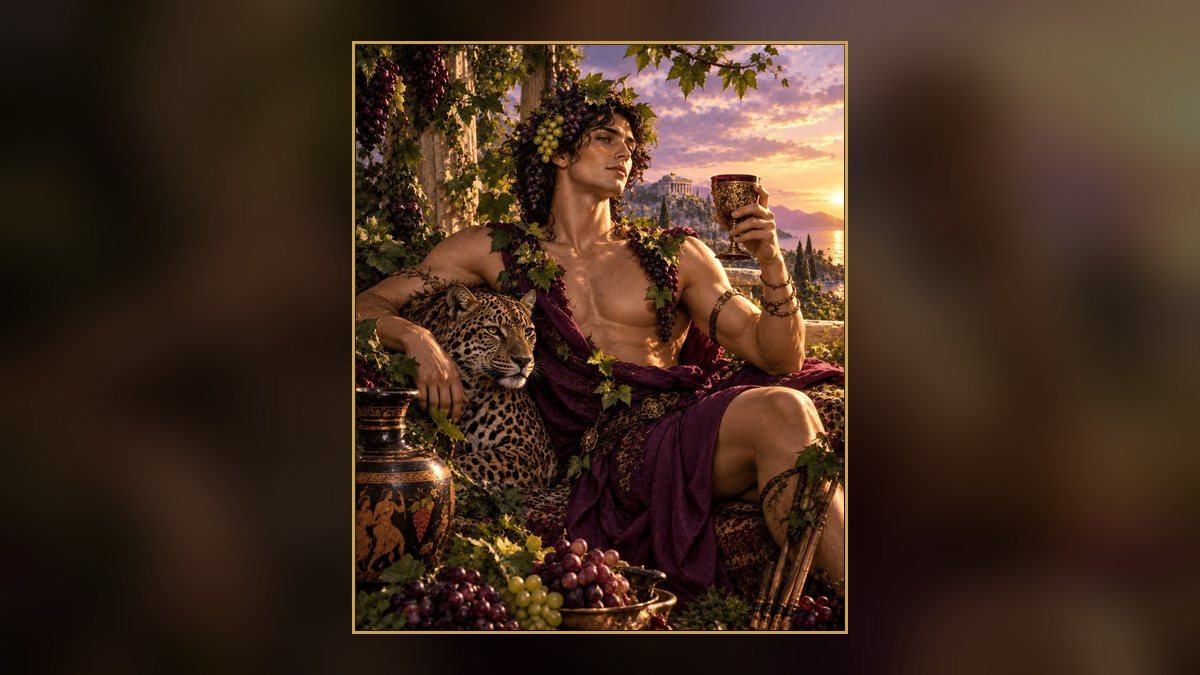
When Greeks said eleutheros, they meant free. A free man was not a slave, a free city was not ruled by a tyrant or a foreign power, and a free act was one that nobody had forced. It is a heavy word, and in the period when Athens was developing its democracy it became heavier still. So when a god was called Eleutherios, the liberator, there was a good chance the title meant more than it first sounded.
For Dionysus, it did. The name has two layers. One is geographical, a name for a place. The other is moral, a name for what he does. The Greeks were happy to leave the two tangled together, and the result is one of the more interesting titles in the whole system.
A village on the border
The place is Eleutherai, a small town on the road between Athens and Thebes, at the foot of Mount Cithaeron. It stood on the frontier between Attica and Boeotia, and its allegiance shifted over the centuries. It had a very old shrine of Dionysus, and the god worshipped there was known as Dionysus Eleuthereus, meaning of Eleutherai. That is probably the original sense of the title.
The Athenians borrowed the cult. Pausanias tells us that the wooden statue of Dionysus Eleuthereus in the Athenian theatre had been brought from Eleutherai, and that the Athenians had taken it as a trophy or as the result of a treaty. A scholar who annotated a comedy by Aristophanes preserves a more colourful tale. According to him, when the image was first carried to Athens, the Athenians rejected it, and the god responded with a disease that afflicted the men of the city. They changed their minds and gave him honours. Such stories were common in the Greek world, and they served to explain why a particular cult had been accepted.
Whatever really happened, the result is clear. By the sixth century BCE, Athens had the statue of Dionysus of Eleutherai and a precinct for him on the south slope of the Acropolis. Each year at the great spring festival, the City Dionysia, the image was taken out of the temple and carried in a procession to a spot outside the city, in memory of its original arrival, and then brought back again with torches and songs. It was a re-enactment of the god’s coming.
The birth of the theatre
That festival is the reason this epithet matters so much. The City Dionysia was the occasion for which the great Athenian tragedies and comedies were written. Over several days in March, thousands of people filled the theatre below the Acropolis, with the god’s statue watching from a seat of honour, and watched competitions between playwrights. The works of Aeschylus, Sophocles, Euripides and Aristophanes were all first performed there.
According to a tradition, the tyrant Pisistratus founded the festival or reorganised it in the sixth century BCE, and the poet Thespis won the first tragic contest, around 534 BCE. The tradition is shaky in its details, but the broad idea seems right. Theatre in Athens grew out of the worship of Dionysus, and it never lost its religious character. The performance began with a sacrifice and a procession, and the whole thing was understood as an offering to the god.
The title Eleutherios gives that fact a political twist. Athens in the later sixth and fifth centuries was the home of a young democracy, and the Athenians were intensely proud of being free. Putting the drama under the protection of the liberator suited the mood. Here, citizens could watch plays that questioned kings, gods and their own city, and a poet could make fun of the leaders of the state. The freedom of speech and the freedom of the stage went together.
The god who loosens
There is another side to the word. Dionysus had another title, Lysios, the loosener, the one who unties. It was often used of the god who frees a person from care, from fear, from the stiffness of ordinary life. Wine was part of it. A little wine relaxes the tongue, and a lot of it dissolves the usual order of things. In Dionysiac rites, the usual social lines blurred. The Bacchae shows chains falling from a prisoner and a palace shaken by an earthquake, as the god asserts his liberty. Some ancient writers say that slaves had a part in certain Dionysian festivals, and had a rare chance to drink and feast alongside their masters.
So liberation, for Dionysus, was both civic and private. It meant freedom from tyranny, and freedom from the weight of yourself. In some ways those are the same thing. A person who can stand in a crowd of strangers and laugh, or weep at a tragedy, is shedding something he was carrying.
A statue as a symbol
A curious afterlife of the idea occurs in Roman times. In many cities of the Roman world, a statue of Marsyas, the satyr who lost the music contest to Apollo, stood in the forum. An ancient commentator on Virgil says that this figure was a symbol of civic liberty. The link is Dionysian: the Romans identified Dionysus with their own Liber, whose name means free, and Marsyas belonged to the world of satyrs and wine around him. It is an odd and rather beautiful example of how a religious title could migrate into the language of politics and stay there.
What the name asks us to remember
When you see the word Eleutherios attached to the wine god, it is worth asking what kind of freedom is meant. It is not the neat freedom of a law court. It is the looser, more dangerous kind, the freedom of the theatre and the festival and the crowd.
The Greeks seem to have understood that a society needs both. A city needs rules, and it needs occasions when the rules relax, when everyone shouts together and watches strangers pretend to be kings. The god who presided over those occasions was given the name of liberty, and the building where they happened, a half-circle of stone seats cut into the side of a hill, is still there. If you sit in it, you are sitting in the god’s own house.