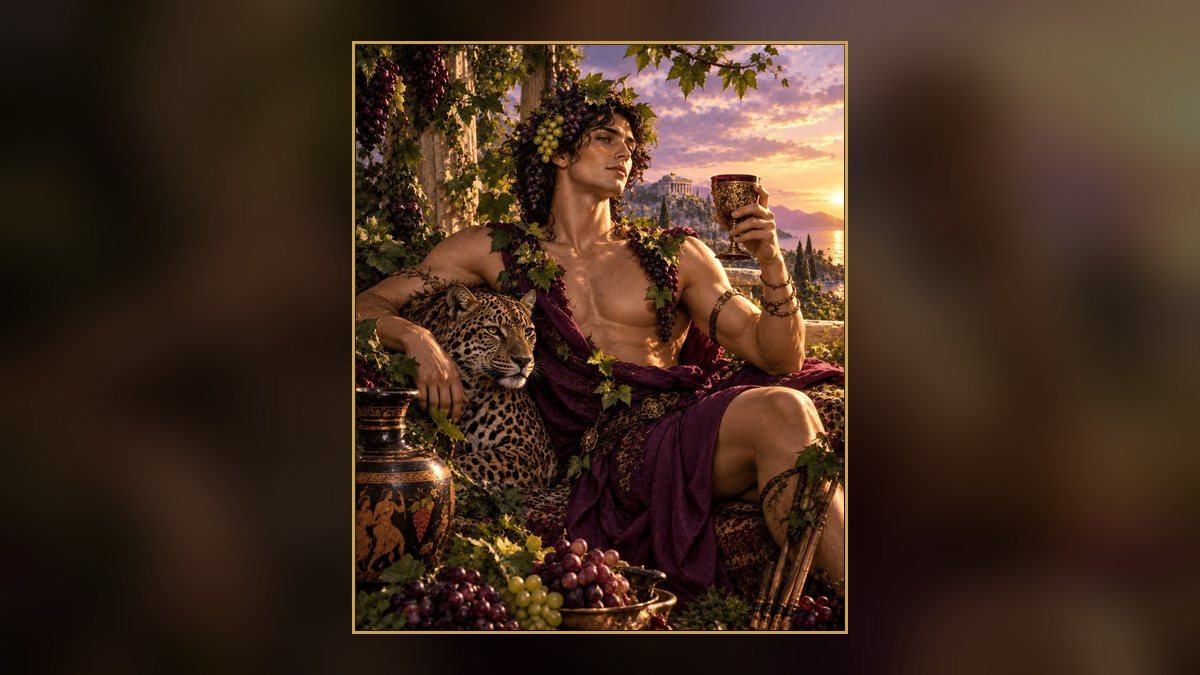
Most of the time we think of Dionysus as the god of wine, and so he was. But the Greeks had other ways of speaking about him, and one of the oldest and strangest is Bromios. The word comes from bromos, which means a roar, a crash, a loud and rumbling noise. It is used of thunder, of a fire that crackles through a forest, of a bull bellowing, of the sound a great crowd makes. To call Dionysus Bromios is to describe him by his noise, and to say that where he is, the air is not quiet.
The title is common in tragedy, above all in the Bacchae of Euripides, the play that tells how Dionysus came to Thebes. In that play he is called by it again and again, as if the poet could not stop. It names the god as the audience would have known him from the rituals, with drums and flutes, women running across a mountain in animal skins, and a cry that went up into the night.
A birth in thunder
The reason for the name lies in the story of his birth. The god’s mother was a mortal woman, a princess of Thebes named Semele. His father was Zeus. Hera, as usual, was furious, and she tricked Semele into asking her lover to show himself in his true form. Zeus had promised to give her anything she wanted. He tried to refuse, but the oath was binding, and he came to her as the god of thunder, surrounded by lightning.
It was too much for a mortal. Semele was destroyed in a blaze, and the baby she was carrying was saved by Zeus, who took it from the flames and sewed it into his own thigh until it was ready to be born. This is why Dionysus is called the twice-born. His first birth was in fire, and his second was from the body of his father.
So the god comes into the world through thunder, and the word bromios catches that. In the opening of the Bacchae, Dionysus arrives at Thebes and stands before the ruin of his mother’s house. The place is still smoking, the poet says, a flame that Zeus’s lightning left, and a vine has grown over it. A flash of divine power and a plant that makes wine, both in one place. It is a haunting image, and it gives the epithet a double sense: the sound of the thunder, and the sound of the revel.
The noise of the rite
The title fits the god’s worship almost literally. Dionysiac ritual was loud. The worshippers, who were mostly women, called maenads, which means raving ones, gathered at night in the hills. They carried torches and the thyrsus, a staff wrapped in ivy and tipped with a pine cone. They played hand drums, shook rattles, clashed cymbals, and blew a reed pipe with a sharp, nasal sound. They sang and shouted. Some described a kind of possession in which the individual seemed to lose herself in the crowd.
The Greeks had a number of cries that were thought to belong to the god, and one of them was the shout of an ecstatic crowd. The bull was one of his sacred animals, and the bellowing of a bull was one way the god was imagined to make himself known. There was also an instrument called the bullroarer, a flat piece of wood on a string that you whirled over your head to make a deep, throbbing growl, and it was used in several mystery cults. Whatever it was that people felt in those hills, it was strongly connected with sound.
What happens to those who refuse
In Euripides’s play, the noise is ominous. Dionysus has returned to Thebes to prove his divinity to the family that denied it. The women of the city leave their homes and run wild on Mount Cithaeron, and the young king, Pentheus, tries to stop them. He is stubborn and rational, and he does not believe the stranger who has arrived is a god. He tries to imprison him, and the chains fall away.
In the end the god leads the king up the mountain, dressed as a woman, so that he can spy on the revels. The maenads see him, mistake him for a wild animal, and tear him apart. The first to strike is his own mother, Agave, who thinks that her son is a lion. She carries his head back to the city, in triumph, and only slowly realises what she holds.
It is one of the cruellest scenes in Greek tragedy. And the noise is its means. The cries of the women, the shouts, the music carry the madness. The god does not argue. He simply makes a noise louder than reason, and reason is overwhelmed.
Other punishments, other voices
The same pattern turns up elsewhere. In the Iliad, a Thracian king named Lycurgus chases the nurses of Dionysus across a mountain with an ox-goad, and the god plunges into the sea, where a sea goddess takes him in. Zeus blinds the king, and he does not live long. In a Homeric Hymn, a ship of pirates kidnaps the god, thinking he is a rich young man. Vines grow over the mast, wine runs on the deck, a lion appears where the god was sitting, and the terrified sailors leap overboard and become dolphins.
These are stories about people who fail to recognise something. It is the same lesson in each: Dionysus can be gentle, and can be a joke, and can seem to be a beautiful boy. But he is also a roar, and a power that does not let itself be ignored.
The shout in the hills
Looking back, Bromios is a surprisingly honest title. Other gods are described by their position or their powers. This one is described by the sound he makes, and the sound is untidy. You can almost hear it: a drum, a cry, a rumble, a bull in the dark, thunder beyond the ridge.
That is perhaps the most important point. For the Greeks, religion was not always orderly. There were moments when a community let go of its rules, gave itself up to something it could not control, and came out the other side renewed. The Dionysian cult was one of those. The title Bromios is its shorthand. It says: this is the god of the noise, and when he comes, you will hear him before you see him.