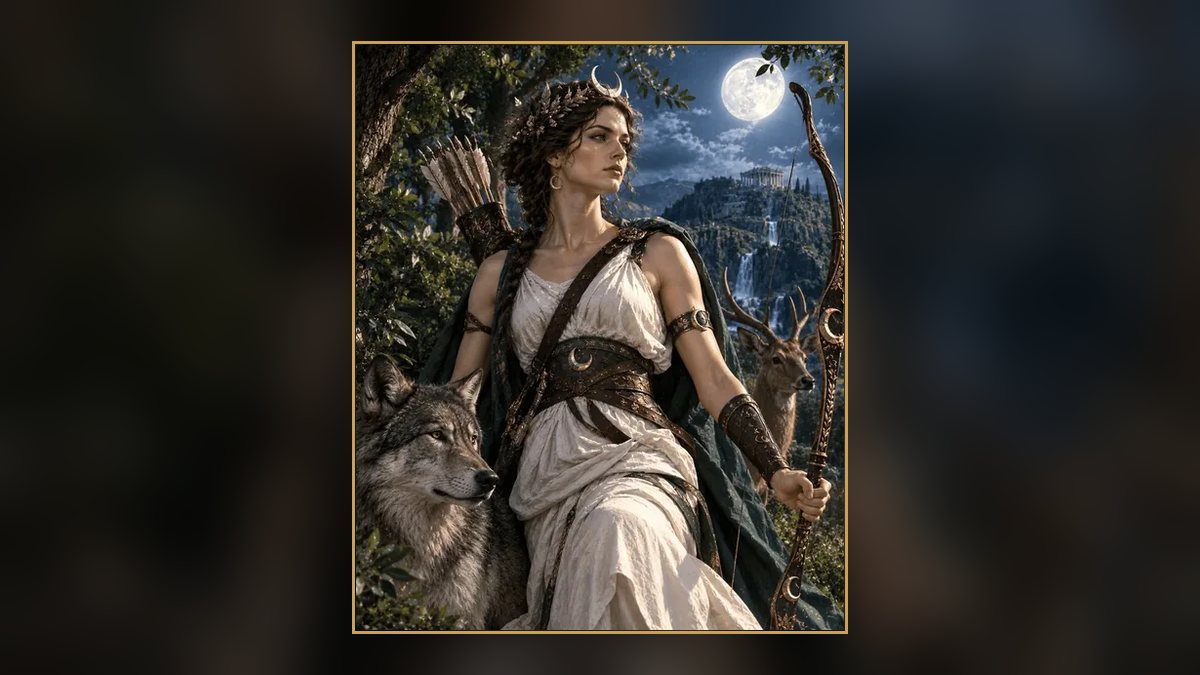
Greek has a word, agros, that means a field, but not a tidy one. It is the open country beyond the farm wall, where nobody owns the grass and nobody is in charge of what comes out of the trees. Agrotera is the feminine form of an adjective built on that word, and it means something like she of the wild places, or the goddess who lives out in the fields. When the Greeks used it for Artemis they were not praising her for being pretty. They were naming her territory.
That territory is easy to underestimate. We tend to picture the huntress as a slim figure with a bow, running through a wood with a deer at her side, and we file her under nature. The Greeks saw something harder. The country outside the city was where animals could kill you, where bandits lurked, where a girl could go missing on her way to a spring. It was also where you got meat, timber and honey, and where young men proved themselves. Artemis stood at the line between the safe and the unsafe, and Agrotera is the title of the goddess who looks after that line.
The vow at Marathon
The best-known story attached to the name comes from Athens, and it is a war story. In the autumn of 490 BCE a Persian army landed on the plain of Marathon, and the Athenians marched out to meet it, badly outnumbered. According to the tradition that Xenophon and later writers repeat, the commanders made a vow to Artemis Agrotera before the fighting began. They promised to sacrifice to her one goat for every enemy soldier they killed.
The Athenians won, and they won far more completely than anyone expected. The trouble was that there were thousands of dead Persians and nowhere near enough goats in Attica to pay the bill. The city worked out a compromise, which was to sacrifice five hundred goats every year on the anniversary of the battle. Writers centuries later were still saying that the offering was being made, and one of them admits, a little drily, that the debt was being paid in installments.
It is a charming story, and it is also a revealing one. Why would a city about to fight a land battle make its vow to the goddess of hunting and not to the goddess of war? The answer seems to be that Athenians divided the job. Athena was for strategy and the defence of the city. Ares was for slaughter as such, and was not much loved. Artemis, with her arrows, belonged to the open ground where an army actually met its enemy, and she was the goddess one asked to let the arrows fly true.
A temple by the river
Athens kept a sanctuary of Artemis Agrotera in the district of Agrai, on the bank of the Ilissos, just outside the old city. This is where the annual sacrifice was offered, and where a magistrate called the polemarch, whose title means war-leader, made the offering himself. He sacrificed there to Artemis Agrotera and to Enyalios, a war god of the older Greek stock, on the same day. The two were evidently seen as partners. One covered the ground, and the other covered the fight.
The district around the sanctuary was a busy religious quarter. Agrai was also where the Lesser Mysteries, a spring festival connected with Demeter and her daughter, were held, so the same stretch of riverbank saw a procession for the grain goddess and a bloody sacrifice for the huntress. For the Athenians there was no contradiction in that. Both were about the land outside the walls, and about what it gave and what it cost.
The goddess who asked for everything
If you want to understand why she was so firmly rooted in the countryside, read the hymn the poet Callimachus wrote to her in the third century BCE. He imagines Artemis at the age of three, sitting on her father’s knee and asking for presents. She asks for eternal maidenhood, for a bow and arrows made for her, and for many names so that her brother will not outdo her. She asks for a tunic that stops at the knee so she can run, for sixty ocean nymphs as dancing companions, and for every mountain in the world. She says she is not much interested in cities and will visit them only when women in labour call for her.
That hymn is a late and charming piece of writing, but it reflects something older. Artemis did not govern the city. She governed everything beyond its walls, and she crossed into it only at certain moments of danger: childbirth, a girl’s passage to womanhood, a battle. Agrotera marks the first part of that picture, the open country as such.
The cost of forgetting her
A common pattern in myths about her is a mortal who offends the wilderness and is punished by it. A king in Calydon once held a harvest festival for the gods and left Artemis out of the sacrifice. She sent a gigantic boar to wreck his orchards, and the heroes of the age had to be called together to kill it. A hunter named Actaeon stumbled on her bathing in a spring and was changed into a stag, then torn apart by his own dogs. A princess named Callisto, one of her companions, was pursued by Zeus and ended up as a bear.
These are not stories about a vengeful woman. They are stories about a place that has rules. The wild country can be used, and it can be admired, but it is not yours. When a person acts as though it is, it answers back, and it does so through its own creatures. Read in that light, the title Agrotera is a kind of warning label.
Why the name still works
Over the centuries Artemis picked up a long list of titles. She was the goddess of childbirth, of the moon, of the girls of Brauron who played at being bears for a year, of the sailors who prayed for a fair wind at Aulis. Agrotera is the one that holds the others together, because all of them have the same root. They are all places where human order stops and something older begins.
If you are reading the epithets as a way to understand the gods, this is a good one to start with. It teaches the method. A title is not an ornament. It tells you where in the world to stand when you speak to the god, and what kind of favour it is reasonable to ask. When you hear Agrotera, you are in a field, at the edge, and you should think carefully about what you take home.