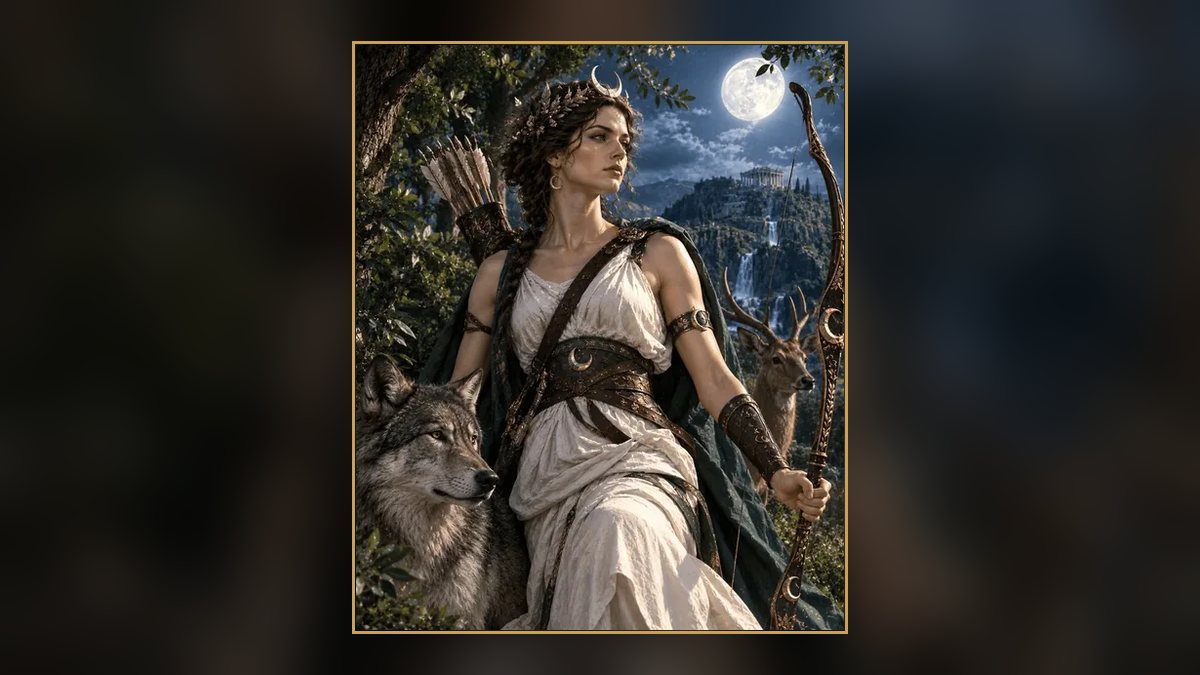
Most of Artemis’s titles say what she does. Cynthia says where she comes from. It is built on the name of Mount Cynthus, a low, rocky hill in the middle of the island of Delos, and when a poet used the word he was asking you to picture a particular place: a barren little island in the Aegean, a palm tree, a round lake, and a woman in labour.
Delos is tiny. You can walk across it in an afternoon, and it has hardly any fresh water or good soil. And yet it was, in the Greek imagination, one of the holiest places on earth, and the reason was that it was the birthplace of Apollo and Artemis. Cynthia and its male twin, Cynthius, are the names that tie them to that one patch of rock.
A mother with nowhere to go
The story is best told in the Homeric Hymn to Apollo, a long poem from perhaps the seventh century BCE. Leto, a gentle Titaness, was pregnant by Zeus, and Hera, furious, had forbidden every place on earth to take her in. Leto wandered from island to island and from city to city, begging for a spot to give birth. They were all afraid. Each one imagined that a new god, especially one with a fearsome reputation, would look down on a poor place and wreck it.
She came at last to Delos and made an offer. If the island would let her give birth there, she promised, Apollo would build a magnificent temple on it, and people would bring so many gifts that the island would grow rich. Delos was frightened too, but this was a promise that mattered to a place with no resources at all. She agreed, and Leto swore an oath on the river Styx to keep the bargain.
Even then the birth was hard. Hera, still angry, kept the goddess of childbirth, Eileithyia, away on Olympus. Leto laboured for nine days. In the end the other goddesses sent Iris, the rainbow messenger, to fetch Eileithyia, with a necklace as a bribe. The moment Eileithyia stepped onto the island, the baby was born. The hymn says that the earth laughed, and that the island was covered in gold.
One twin or two
There are different versions of who was born first, and the difference matters. In some tellings Artemis arrives first, on the island of Ortygia, which is a name for Delos or for a place near it. She then turns around and helps deliver her brother. This is the reason, some writers said, that she became the goddess who helps women in labour. She had seen what it was like, and she had been the midwife on the very first day of her life.
It is a lovely idea, and it makes the title Cynthia richer. A poet who called her by that name was not just saying she was born on Delos. He was reminding the listener that she is the one who knows what birth costs, and that the same goddess who kills with arrows also eases pain.
An island that would not stay put
Delos has its own mythology. One tradition said that before the twins were born it was a floating island that drifted at the mercy of the sea, and that it was fixed in place on the day they arrived. In the earliest versions it is a girl named Asteria, a sister of Leto, who threw herself into the sea to escape Zeus and became the island. The later poet Pindar describes it as a thing that was shifting and unmoored until Zeus put its roots down with pillars.
That detail made Delos a natural symbol of shelter. A wandering place that comes to rest, a hunted mother who finds a bed. It is not surprising that the Greeks treated the island as inviolable. At various times the Athenians purified it by digging up old graves and moving the bodies to a neighbouring island, and they forbade anyone to be born or to die on Delos. Women about to give birth were taken across the water to the next island so that the sacred ground would not be stained.
A name for poets
Cynthia became a favourite of the Roman poets, who loved Greek titles and used them as a kind of code. The elegist Propertius, in the first century BCE, called his beloved Cynthia, and everyone understood that he was giving her the name of a goddess, and a slightly forbidding one at that. Virgil uses the title for Apollo’s sister in passing. Ovid scatters it through his poems. It was a handy word for a moon-lit, cool, distant woman, and it flattered a mortal to be given it.
That tells us something about how the epithet worked. Cynthia had gone from a place-name to a mood. You used it when you wanted the goddess, but not the hunting, and when the quiet, silvery side of her mattered more than the arrows.
What the name does
This is why Cynthia is not interchangeable with Agrotera, even though they belong to the same goddess. One names her territory. The other names her origin. When someone calls her Agrotera, you are in the field. When someone calls her Cynthia, you are on the island, looking at a small rock that nobody wanted, where a goddess was born anyway. The two names are like a map and a baby photograph of the same person.
If you ever visit Delos, you can climb Mount Cynthus in about twenty minutes. From the top you see the whole island and the other Cyclades around it, spread out like stepping stones. It is not a grand view. But you understand, standing there, why a name like this carried weight. It points to a place that is small, ordinary and utterly necessary, and the Greeks believed that was exactly the kind of place where something divine would choose to begin.