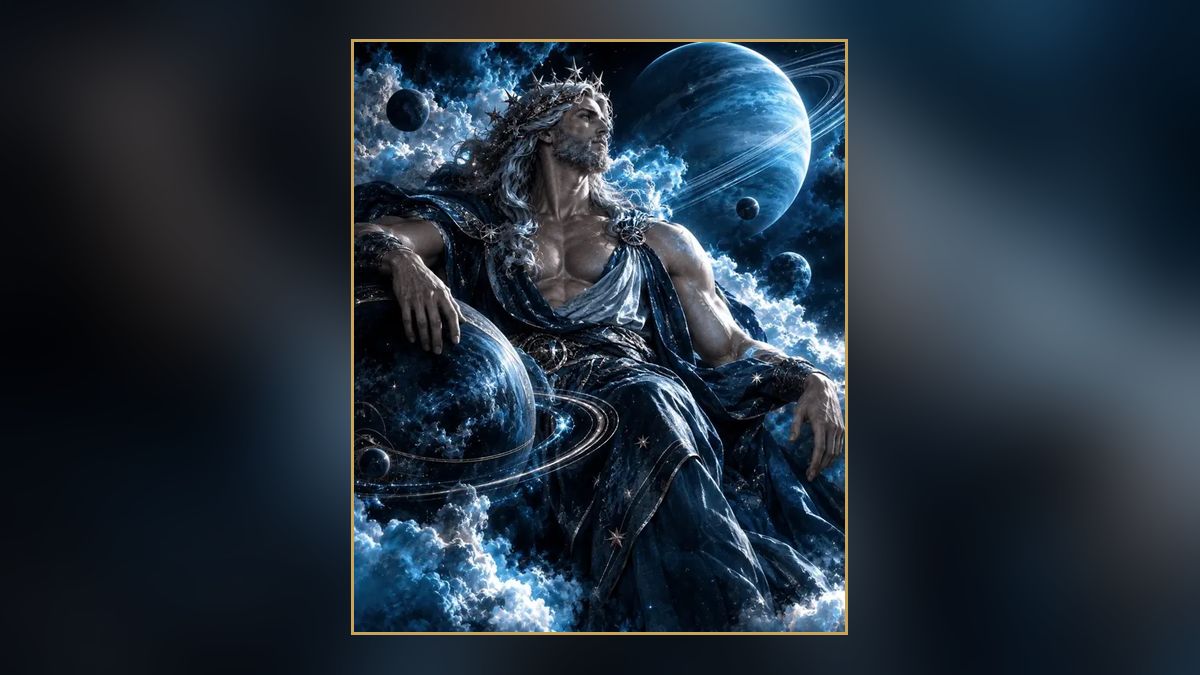
Uranus is the god nobody prays to. He has almost no temples, almost no festivals, and almost no scenes where he does anything except hide his children and get ambushed. The sky itself was a very Greek obsession, but the god who personifies it hardly seems to be worshipped. When I first noticed that, I thought it was a gap. Now I think it is the point. Uranus is not a god you meet. He is a starting condition. He is the place where a pattern begins, a father's fear of his sons, and the whole of Greek divine politics is the long story of that fear being passed down, nearly broken, and finally redirected. If you want to understand why Zeus behaves the way he does, you have to start with the first king, who behaved even worse.
The first couple
Hesiod's Theogony gives the order. At the start there is Chaos, then Gaia, the Earth, broad-breasted and safe forever, and then Tartarus and Eros. Gaia, without any partner, bears Uranus, the starry Sky, to be her equal, so that he could cover her all around and be a safe home for the blessed gods forever.
Read that last phrase. The Sky was made to cover the Earth. That is a very physical image, and it is meant literally. Uranus is the dome that sits over everything, the roof of the world, and in the earliest picture the two are always in contact, the sky lying on the earth like a lid on a pot. They are lovers, and they never separate.
And that is the problem. Gaia and Uranus have children, and the children have nowhere to go. There is no space between the sky and the ground. The first generation of the world is born into a gap that does not exist.
The children he hid
Hesiod lists the offspring. First come the twelve Titans, six sons and six daughters, among them Oceanus, Coeus, Hyperion, Cronus, Rhea, Themis. Then the three Cyclopes, one-eyed makers of lightning, named Brontes, Steropes and Arges. Then the three Hundred-Handers, Cottus, Briareos and Gyges, enormous beings with a hundred arms each and fifty heads.
Uranus hated his children from the moment they were born, the monstrous ones most of all. As each child came out of Gaia's womb, Hesiod says, Uranus pushed it back, hiding it in a hollow of the earth and not letting it see the light. He enjoyed the wickedness of it. Gaia, stuffed with children she could not release, groaned inside, and she began to look for a way out.
I find this one of the most unnerving images in early Greek poetry. It is not a war. It is not a fight over power. It is a father who cannot bear the sight of his own children, and a mother who has no room to give birth. And the reason is a kind of fear, which Hesiod does not explain at first but which will become clear by the end.
The sickle
Gaia creates a weapon. She makes a great sickle of grey adamant, a metal that cannot be broken, and she asks her sons to use it against their father. All of them are afraid except one, Cronus, the youngest and most cunning. He agrees.
The ambush is set. Night comes, and Uranus arrives to lie on Gaia as he does every evening. Cronus, hidden, reaches out with his left hand, takes hold of his father, and with the sickle in his right hand cuts off his genitals and flings them behind him into the sea.
What happens next is some of the strangest creation poetry in the Theogony. The drops of blood that fell on the earth gave birth to the Erinyes, the Furies, the goddesses who punish crimes against family. They also gave birth to the Giants, and to the ash-tree nymphs. The severed flesh, carried over the sea, produced a white foam, and from that foam grew a girl, who came ashore on Cyprus. That was Aphrodite.
So the same act of violence produces both the Furies, who punish bad sons, and the goddess of love. I find it hard not to see a message in that. Desire and revenge come from the same cut.
The name he gave them
There is a tiny, haunting detail at the end of this story. Before he leaves, the mutilated Uranus calls his sons the Titans. Hesiod gives an explanation for the name that he offers as if it were obvious, though no one is sure he was right. The word seems to come from a verb meaning to strain or to stretch. Uranus, according to the poem, called them that because they strained, overreaching in a great crime, and he said that vengeance would follow later.
Whatever the true origin of the word, the line matters. The very name of the Titans, the whole second generation of gods, is a curse. It is the father's last word, spoken in pain. The people who will rule the world for a generation are named by the person they ruined, with a promise that they will pay.
And they do. Cronus, having overthrown his father, immediately begins to fear that the same will be done to him. His parents tell him it will, that he is destined to be overcome by one of his own sons. His solution is to swallow his children, which brings us to the main structural point.
The pattern
Look at the sequence. Uranus fears his children and hides them. Cronus overthrows Uranus. Cronus, fearing his own children, swallows them. Zeus, the youngest, is rescued by his mother and overthrows Cronus. And then Zeus, as we learn, is warned that his first wife, Metis, will bear a child stronger than he is. So he swallows her.
That is the same move a third time. Uranus hides his children in the earth. Cronus swallows them into his belly. Zeus swallows the mother of the child who might beat him. Every generation of rulers tries to solve the same problem of an heir who might take over, and every generation goes a step further in how completely it tries to remove the threat.
This is my theory, and it is not original to say the pattern exists. What I want to emphasise is that the pattern begins with Uranus, and that the Greeks clearly understood it as a pattern. The Theogony is not a list of gods. It is a story about how a family learns, with great difficulty, not to be afraid of its own children.
And the way it finally gets broken is the best part. Zeus, unlike the others, shares. He divides power among his brothers and sisters, giving each a realm, and he gives honours to the gods who fought for him. He is the first ruler who treats the people around him as partners. The cycle ends not when someone is destroyed but when the king learns to give things away.
A god with no worshippers
Now back to the puzzle I started with. Why did the Greeks barely worship Uranus? The sky was everywhere. They looked at it every day, they prayed to Zeus as the god of weather, they built temples to Helios, the sun. But the personified Sky, the god of the old story, had hardly any cult.
I think the reason is that the Greeks were telling a story about origins, not describing a present deity. Uranus belongs to the earliest chapter of the world, the way a founder belongs to a family history. You do not pray to the person who started the quarrel. You tell the story of what he did. He is in the poem, in the genealogies, in the names of things, and the Greeks seem to have been content to leave him there.
One thing does survive. Pausanias mentions shrines to Aphrodite Urania, Aphrodite of the Sky, in Athens and elsewhere, and he says the worship of the heavenly Aphrodite was first established by the Assyrians. Whatever the truth of that, her name carries the memory. The goddess born from his severed parts is the one who is remembered, and she bears his name as an epithet.
An older story still
There is one more thing worth knowing, and it changes how I read the whole myth. The story of a sky god mutilated by his own son is not purely Greek. In the twentieth century, scholars studying clay tablets from the Hittite kingdom in Anatolia found a text that came to be called the Kingship in Heaven, which tells a closely similar story. In it, a god named Anu, whose name means sky, is overthrown by his cupbearer Kumarbi, who bites off Anu's genitals and swallows them. The swallowed seed then makes Kumarbi pregnant with a succession of strange children, including a storm god who will eventually overthrow him.
The parallel is hard to miss: a sky god, a castration, a swallowing, a storm god who wins in the end. Hesiod, writing around 700 BCE, seems to be drawing on a tradition that reached Greece from the east, in a form the Greeks reshaped for themselves. I find that exciting. The oldest story in the Theogony is not a purely native invention. It travelled.
That does not make it any less Greek. What the Greeks did with the story is their own. They took a tale of sky gods and storm gods and turned it into a long meditation on family, fear and the passing down of power.
What I take from him
So here is the view from where I stand. Uranus is not a villain in the way Zeus can be. He is a first draft. He is a god who lacks the imagination to see his children as anything other than a threat, and who is punished for it by the one who happens to be brave enough. Everything bad that happens in the next two generations is a consequence of that first failure.
The Greeks gave the sky a personality, and the personality was fear. That is a strikingly honest thing to have said about the roof of the world. Whenever you look up, the oldest story says, you are looking at the first father who could not bear to let his children into the light.
Comments
Sign in to join the conversation.