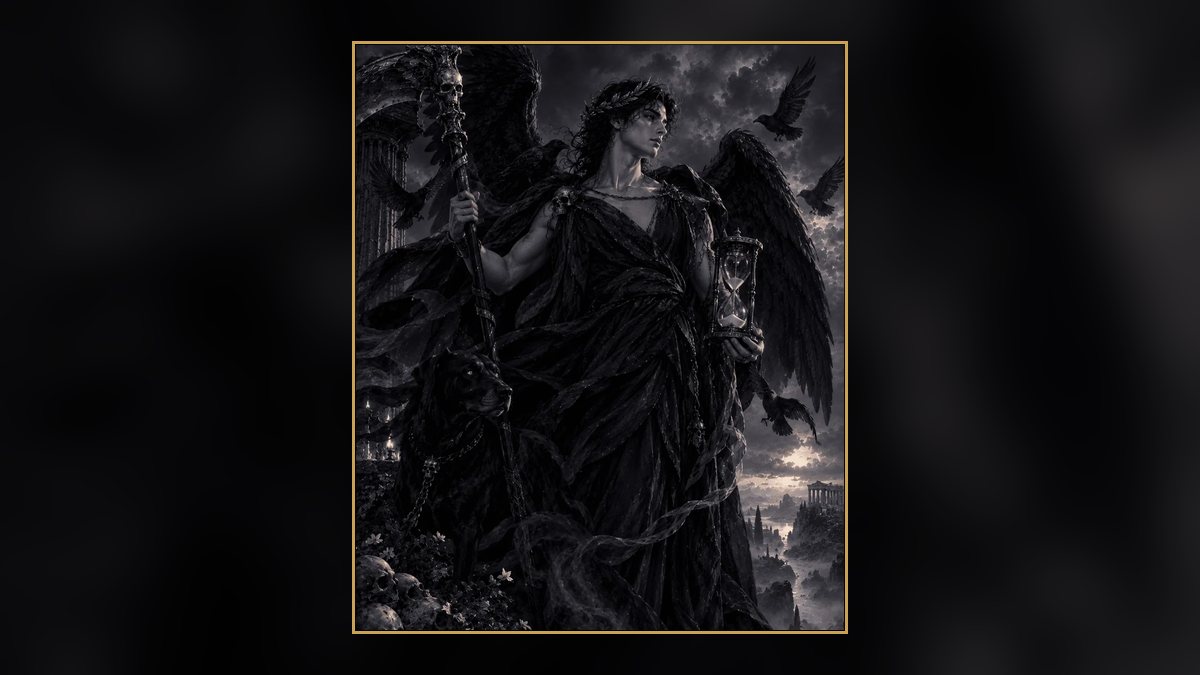
Greek religion ran on exchange. You give a god a sacrifice, a bit of wine, a statue, and in return you hope for something. Nearly every deity could be flattered, appeased or bargained with. The exception is Thanatos. An old line of Aeschylus, which survives only as a fragment, says that Death alone among the gods does not love gifts, and that neither sacrifice nor libation will work on him, and that he has no altar or paean. I think that is the most important fact about him. He is the one god you cannot negotiate with, and so, interestingly, the Greeks spent a great deal of imagination trying to negotiate with him anyway.
The iron heart
Hesiod places him with his twin Hypnos in the house of Night, and sets out their difference clearly. Sleep is gentle and calm, but Death has a heart of iron and a spirit of bronze that never relents. He seizes whoever he catches, and even the immortals hate him.
That last phrase is the thing I keep coming back to. The gods hate Death. It's not just a human complaint. The Olympians, who are supposedly beyond his reach, still find him repellent. They can't die, but they can feel the shadow of him, and every time they have to deal with him, they do it badly.
The wrestling match
Euripides gives us the best scene. In the play Alcestis, King Admetus has been told by Apollo that he can escape his death if someone else dies in his place. His wife Alcestis volunteers. Thanatos appears at the palace carrying a sword with which to cut a lock of the victim's hair, a gesture that dedicates her to the gods below. Apollo, who once tricked the Fates for Admetus's sake, tries to talk him out of it. Thanatos refuses, calmly and without anger. He is only doing what he is for, and he wants the honour that's due.
Then Heracles shows up as a guest, discovers what has happened, and decides to repay his host's hospitality. He goes to Alcestis's tomb, waits for Thanatos to arrive to drink the blood of the offerings, springs out of ambush, grabs him in a wrestling hold and doesn't let go until Death gives her back.
It's one of the most astonishing moments in Greek drama, and also one of the least solemn. The bravest hero in the world physically beats up death, in a graveyard, as an act of politeness. And the play doesn't treat it as a victory over the inevitable. Alcestis comes back, but she can't speak for three days, as if she hasn't fully returned. Euripides seems to know that there's something unreal about getting away with it.
The man who chained him
The other story is Sisyphus, the cleverest man in Greece. When Thanatos came for him, Sisyphus asked to see how the chains worked, and then used them to bind Death himself. And with Thanatos locked away, nobody could die. People were chopped to bits and still lived. The old stayed alive. Offerings stopped, because there were no more funerals to pay for.
The gods, particularly Hades, were furious. In some versions, it was Ares who finally freed Thanatos, because he was sick of seeing his battles lose all their point. Think about the joke: the god of war is bored because nobody he fights can die. It's a lovely demonstration that violence only means something if death stands behind it.
Sisyphus's reward was, as everyone knows, the boulder. But I love what the story admits. A world without death isn't a happy one. It's a broken one, and even the god of war wants it fixed.
Death in departments
Here's where I propose my own idea. The Greeks never gave Death a single face. They divided the work. Thanatos takes you, and that's the quiet moment of death itself. Hermes, as the guide of souls, leads you from the place of death to the gate of the underworld. Charon rows you over the river. Hades, the king, keeps you there. Cerberus makes sure you don't leave. Beside them are the Keres, the spirits of violent death on the battlefield, who are much more frightening, and the Fates, who decide how long you get.
This looks to me like the Greeks dealing with their fear by cutting it up. Death is too big to think about as one thing. But if you break it into stages, each with its own character, you can handle them one at a time. There's a gentle one who takes you, a friendly one who walks you down, a boatman who wants his coin and a king who is, in some stories, just and fair. By the time you reach the end, the thing you've been afraid of has turned into an administration.
Thanatos is also the most abstract of the lot. The Keres have teeth. The Fates have spinning thread. He is just a winged figure with a sword and a calm face. In vase paintings, he and Hypnos appear as young men, bearded or not, carrying a body out of battle, with an air of dignity. The person who is dead is looked after.
The Spartan shrines
For all his unpopularity, he wasn't always ignored. Plutarch, in his life of the Spartan king Cleomenes, says that the Spartans built shrines to Fear, to Death and to Laughter. Plutarch's own explanation is mostly about Fear: the Spartans treated it as something that held a state together, since citizens who dreaded disgrace more than danger could be trusted. Death and Laughter sit in the same list, and I take that as a sign that they were treated as forces to be kept on good terms with, not shut out.
I find it a beautiful and disturbing detail. A people who made war their whole way of life honoured Death not as something to avoid but as something to be on good terms with. They couldn't bribe him, and so they got to know him. It's the opposite of the Sisyphus approach.
Why no one prayed to him
I come back to the line from Aeschylus. The Greeks prayed to Hades, to Persephone, to Hermes as the guide of the dead, even to the Furies. But Thanatos, the actual act of dying, has almost no cult. And that makes sense. You pray to gods for things. You can ask Hades to be kind to a dead relative. But you can't ask Thanatos for anything, because he has already made his decision by the time you are in front of him.
That's why he comes across as the most honest god in the Greek world. He doesn't bargain, doesn't flatter, doesn't take offence, and doesn't hurry. He appears on time with his sword, and he does his job. Everyone else in Greek myth lies, tricks, or negotiates, and the only truly consistent character is the one at the end.