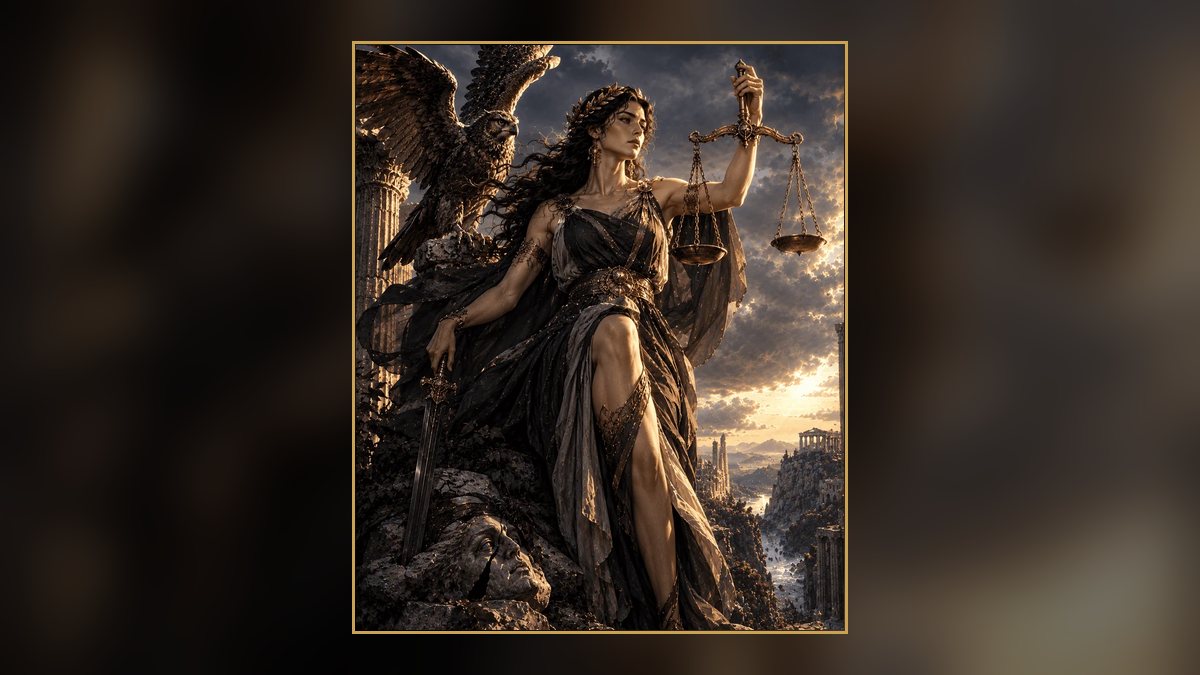
Nemesis has been flattened into a word for an enemy, as in "my nemesis," and that has done her a disservice. The older Greeks used the word for something else, a particular feeling, close to indignation, that you get when someone seems to have more luck, more praise or more happiness than they should. Nemesis, as a goddess, is that feeling turned into a power. Once you see it that way, she becomes far more interesting than a simple avenger, and far more familiar.
A child of Night
Hesiod places her among the children of Night, along with Doom, Death, Sleep, the Dreams, the Fates, Deceit and Old Age. Her entry describes her as a woe to mortals. It's a dark family. But look at what she's grouped with. Most of her siblings are things that happen to people whether they like it or not. Nemesis is the only one of that set that is about other people's opinion. She is a judgement, not an event.
That sets up my main idea. The Greeks thought of the world as having a kind of balance, with each person assigned a measure of good fortune. When someone goes beyond that measure, you feel it. A pang of disapproval runs through the crowd. They sense that the person is getting more than they ought to have. Nemesis is the name for that pang, and for the force that tends to correct it.
The luck that gets noticed
Herodotus gives her one of the best illustrations. When Croesus, the fabulously rich king of Lydia, is told by Solon that no man can be called happy until he is dead, he doesn't believe it. Then, Herodotus says, a great nemesis from heaven fell on him, evidently because he thought himself the most blessed of men. His son died in a hunting accident soon afterwards.
Notice what the offence is. Croesus hasn't committed a crime. He hasn't harmed anyone. His error is feeling too sure of himself. The universe, as the Greeks imagined it, doesn't like to be taken for granted. And Herodotus returns to this pattern again and again. Whenever someone becomes too powerful or too confident, something happens to bring them down.
The word the Greeks used for the offence was hubris, and the word for the reaction was nemesis. Hubris is the person overstepping. Nemesis is the weight that pushes back. They are two halves of a single pattern, and each makes sense only because of the other.
Rhamnous and the stolen marble
Her most important sanctuary was at Rhamnous, in the north-east of Attica, a quiet, rocky site above the sea. The statue there has a wonderful story. Pausanias says that when the Persians landed at Marathon, they were so certain of victory that they brought a block of Parian marble with them to make a monument. They lost, and the Athenians took the marble and had it carved into a statue of Nemesis. Pausanias attributes the work to Pheidias, though other writers say it was his pupil Agoracritus.
I find that story irresistible. The Persian monument to their own victory became a monument to the force that punishes overconfidence. Whether it's true or not, it was told by people who understood her, and it fits the picture perfectly. A general who orders a victory statue in advance is exactly the sort of person Nemesis exists to correct.
Her image carried an apple branch and a bowl decorated with Ethiopians, according to Pausanias, and she was often shown with a wheel. Later art gave her scales as well. These are all tools of measurement. She isn't brutal. She is meticulous.
Narcissus
The other story that everyone knows is that of Narcissus. In one version, a beautiful boy rejects everyone who loves him, including Echo, and one of the rejected suitors prays that he might love and not be loved in return. Nemesis hears the prayer. She leads him to a pool of clear water, where he sees his own reflection and falls in love with it, and he wastes away.
The punishment fits the crime so perfectly that it looks like a joke. But it is also a nice example of what she does. Narcissus gets exactly the amount of attention that he gave out, and nothing more. His unfairness is returned to him in kind, and with interest. That's how Nemesis works, more like an accountant than a murderer.
The mother of Helen
One of the weirdest stories connects her to the Trojan War. In a lost epic called the Cypria, Zeus chases Nemesis across the earth and sea. She keeps changing shape to escape him, becoming a fish, a beast, and finally a goose. He turns into a gander and catches her. She lays an egg, which is found by Leda, who raises the child inside it. That child is Helen.
The Greeks, who liked their symbolism, took this seriously. The most beautiful woman in the world, the cause of the greatest war in Greek legend, was the daughter of Nemesis. Helen's beauty, in other words, was the thing that provoked divine disapproval on a massive scale. A woman too lovely to live safely, and a city that had too much, and a war that brought both down. It has the shape of a lesson, and I don't think the poets missed it.
Why she's a social goddess
This is where I get to my own theory. Most of the Greek gods we remember are tied to places, crafts or cosmic powers. Nemesis is different. She exists only where there are people watching one another. A lone person on a desert island has no use for her. She is a social force, and the Greeks, who lived in tight communities where everyone knew everyone else's business, were very good at feeling her.
If you had won a lot, you would be worried about her. You would give thank offerings, make modest speeches, and avoid bragging. People who failed to do so were called arrogant, and they usually came to a bad end, which made everyone feel the system worked. It's not a strange idea. In a small town, we still say someone is getting too big for their boots.
So I'd propose we stop calling Nemesis the goddess of revenge. Revenge needs a victim and a wrong. She needs only an imbalance. She is the goddess of the moment when you realise that you've had a little too much, and the community, or the universe, begins to even things out. It's less dramatic than vengeance and more accurate.