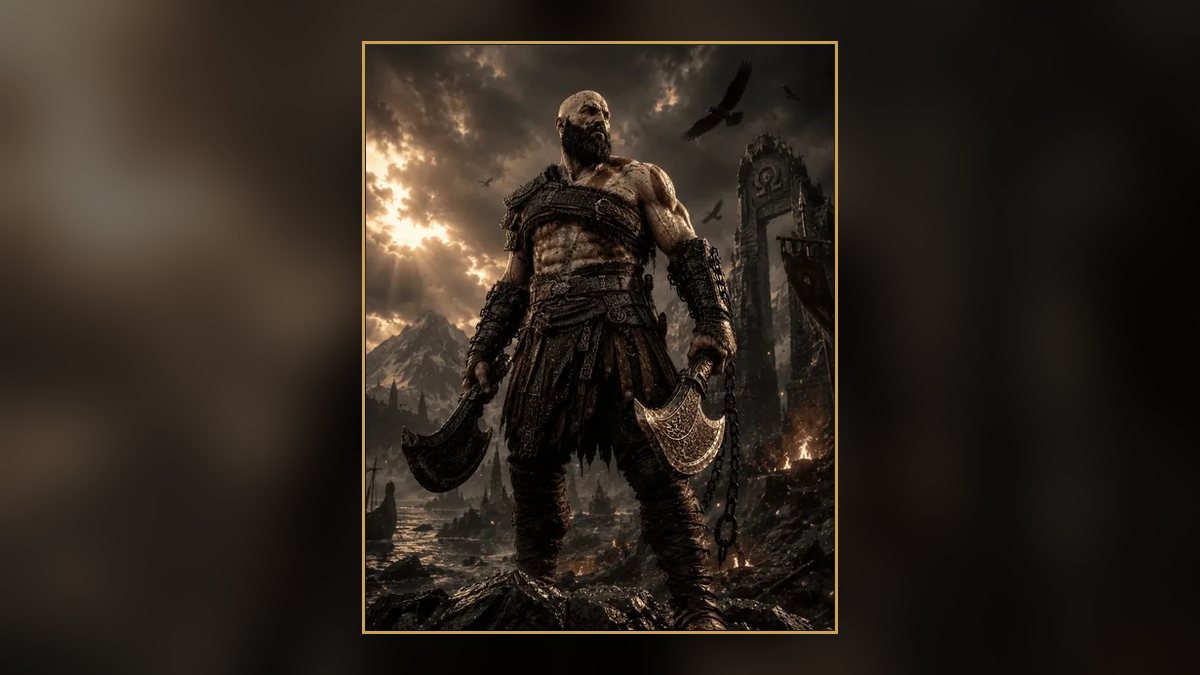
If you know the name Kratos, there is a good chance you know it from a video game: a pale, furious Spartan with a chain-bladed weapon and an enormous amount of unresolved anger. That character is a modern invention, and a good one, but he borrowed his name from somewhere older and stranger. The original Kratos is a minor figure in Greek myth, a winged attendant of Zeus who appears in one great scene and has hardly any biography at all. He does not have a famous family quarrel or a love story or a monster to defeat. What he has is a job. He makes sure that what Zeus wants gets done, and he does not discuss it. I think that is more unsettling than any amount of rage, and in this article I want to look at what the Greeks were doing when they gave that job a name and a face.
A word that will not sit still
Kratos is a Greek noun meaning strength, power, authority, mastery. It is not quite the same as raw muscle, which is closer to the word bia, force. Kratos is the thing that lets you hold what you have taken. It is the power to rule, to win, to be obeyed. You can see it all over the language we still use. Democracy is demos plus kratos, the power of the people. Aristocracy is the power of the best. An autocrat has power over himself, which is to say, over everything. And in modern Greek, kratos is simply the word for the state. When a Greek person today talks about the government's authority, they are using the name of this old attendant of Zeus.
The Iliad uses the word constantly in a very particular sense. Victory in battle is something that Zeus gives, and the gift is called kratos. When the poet says that the father of gods and men lifted up the strength of the Trojans, or gave the upper hand to the Greeks, the word is this one. So the early Greeks already thought of power as something that flows down from the top, a measured quantity that the king of the gods can hand to one side or the other. In that sense, Kratos stands very close to Zeus. He is not a separate force. He is the part of Zeus that makes things stick.
Four children and one house
Hesiod gives him a family. In the Theogony, Kratos is one of the four children of the Titan Pallas and Styx, the river of the underworld whose name the gods swear by. His siblings are Zelos, rivalry or zeal, Nike, victory, and Bia, force. When Zeus called the gods to Olympus before the war against the Titans, Styx was the first to arrive, and she brought her children. Zeus honoured her, made her river the greatest oath, and kept the four of them at his side for good.
Hesiod's description of that arrangement is one of my favourite lines in the poem. He says these children have no home apart from Zeus and no road except the one the god leads them on. They always sit near him. Think about how unusual that is for a Greek divinity. Almost every god had a shrine somewhere, a city that claimed them, a mountain, a spring. Kratos and his siblings have none of that. Their address is the throne room. If Nike's story shows what victory looks like from the outside, Kratos's tells you what it looks like when you live in the house of the one who gives it out.
The cliff at the end of the world
His single great scene comes at the very beginning of Prometheus Bound, a tragedy attributed to Aeschylus. The play opens in a barren wasteland at the edge of the earth, in Scythia, where the sea meets nothing. Two silent figures haul a prisoner onto the stage. The prisoner is Prometheus, the Titan who stole fire for humanity. His captors are Kratos and Bia, and with them is Hephaestus, who carries the hammer and the chains.
Kratos speaks first, and the very first thing he says is that they have reached the farthest plain of the world, a desert with no human foot on it. Then he gives an order to Hephaestus. Take the rebel, nail him to the high rock with unbreakable fetters. He stole your own gift, the radiance of fire, and handed it to mortals. For that crime he must pay the gods a penalty, so that he will learn to put up with Zeus's rule and give up his habit of loving humankind.
The phrase that strikes me is the one at the end: give up his love of humankind. Kratos does not say Prometheus is dangerous, or that he broke a law, although he did. He says he must be taught to stop caring about the wrong people. This is power at its most naked. It does not argue that the punishment is fair. It just assigns it.
The argument that never happens
What happens next is the center of the scene. Hephaestus hesitates. He is a craftsman god, a creator, and Prometheus is his kinsman, a relative and a friend. He tells Kratos that he does not have the heart to bind a god who is family. And Kratos does not debate him. He asks why he is wasting time in useless pity, and whether he does not hate the god who is most hated by Zeus.
Hephaestus answers with something I find genuinely moving. He says that kinship and shared life have a terrible force. Kratos replies that he agrees, but that it is not possible to disobey the father's orders. Do you not fear that more? Hephaestus, stung, says that Kratos is always merciless and always full of arrogance. Kratos shrugs the insult off. Pity will not help him, he says, so do not waste the effort.
Then comes the line that I think defines the character. Kratos says that every job is a burden, except to rule the gods, because no one is free except Zeus. It is a stunning thing to say. He is explaining the whole structure of the universe in a single sentence: everybody else is working for somebody, and the one at the top is the only one with no master. Hephaestus has no reply. He knows it is true.
A little earlier in the scene, Hephaestus had already given us the other side of the same idea, in a line that has become proverbial. Everyone is harsh, he says, who has newly come to power. That sentence is Aeschylus's quiet comment on the whole play. The regime of Zeus is young, built on a victory over the Titans only a few generations back, and young regimes do not trust anyone. Kratos is what that distrust looks like when you give it a body.
Silent Bia
One more detail deserves attention. In the play, the character of Bia is on stage, but she does not say a word. Aeschylus gave her a mute part. The siblings are Power and Force, and only one of them speaks. I take that as a deliberate choice. Force does not need to talk. Power, on the other hand, needs to justify itself at least a little, because its authority depends on being recognised. It is Kratos who delivers the speeches, the taunts, the orders, and the one grim joke.
And he does have a joke. When the chains are on, Kratos turns to Prometheus and tells him to play the arrogant now. Steal the honours of the gods and give them to creatures of a day. Can mortals take any of this suffering off you? The gods, he says, gave you the wrong name. They call you Prometheus, Forethought, but you need forethought yourself to get out of this contrivance. It is a vicious pun, delivered in the voice of a bureaucrat who has been waiting years for a chance to be witty.
A god without a shrine
If you try to find where the Greeks worshipped Kratos, you will mostly come up empty. As far as I know, there is no major cult of him. Pausanias, the travel writer, mentions an enclosure on the high rock of Corinth dedicated to Necessity and Force, which people were not allowed to enter, but that is Bia, not Kratos, and it is a place of fear rather than devotion. The Greeks did not pray to power. They tried to stay on the right side of it.
That is a very Greek attitude, and I think it explains why the figure is so thin as a character. You do not build a personality for something you hope never to meet. You give it a face, a pair of wings and a place at the throne, and you keep your distance.
The other Kratos
I should say a word to anyone who arrived from the game. The Kratos of God of War, first appearing on the PlayStation 2 in 2005, is a Spartan warrior who kills his way up to godhood, and then, in the later games, becomes a father in a cold northern landscape. He is complex, haunted, and given to terse, painful speeches. The Greek Kratos is none of these things. He has no past, no grief and no conscience. If anything, the game's hero is the answer to the question the ancient figure raises: what would it be like to be power, and to feel it? The designers took a quality with no inner life and gave it a very loud one. It is a clever inversion, and it works because the original left so much room.
Why his stats look the way they do
Look at Kratos's card in this game and you will see the shape immediately. Might and wrath sit at the ceiling, endurance is very high, and favour and cunning are low. He is built to hit hard and take blows. He is not built to persuade. That seems exactly right to me. In Aeschylus he never wins an argument because he never has to make one. He only has to be the last voice in the room.
And that is the thing to remember about him. Kratos is not evil. He is not even cruel in the way a villain is cruel, with pleasure. He is what authority sounds like when it stops needing to explain itself. The scene at the cliff has lasted more than two thousand years because we have all met him: the voice that says it is not my decision, that tells you to hurry up before the boss sees, and that treats pity as a waste of effort. The Greeks gave that voice wings and a throne. I would say they were being generous.
Comments
Sign in to join the conversation.