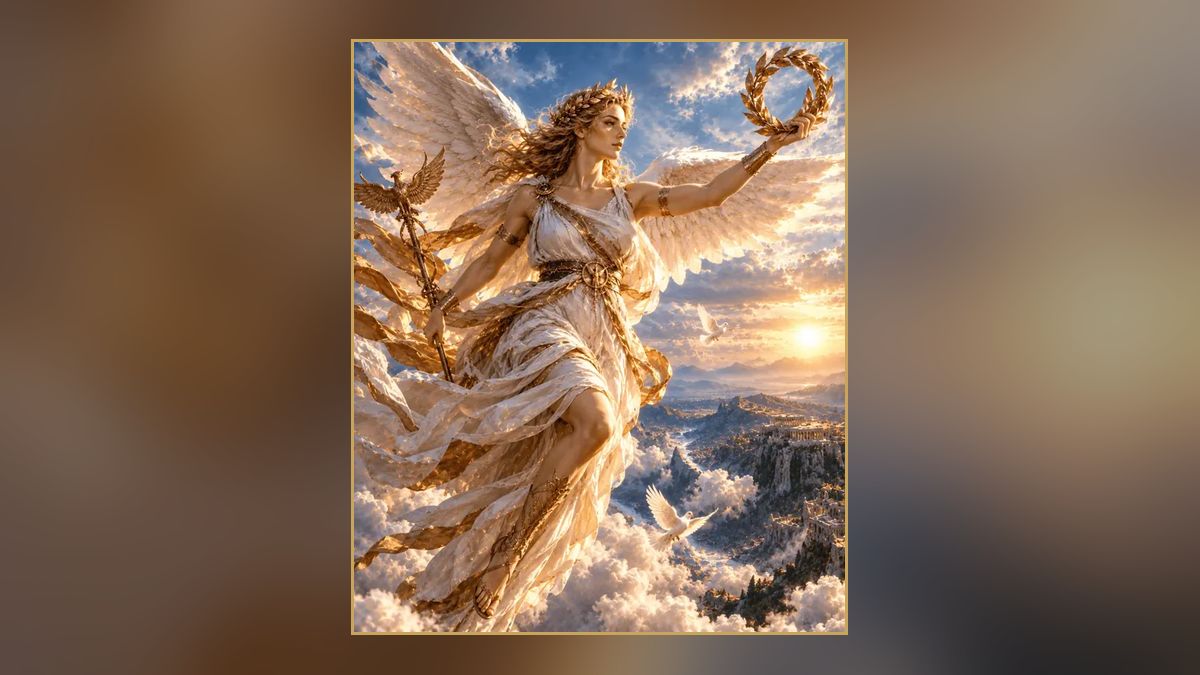
Nike is the goddess of victory, and every modern person knows her face, even if only from a sportswear logo. The Greeks knew her as a winged woman who flies over battlefields and stadiums, placing wreaths on the winners. It sounds simple. A goddess for winning. But when I started reading how the Greeks actually treated her, I found a strange tension. They wanted her badly, and they were afraid she would leave. They carved her without wings, so she could not escape. And then, in their battlefield monuments, they did the opposite and built her memorials out of wood so they would rot. My argument is that Nike shows how the Greeks felt about winning: it was the best thing in the world, and it was meant to be temporary.
Where victory comes from
Start with her family tree, because I think it holds the key. In Hesiod's Theogony, Nike is the daughter of Pallas, a Titan, and Styx, the river of oaths. She has three siblings: Zelos, whose name means rivalry or zeal, Kratos, power, and Bia, force. Hesiod says that these four have no house apart from Zeus, and no path other than the one Zeus leads them on. They live with him always, sitting beside his throne.
How did they get that place? Hesiod tells the story in a short and rather beautiful passage. When Zeus called all the gods to Olympus before the war against the Titans, promising honours to anyone who fought on his side, Styx was the first to arrive. She brought her children with her. Zeus welcomed her, gave her great gifts, and made her river the sacred object by which the gods swear their strongest oaths. He kept her children with him permanently.
Think about what that says about victory. It does not come from the strongest. It comes from loyalty and timing. Styx got there first and picked the right side. Her children, among them Victory, were the reward. In the Greek view, winning is attached to a decision: backing the right person before anyone else does.
The family also tells you what a victory is made of. Zelos, rivalry, is the drive to compete. Kratos is the strength to do it. Bia is the force that makes it happen. And Nike is what you get when those three work together. She is not an ingredient. She is the result.
The goddess who is held out
The most striking visual detail is how Nike appears in the biggest cult statues in Greece. Pausanias describes the two greatest statues made by the sculptor Pheidias in the fifth century BCE. The gold and ivory Zeus at Olympia held in his right hand a small statue of Nike. The enormous Athena Parthenos, in the Parthenon at Athens, did the same. Each of the two mightiest gods in the Greek world held a tiny Victory in the palm of one hand.
That is a remarkably telling image. The god does not wear victory. He holds it, out in front, like something that has been won and might be given. It is the power to hand victory to someone else. A visitor looking at the statue would see exactly where winning comes from, and that it is in someone's gift.
Nike herself is almost always shown moving: a young woman with large wings, running or flying, with a wreath or a palm branch or a libation vessel in her hands. She crowned the victors at the Olympic Games, and the great poet Pindar wrote songs for such victors, in which the whole glory of the win is something the gods bestow on a favourite.
The wingless one
Here is the detail that started my interest. On the Acropolis in Athens, on a high bastion beside the entrance, stands a small, elegant temple to Athena Nike, built in the 420s BCE, during the Peloponnesian War. Inside it, according to Pausanias, was a statue of Victory with no wings. The Athenians called her Nike Apteros, the Wingless Victory.
Later writers had an explanation. The wings were omitted, they said, so that Victory could never fly away from Athens. Pausanias tells a similar story about the Spartans, who had a statue of Enyalios, a war god, bound in chains, so he would never leave the city. A winged goddess flies off, and a wingless one stays.
I do not know whether that explanation is the original reason. It could be a later guess to explain an odd statue, and some scholars think the temple's Nike was simply a form of Athena. But I find the idea beautiful and very human. A city, in the middle of a long and dangerous war, builds a shrine and carves its goddess without the one thing that would let her escape. It is a wish made in stone: let this one stay.
The trophy that was meant to fall apart
And then there is the opposite instinct, which is just as Greek. After a battle, the winning side set up a monument called a tropaion. The word comes from the Greek for a turning, because it was placed on the spot where the enemy turned and fled. In its original form it was a simple thing: a tree trunk or a post, hung with the captured armour of the losers, a helmet, a breastplate, shields, with a dedication to the gods.
The remarkable part is that the Greeks usually made them from wood, and deliberately did not repair them. The writer Plutarch explains why. He says that it was thought improper to build lasting stone memorials to victories won over fellow Greeks. A permanent monument, in effect, kept the hatred alive. A wooden trophy would rot and fall in a few years, and with it the enmity. Writers such as Plutarch and Diodorus report that permanent stone trophies were frowned on, as if the builder were refusing to let go of a grudge.
So here are two instincts in the same culture. At Athens, they carve Victory without wings so she will never leave. On the battlefield, they build her monument from something that decays. The same people who wished victory could be preserved forever also believed, at the deepest level, that it should be allowed to fade.
I do not think that is a contradiction. I think it is a very precise understanding of what winning is. A victory is a moment, a turning point, and it is dangerous to freeze. The Greeks knew that the winners of one war are the losers of the next, and that pride in a conquest can turn into the cause of a new fight. Their art wanted Nike close. Their practice insisted that she not be pinned down.
The Victory of Samothrace
The most famous Nike of all, and the one most people can picture, is the statue found on the island of Samothrace and now in the Louvre. It is a headless, armless marble woman, in a billowing, wind-swept dress, standing on the prow of a ship, with the huge wings of the goddess spread behind her. It was probably made around 200 to 190 BCE, perhaps to celebrate a naval victory, and it was set above a pool of water as if the ship were sailing toward the viewer.
What strikes me is how well it expresses the same idea in a different way. The goddess has just landed, and the wind is still pressing her dress against her body. She is arriving, not staying. The whole statue is a moment of contact, and you can feel that she is about to go.
And the missing head and arms, I think, make it even more powerful. We do not see what she carried, a wreath or a trumpet. We only see the instant. If the Greeks ever made a perfect image of the idea that victory is brief, this is it.
What I take from her
So here is where I come out. Nike is the goddess who tells you that victory is real and also that it will not last. She comes from loyalty, not from power. She is held in the hand of Zeus, not worn by him. She is carved without wings by a city that wanted her to stay, and commemorated in wood by soldiers who knew she would not.
The people who invented the Olympic Games and wrote odes to their winners were not naive about winning. They loved it, and they were wary of it. They gave it a goddess with wings, and then they argued among themselves about whether to clip them.
I think that is an unusually mature piece of thinking for something that now appears on trainers. The next time you see the swoosh, it is worth remembering that it comes from a goddess whose own city carved her so she could not leave, and whose own soldiers expected her to rot.
Comments
Sign in to join the conversation.