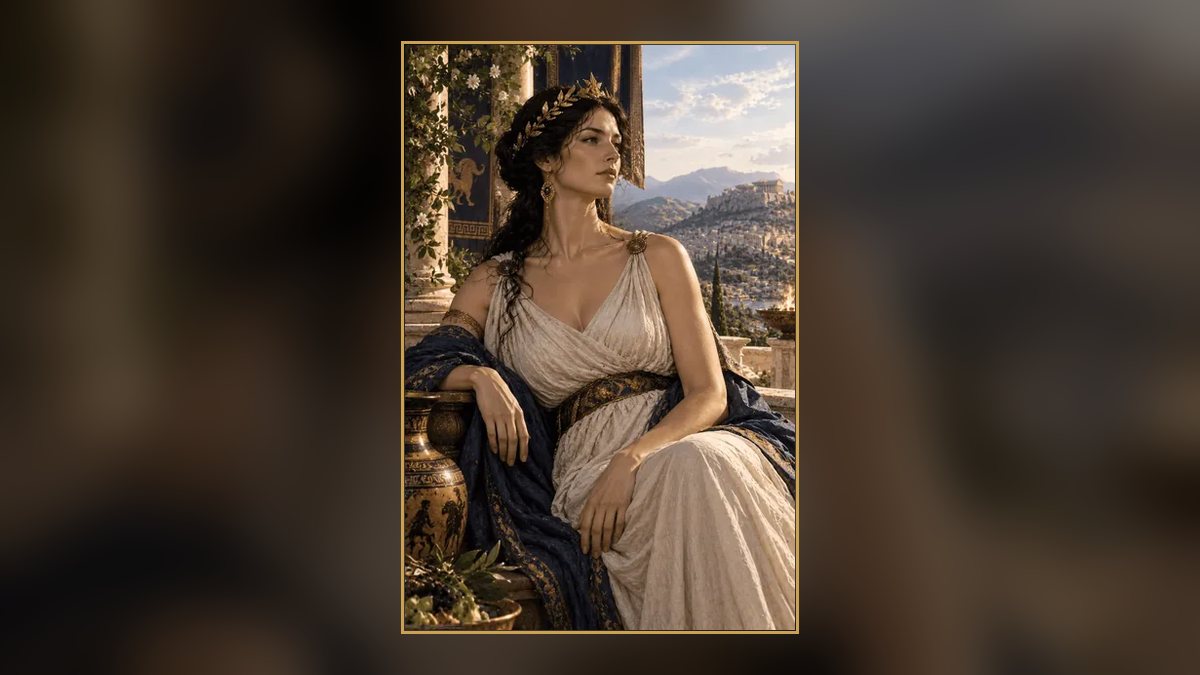
Heracles has twelve labours, a lion skin, a club and a death so dramatic it has its own plays. His mother has a long night. That is how most people remember Alcmene, if they remember her at all: the woman Zeus visited disguised as her husband. It is a strange way to be remembered, because it reduces her to the moment when something was done to her. The more I read about her, the less that seems like the centre of the story. Alcmene is deceived, endangered, left to give birth under attack from a goddess, and then spends the rest of her life defending the people she loves. Her myth runs from the bedroom to the battlefield, and I think it makes her one of the toughest mortal women in Greek tradition, which is saying something.
A house of heroes and exiles
Alcmene came from the best family in the Peloponnese, which in myth means she came from a family with a lot of bodies in its past. Her grandfather was Perseus, the Gorgon-slayer. Her father, Electryon, was king of Mycenae. Her husband, Amphitryon, was her cousin, a grandson of Perseus through another line. So she is one of those characters who carries a famous hero's blood and has to live with the expectations it creates.
The trouble started with cattle. Raiders from the island of Taphos, a people called the Teleboans, stole Electryon's herds and killed most of his sons. Electryon swore that whoever recovered the cattle and avenged his sons would marry his daughter. Amphitryon got the cattle back, but in a clumsy accident on the way home, a club he threw at one of the animals bounced off its horns and killed Electryon. A man who has killed his future father-in-law is not a wedding prospect.
Creon of Thebes took the couple in and purified Amphitryon of the death. But Alcmene, who had just lost her father and her brothers, set a condition before she would marry him. He had to take revenge on the Teleboans first. It is a revealing detail. Alcmene is not simply a bride to be won. She has her own demand, and it is about justice for her family. Amphitryon agreed, gathered an army and went to war.
The night that lasted three
While Amphitryon was away at the war, Zeus saw his chance. The god took on his appearance, walked into the house and told Alcmene that the war was over and the brothers avenged. She believed him, because why would anyone not believe her own husband returning from battle? Zeus made the night last as long as three nights, so that the child he planned to conceive would be strong enough for the job ahead.
That detail, the stretched night, comes from Apollodorus and later writers. The much older Hesiod poem called The Shield of Heracles opens with the same event, but with less fuss: Zeus left Olympus, went to Thebes in the dark and slept with her, and later that same night Amphitryon returned home, having finished his work against the Teleboans. Think about what that means. One woman, one night, two men with the same face. She conceived twins, Heracles by the god and Iphicles by the mortal. Twins with one divine father and one mortal father is a pattern Greek myth also gives to Leda's sons, Polydeuces and Castor, and the poets seem to enjoy the idea a little.
The question I always come back to is what Alcmene knew. In most versions, nothing. She is sincerely deceived. That makes her different from many of Zeus's women in the stories, because she was not seeking him and could not have refused him. The Greek sense of the situation is subtle. Her virtue is explicitly preserved: she is described as one of the most faithful and admirable women of her age, and the poet of the Odyssey puts her in the underworld among famous heroines. Zeus is the one who has done something wrong, or at least something that needs explaining.
The comedy that asks what the husband felt
Centuries later, the Roman playwright Plautus turned the whole thing into a farce called Amphitruo. In his version, Jupiter takes Amphitryon's shape while the god Mercury plays the role of the servant, standing at the door to keep the real husband out. When the real Amphitryon finally returns, he finds a double in his own house, his wife insisting that he was already there, and a servant who denies knowing him. It is a masterpiece of mistaken identity, and the play has been adapted more times than I can count, including by Moliere and Kleist.
I mention it because the play is curiously kind to Alcmene. She is shown as bewildered and hurt, loyal to a husband who now accuses her of lying. The comedy gets its energy from her honesty, set against everyone else's confusion. In the final scene Jupiter appears in the thunder, explains the whole thing, and promises her a glorious son. She is cleared, and in a flourish that only a comic poet would think of, she gives birth quickly and without pain.
Hera takes the labour
That painless birth is Plautus's invention. In the older tradition, the delivery was a nightmare, and it was Hera's doing. Homer tells it in the nineteenth book of the Iliad. Zeus, delighted with himself, announces to the gods that on that day a child of his blood would be born who would rule all those around him. Hera, who has no intention of letting the son of a rival win, asks him to swear it solemnly. He does. Then she goes down from Olympus and arranges for another child, Eurystheus, grandson of Perseus, to be born prematurely at seven months, and delays the birth of Alcmene's baby. Eurystheus becomes the ruler. Heracles will serve him.
This is the origin of the Twelve Labours, and I think it is worth saying how rarely that is mentioned. The reason Heracles spends his best years doing impossible tasks for a mediocre king is that his mother's labour was held up for a few days. The whole mythic career of the greatest hero in Greece depends on an obstructed childbirth.
Later writers added a famous detail. Ovid tells that Eileithyia, the goddess of childbirth, sat outside Alcmene's room with her legs crossed and her fingers locked together, which blocked the delivery magically. Alcmene screamed for seven days. Finally a servant named Galanthis, a clever woman, rushed out and announced that the baby had arrived. Eileithyia leapt up in shock, the spell broke, and the child was born. In revenge, the goddess turned Galanthis into a weasel. I find it very telling that the Greeks and Romans imagined a labour as a battlefield where women fought with whatever they had.
Two babies and two snakes
The twins grew up in Amphitryon's house at Thebes. Hera was not finished. One night, when the boys were about eight months old, she sent two serpents into the nursery. Iphicles screamed. Heracles grabbed one in each hand and strangled them. When Alcmene and Amphitryon ran in with their lamps, they found the baby playing with the corpses.
Amphitryon, shaken, consulted the blind seer Tiresias, who explained that the boy would be a hero and that Hera's hatred would follow him all his life. It is the first time Alcmene is told the truth about what her son would face. She keeps going anyway. She raised him, along with the child who was fully mortal, with the same care, and when Heracles grew up she is said to have had him taught by the best teachers in Greece, in chariot driving, wrestling, archery and music, though that last lesson went badly when he killed his music teacher with a lyre.
The widow who would not be pushed
Here the story moves to its last and, to me, most surprising act. After Heracles died and rose to Olympus, his enemy Eurystheus decided to destroy the whole family. Alcmene, now an old woman, and the hero's many children, the Heraclidae, fled from city to city, driven away by the king's threats. Eventually they arrived in Athens and asked for protection at an altar.
Euripides dramatised the moment in his play The Children of Heracles. Alcmene is there, ancient but fierce, supporting the children while Athens decides whether to defend them. Athens does, and in the battle that follows, Eurystheus is captured. The Athenians believe a prisoner should be spared. Alcmene does not. She demands his death, with a hardness that has shocked readers ever since. She is not gentle, she is not forgiving, and the play does not apologise for it. After a lifetime of obstruction and persecution by one person's will, she wants it finished.
I take that scene as the key to her character. Alcmene is a mother who has been under siege for her whole adult life. Nobody who had gone through what she did would be mild. The Greeks, who liked their women dignified, still allowed her this ferocity, and I think they did so because they understood where it came from.
A tomb that was empty
Alcmene's death is told in several ways. In one tradition she died in Megara on the way home from a journey, and the sons of Heracles quarrelled over where to bury her, until Zeus sent Hermes to swap her body with a stone. In another, she was taken to the Isles of the Blessed and married to the wise judge Rhadamanthys.
A story I love comes from Plutarch. In the early fourth century BCE, the Spartans opened what they believed was Alcmene's tomb at Haliartus in Boeotia. Inside they found no body, just a stone, a bronze bracelet and a bronze tablet written in strange, ancient letters that nobody could read. The Spartan king sent copies to Egypt in the hope that the priests there could decipher them. It is a nice reminder that people took these myths seriously enough to dig. Alcmene's grave was still a place worth visiting centuries after the story was first told.
Why she matters
If you look at her card in the game, the epithet says Mother of Heracles. That is accurate, but I want to push it slightly. But she is not just a line on his family tree. She is the one who stayed put through every storm, so that the hero had a fixed point to come back to.
And that is her power. She was deceived and she endured it. She was obstructed and she kept pushing. She was hunted and she held the line. Heracles gets the monsters and the glory, but I know which of them I would want next to me in a siege.
Comments
Sign in to join the conversation.