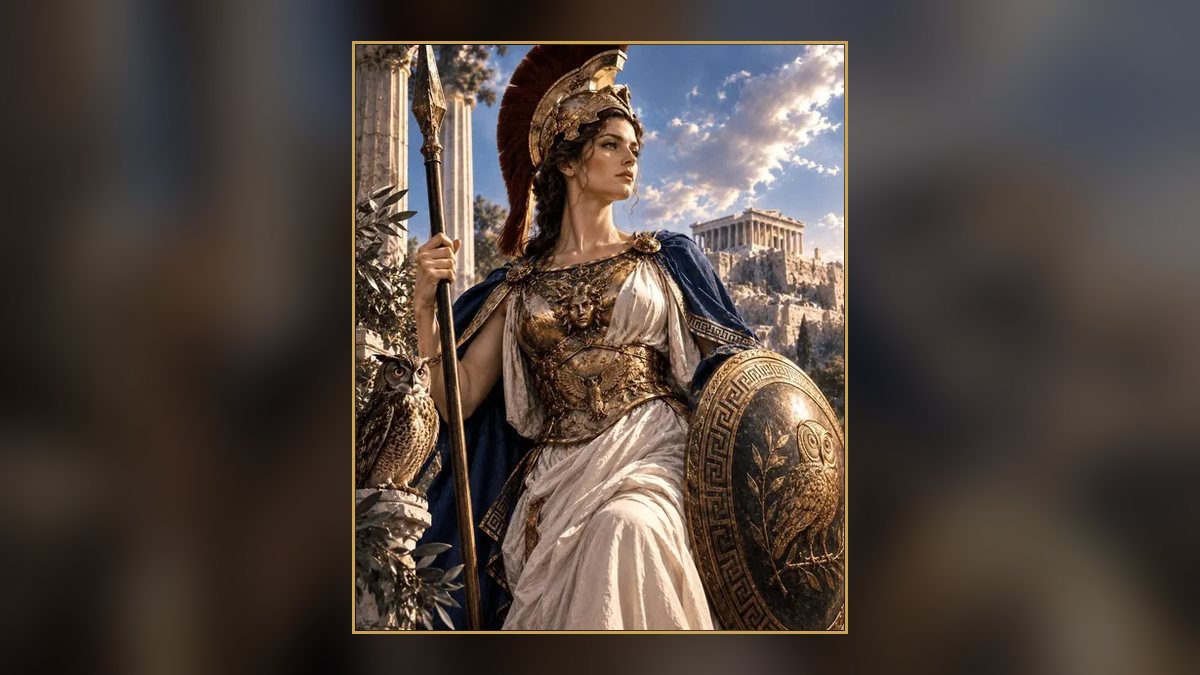
When a ship rounded the southern tip of Attica and sailed north toward Athens, there was supposedly a point at which the sailors could see the tip of a spear shining in the distance above the land. It was not a lighthouse. It was the point of the spear held by a colossal bronze statue of Athena, standing on the Acropolis, and she was called Athena Promachos, the one who fights in the front.
The title is old. It appears in ancient hymns and inscriptions, and it simply means a fighter who stands ahead of the others, a champion. But the statue that carried it for centuries gave it a face, and it is hard to separate the two now.
The statue
After the Greeks beat the Persians, in 479 BCE, the Athenians set about rebuilding what the invaders had destroyed. Among the first big projects was a statue paid for, tradition says, out of the spoils taken from the enemy. It was made by Pheidias, the same sculptor who would later make the ivory-and-gold Athena for the Parthenon and the Zeus at Olympia. This earlier piece was cast in bronze, and it stood in the open air just inside the main gate of the Acropolis, facing the visitor as he came up the ramp.
It was enormous. Ancient writers put it at about nine metres tall, and the base alone was high. She held a spear in one hand and a shield in the other, with her helmet on, and she stood in the posture of someone about to step forward. The figure was not seated or at rest. She was in motion, and that was the point.
The statue stood for some nine hundred years, until the later Roman period. It was eventually carried off to Constantinople, where it is said to have been destroyed by a mob in 1203. Nothing of it remains, though the base can still be seen on the rock, and archaeologists have found part of its foundations.
A different kind of war goddess
What sort of figure is being represented? That is where the title gets interesting. The Greeks had two war deities who rarely appeared on the same side. Ares was the god of battle as such, of the noise, the panic and the slaughter. Athena was the goddess of war as a skill. She was the one who gave a plan to a general, a spear to a hero, a flash of good sense to a soldier who was about to make a mistake.
Homer makes the contrast plain. In the Iliad, a young warrior named Diomedes is guided through the fighting by Athena. She takes the reins of his chariot, pushes his spear into the war god’s side, and drives off the god himself, who goes crying to his father. Zeus tells him off and says that of all the gods he is the one Zeus hates most, because he loves nothing but strife. Athena, who fights beside her favourites, he says nothing against.
Promachos belongs to this second sort of war. She is the one who stands at the front because that is where the decision is made, not because she enjoys it. A hero who has her favour wins by being prepared, and by being clever.
In the great battles
Athena is present in almost every major conflict in the stories. In the war of the gods and the Giants, she fought at Zeus’s side and killed one of the enemy by throwing a whole island onto him. She helped the hero who killed the monster Medusa. In the Odyssey she is behind every moment that Odysseus survives, and she appears at the last minute to stop a civil war in Ithaca.
At Troy she is, to the Trojans’ misfortune, firmly on the Greek side, because Paris insulted her in the beauty contest. She has a temple in the city, and the priests there placed a robe on her statue as a gift, hoping to win her over. She turned her head away. It is one of the quietest and most effective images in the poem. The most powerful warrior goddess in the world refuses a gift, and a city knows it is lost.
The pose on the prize jars
You do not have to climb to the Acropolis to see how the Greeks pictured Athena Promachos. She appears on thousands of painted jars. At the Panathenaic Games, the great festival of Athens, winners of the athletic contests were given amphorae filled with olive oil from the sacred trees, and on one side of each pot the painter showed the goddess striding forward, spear raised, shield on her arm, with a column on each side and a small bird on top. The pose hardly changed for centuries. It was the standard image, as recognisable to an Athenian as a national flag, and it shows that this title was not only a statue but the everyday face of the goddess.
What the Athenians were saying
By the time the bronze statue was raised, the Athenians had just done something extraordinary. They had survived a Persian invasion, twice. They had evacuated their city, fought at sea, and come back to ruins. The title Promachos gave that experience a face. It was a way of saying that their defence had been led, not simply endured, and that the goddess who had once stood in front of Diomedes had stood in front of them.
It also reminds us that the Greeks did not think a war goddess should be gentle, and they did not think she should be wild either. She should be the one who is not afraid, who stands where the others look to her, and who has a spear in her hand and a plan in her head. If you want a quick summary of how a Greek imagined excellence under pressure, this is it. Not rage, not fear, just a calm figure at the front, bronze in the sun, pointing the way home.