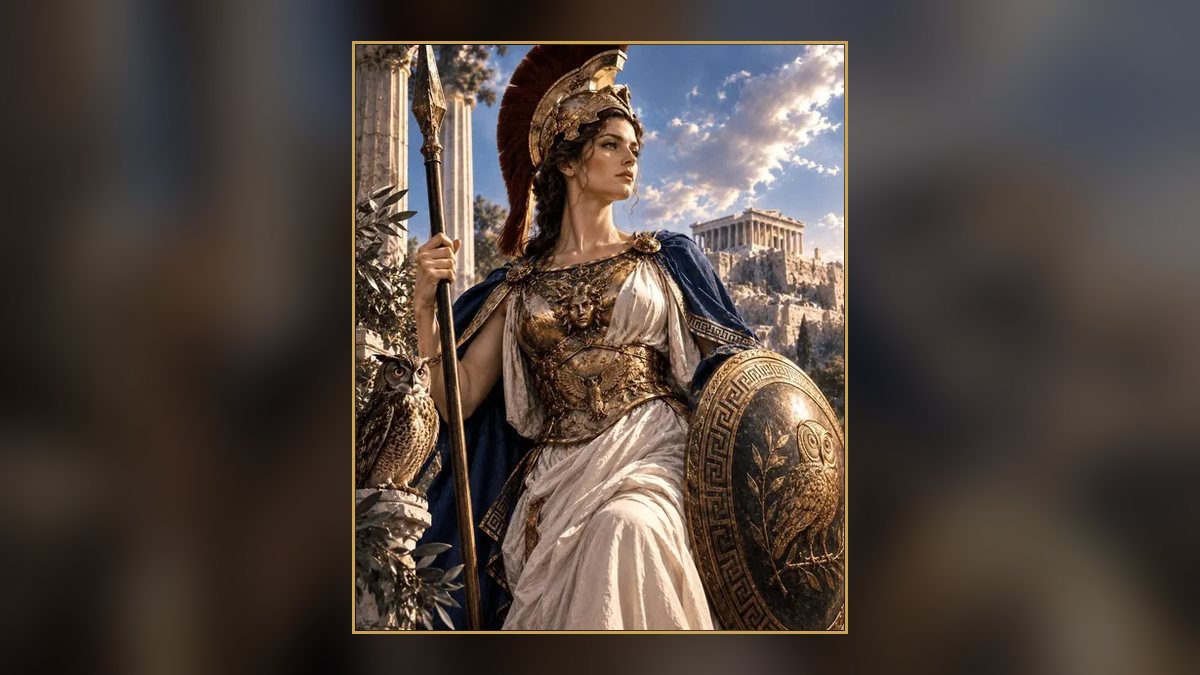
Every year, tourists climb the Acropolis, stand in front of the Parthenon, and look at a building whose name they usually have not stopped to think about. It is the house of the Parthenos, the maiden, and the maiden is Athena. The word is one of her oldest titles, and it carries a more interesting idea than it first appears to.
In ordinary Greek, parthenos meant a young woman who had not yet married. For a goddess, it was something else. When people called Athena Parthenos they were not saying anything about her private habits. They were saying that she belonged to herself, that she was not the wife of any god, and that no one had authority over her. In a society where almost every woman passed from her father’s house to her husband’s, that was a striking claim.
A birth without a mother
The myths of her origin make the point sharply. Zeus had swallowed his first wife, Metis, whose name means cunning, because it had been foretold that her child would be stronger than its father. After a while he developed a terrible headache. Hephaestus, or in some versions Prometheus, split his skull open with an axe, and Athena sprang out fully grown, in armour, shouting a war cry.
She therefore had a father and no mother. In a Greek family that is a notable position. She was entirely Zeus’s child, and entirely her own person, and she took the side of the father in the stories where she had to choose. In Aeschylus’s play The Eumenides, when the question is whether a son who killed his mother should be punished, she votes for acquittal, and she says her reason openly: she has no mother, and she is wholly on the father’s side. It is a startling speech, and not everyone is comfortable with it.
The temple
The Parthenon was built between 447 and 432 BCE, under the leadership of the statesman Pericles. The architects were Ictinus and Callicrates, and Pheidias supervised the sculpture. It was paid for out of the funds the Athenians collected from their allies in the league against Persia, which was a controversial decision at the time, and still is.
Inside stood the statue that gave the whole building its purpose, a figure of Athena Parthenos some twelve metres tall. Its core was wood, and over it the sculptor laid plates of ivory for the flesh and sheets of gold for the robe and armour, some forty talents’ worth, which, the Athenians were proud to point out, could be removed and weighed in an emergency. In her right hand she held a figure of Victory. Her shield stood at her side, painted inside and out with battles, and a great snake curled behind it. On the base was carved the story of the first woman, Pandora, being made by the gods.
Nothing of the statue survives, though small Roman copies show us roughly how it looked. What does survive is the building itself, ruined but still imposing, with its sculpted frieze and the figures that once filled its two pediments. One of them shows the birth of Athena. The other shows her contest with Poseidon for the patronage of Athens.
The city’s own girl
The word Parthenos does something else. It makes Athena local. She is not an imported goddess of the sort one sends offerings to from far away. She is the maiden of this particular city, and her temple is her house, built by her people.
Athenians believed that their own ancestry was bound up with her. One of their earliest kings, Erichthonius, was said to have been born from the earth after Hephaestus tried to force himself on Athena and failed. In that story she wipes the god’s seed from her leg with a piece of wool and throws it away, and Earth bears a child. Athena takes him in and raises him in secret, and he becomes the ancestor of the Athenians. In this strange tale she is a virgin, and also, in a way, a mother, and the city is her adopted child.
Every four years, at a festival called the Great Panathenaia, the Athenians carried a new robe up to the old wooden statue of Athena on the Acropolis. It was woven by women and girls over many months, and the procession is widely thought to be what is carved on the frieze of the Parthenon. It is one of the very few images of the ancient Greeks acting as a community that has survived at that scale.
What happened to the house
The building has had an unlucky second life. It stood as a temple for about a thousand years, then became a Christian church, and after the Ottoman conquest a mosque. In 1687, during a war between the Ottomans and Venice, the Turks were using it to store gunpowder, and a Venetian shell hit it. The explosion blew out the middle of the building and brought down much of the roof and walls. What we see today is what remained, put back together over generations. That a maiden’s house should survive such a history, and still be known by her name, says something about how firmly the title took hold.
What the word really holds
Parthenos is about control. A girl who is not married has not been handed over. She still holds her own name and her own decisions. For Athena this status was permanent, which made her unusual among the gods and useful to the Athenians. She could be a patron without being a possession, and a protector without needing anyone’s permission.
That is the hidden meaning in the name of a building millions of people photograph every year. It is a temple to a woman who is no one’s wife, and who guarded a city of men who voted. The Athenians were not feminists in any modern sense, but they chose, when they wanted a symbol of their own pride, a figure who answered to nobody but her father, and who stood in armour at the top of the rock.