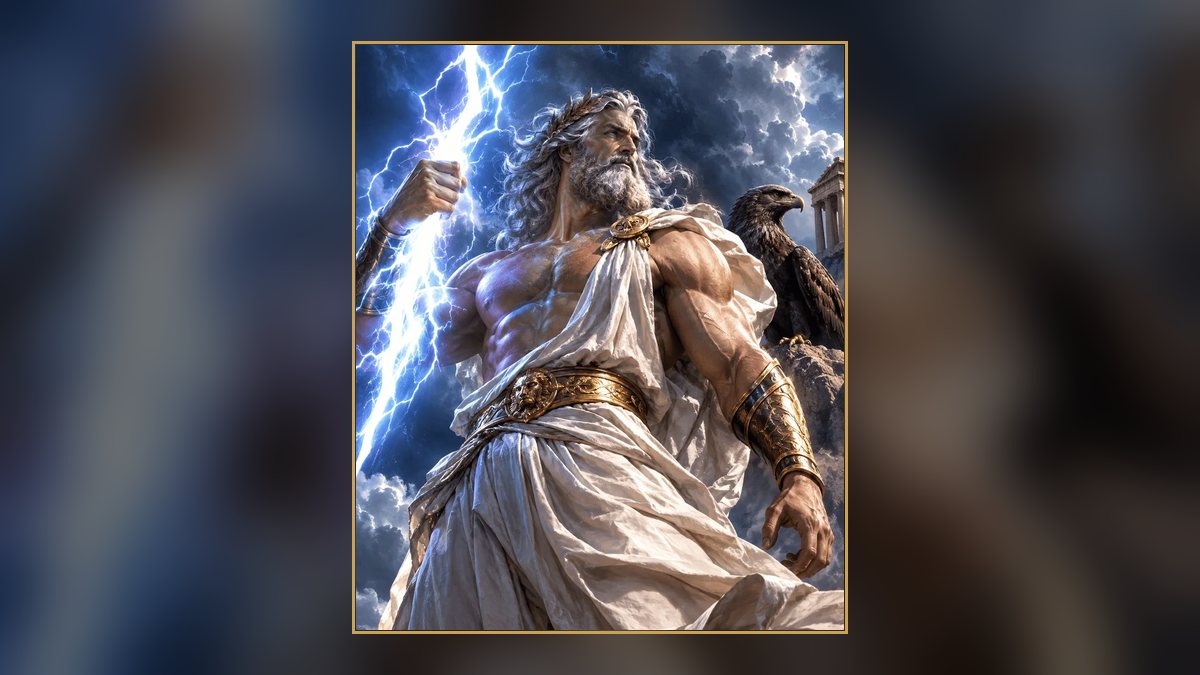
Among the many titles of Zeus, Kataibates is one of the stranger ones. It is built from a verb that means to descend, to come down, and it names Zeus as the god who descends. We do not meet it in the great poems. We meet it mostly in the notes of travellers and in inscriptions, which is a clue that it belonged to actual cult, to places and rituals, and not to literature.
What does it mean for a god to come down? In the ancient world the plainest answer was lightning. A bolt falling out of a clear or cloudy sky is the most direct sign of divine presence a person could imagine. Where it hit, something had happened that was not ordinary, and the Greeks reacted to it in a way that tells us a lot about their imagination.
Ground that belongs to the god
When lightning struck a spot, the Greeks treated that spot as sacred. It could be a field, a corner of a courtyard, a stretch of road. People would fence it off, often with a low wall or a ring of stones, and it became a place where no one was supposed to walk or build. Such a place was called an abaton, a place not to be trodden, or sometimes an enelysion. They sacrificed there, and they let it be.
The reasoning is not hard to follow. If Zeus had come down at that precise spot, it was now his property. He had taken it. Treading on it, ploughing it or building a house there would be an act of trespass against a god. Several ancient authors mention such sites, and the practice continued into Roman times, when a place struck by lightning was formally buried and consecrated by priests.
Pausanias, the traveller who wrote a guide to Greece in the second century CE, records an altar of Zeus Kataibates at Olympia, in the great sanctuary where the games were held, and explains the title as the one who comes down, the god of the lightning bolt.
The one who came too close
The most famous story about the descent of Zeus is not a happy one. A princess of Thebes named Semele was loved by Zeus, and Hera, as usual, was furious. Hera disguised herself as an old nurse and whispered into Semele’s ear that her lover might not really be a god. If he were, she should ask him to show himself as he really was.
Semele made Zeus swear an oath, and he had to keep it. When he appeared in his full power as lord of the thunderbolt, her mortal body could not stand it, and she was burned to ash. Zeus snatched the unborn child from the fire, sewed it into his thigh, and carried it to term. The baby, born a second time, was Dionysus.
The story is a very bleak picture of what it means when the sky really comes down. It is wonderful and fatal at once. Mortals can ask the gods to approach, and often do, but they should not expect to survive when one answers in full. The place where Semele died was said to be shown to visitors in Thebes, and it was one of those fenced, sacred spots, the sort of enclosure the title was meant for.
Punished from above
The same image of descent shows up in stories of arrogance. At the siege of Thebes, a warrior named Capaneus swore that not even Zeus’s lightning would stop him from climbing the wall. He had almost reached the top when Zeus struck him, and the body fell from the ladder. It is a standard picture of the sky answering a boast. A mortal king named Salmoneus built a bronze bridge and dragged brass pots behind a chariot to imitate thunder, and threw torches into the crowd for lightning. Zeus killed him with the real thing.
In these stories the bolt arrives as a verdict. The power that descends is not random. It lands on those who have claimed something that is not theirs, whether the name of a god, a place on the wall, or a view of the divine face.
The other kind of descent
There is a lighter side to the verb too, which the poets could not resist. Zeus descended in other forms for his love affairs. He came to a locked room in a shower of gold, to a girl on the shore as a gentle white bull, to a queen as a swan. These myths are mostly literary, and the epithet does not seem to have been used for them. But the idea shares a root with the cult title. The same god who strikes the ground and fences it off can also arrive in disguise, and both kinds of arrival leave a mark.
Reading the sky
Kataibates was one of several lightning titles. The Greeks also spoke of Zeus Keraunios, of the thunderbolt, and of Zeus Astrapaios, of the flash, and each stressed a different side of the same event. The practical importance of the sky’s signs shows up in Athens, where a group of officials called the Pythaistai were supposed to watch for lightning over a spot on Mount Parnes, north of the city. If they saw a flash in the right direction, it was taken as a go-ahead to send a sacred delegation to Delphi. A man on a hillside, watching the weather and waiting for a message, is as good a picture of this god’s religion as any temple.
What the name asks of us
The charm of Kataibates is that it is so concrete. It does not say Zeus is great or just or wise. It says that the sky is not far away, and that there are spots on the earth where it has recently touched. A traveller who found a fenced corner of a field was being told something. This is ground that is not like the rest. Walk around it.
That is a different relationship to the divine than the one in the big temples. It is less about worship and more about attention. The Greeks assumed that the world was marked in places by the gods, and that a careful person learned to read the marks. When you hear the name Kataibates, imagine a scorched patch of earth with a few stones around it, and a god who is not in the distance at all, but has just left.