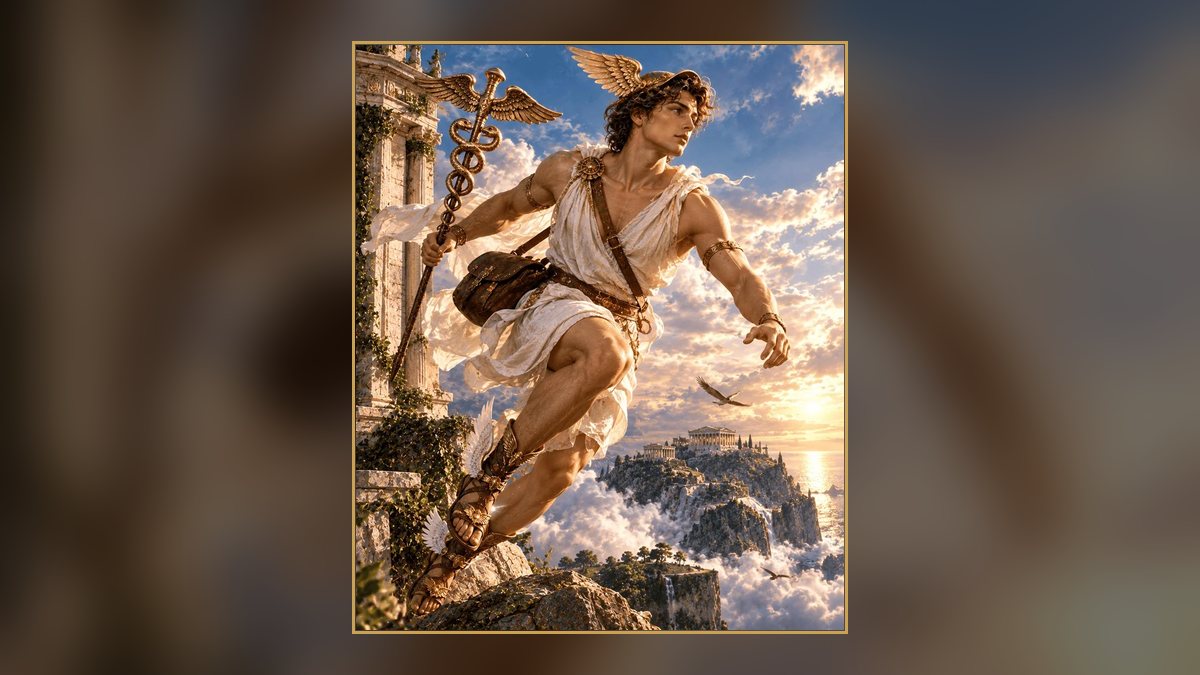
Hermes has many titles, and some of them make sense at once. He is the messenger, the guide, the god of travellers, the patron of thieves. But there is one, found in the oldest Greek poems, that nobody in ancient times could explain with complete confidence, and that has been argued over ever since. Argeiphontes. In the Iliad and the Odyssey it comes up again and again when the poet needs to name Hermes, and it is almost never glossed.
The traditional explanation, the one that the Greeks themselves gave, is that it means slayer of Argus. Argus, or Argos Panoptes, was a creature with eyes all over his body, the sort of being who could sleep with some of them open, and who once served as the watchman of a heifer. How he met his end, and who killed him, is one of the best-known stories in the myths.
The heifer
The story, as told most fully by the Roman poet Ovid, begins with a mortal girl named Io, a priestess of Hera at Argos, whom Zeus noticed. To hide his affair from his wife, he turned Io into a white cow. Hera was not fooled. She asked for the cow as a gift, and Zeus could hardly refuse. Hera then set Argus Panoptes, the all-seeing, to guard the animal, tied to an olive tree.
Argus was the perfect jailer. He had eyes, in different accounts, all over his body or in the back of his head, and he slept with only a few shut at a time. Io, poor creature, was kept in a field and could not even speak to tell anyone who she was. When her father came to see the strange cow, she wrote her name in the dust with her hoof.
Zeus, uncomfortable, sent his son Hermes to free her. The god disguised himself as a shepherd, with pipes in his hand, and sat down near the watchman. He began to play, and to tell stories. In Ovid’s version he tells the tale of how the pipes themselves were invented, from a nymph turned into reeds, and while he was speaking, Argus’s eyes began to close, one by one. When the last of them was shut, Hermes struck. In some versions he used a sword and in others a stone, and he threw the body down the hillside.
The eyes on the tail
That would be the end of it, except for a lovely detail that Ovid adds. Hera was grieved at the death of her servant, and wanted to honour him. She took his hundred eyes and placed them on the tail of her favourite bird, which is why the peacock’s feathers are patterned with eyes. It is a story that explains something you can see.
Io’s fate was less tidy. Hera, still angry, sent a gadfly to torment her, and the cow ran in a frenzy across the world. She swam a strait that has been called the Bosporus, the ox-crossing, ever since, wandered through Asia, and finally reached Egypt, where Zeus restored her to human form. Her son Epaphus became the ancestor of a long line of kings. Later Greeks identified her with the Egyptian goddess Isis, which is the sort of thing that happens when mythologies meet.
Is the story really the origin?
The trouble is that this explanation may be backwards. The epithet is used in the Iliad, centuries before Ovid, and in none of the early poems is there a clear reference to the Argus story. Homer uses the title as if it were a standing name, like swift-footed Achilles, and he never says what it refers to. A few ancient writers seem to have known the myth, but it is not mentioned in the oldest sources.
Modern linguists therefore suspect that Argeiphontes may have meant something else originally. Argos is also a word for bright, white, swift. The second half of the word could come from a verb meaning to appear or shine. One suggested reading is bright-appearing, or swift-showing, a title that fits the messenger who arrives in a flash. On this view, the story of Argus was invented later to explain a word whose meaning had been forgotten, the way a pun becomes a legend.
It is impossible to prove. The myth is also a genuine and old one, and may have developed alongside the title. But the possibility that a god’s most famous exploit came from a misunderstanding of his name is one of the more entertaining ideas in the study of Greek religion.
What the name does with the story
Whichever came first, the title and the tale have been welded together in the Greek imagination for more than two thousand years, and the combination says something about Hermes. He is the god who kills without a fight, who wins by wit and patience. The Greeks admired this. In their eyes, he was an expert in subtlety. He did not break the watchman’s defences. He sat down beside him and told him a story until he fell asleep.
There is also a note of moral ambiguity. The one who kills Argus is acting on the orders of Zeus, and he is freeing an innocent girl. But he is also murdering a faithful servant, who was doing what he was told. The epithet never lets the god forget that. It is a kind of badge, a mark of a deed that was both a rescue and a killing.
A short history of a long name
Names like this show how much of Greek religion was memory. Each title was a small museum. It held a story, or half a story, or the faint outline of a story that had gone missing, and the people who spoke it did not always know exactly what was inside. That does not make it less valuable. If anything it makes it more so. When someone calls Hermes Argeiphontes, they are touching a very old piece of language. They may be saying that he killed a monster with a hundred eyes. They may be saying he is bright and quick. And they may be doing both, as the poets seem to have done, with no apparent concern about which was right.