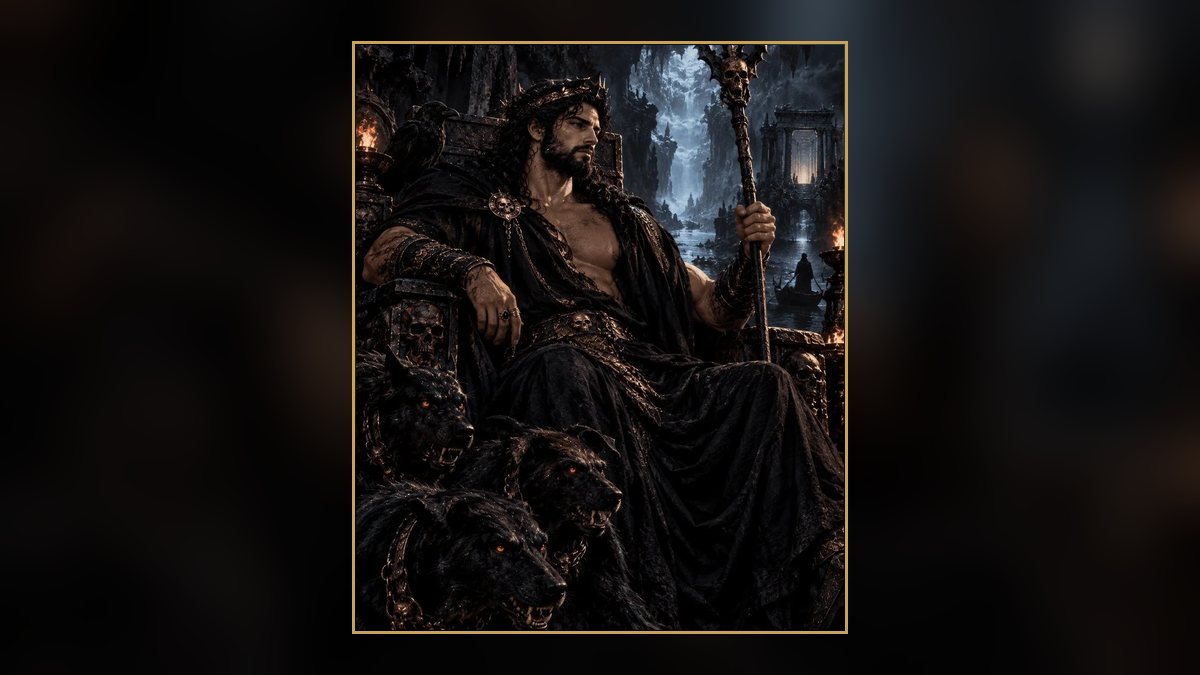
Of all the names for the lord of the underworld, Aidoneus is the one that feels most like a shadow. It appears in Homer and in the oldest poems, usually in the same breath as the name Hades, as if the two were variations of a single sound. The form is a poetic extension of Hades, and it carries the same root, a word that the Greeks connected to the unseen. A person who uses it is naming a god who is, by definition, out of sight.
How the Greeks got there is a matter of debate. Some ancient writers claimed that the name meant not seen, built on a negative and the verb to see. Modern linguists are more cautious, and the true origin is uncertain. But the idea took hold anyway, and it shaped the god. Hades was the unseen. He ruled a place that nobody could look at while alive, and he was not shown in many cult images or celebrated in many festivals. In a world full of gods who were visible and busy, he was the one who was missing.
The helmet
The best-known link between the god and invisibility is a piece of armour. According to the myths, Hades owned a helmet, called the cap of Hades, that made its wearer invisible. It was said to have been made by the Cyclopes, the same one-eyed smiths who gave Zeus his thunderbolt and Poseidon his trident, as a gift when Zeus freed them during the war against the Titans. Hades got the helmet, and it was the perfect weapon for a god who already lived out of sight.
He did not keep it to himself. In the Iliad, the goddess Athena puts on the helmet of Hades to keep Ares from seeing her when she joins the hero Diomedes in battle. A similar helmet appears in the story of Perseus, who borrows it to approach the Gorgon Medusa without being noticed. The hero cuts off her head, puts it into a bag, and escapes with the cap on. The fact that the helmet is lent around suggests how closely the Greeks linked the god and the idea of vanishing. To disappear was, in some sense, to be in his keeping.
A god with almost no home
A telling sign is how few temples he had. The Greeks built sanctuaries to nearly every god, and cities competed to have the grandest ones. Hades was an exception. There were hardly any places where he was worshipped in the usual way. Pausanias, the travel writer, mentions a sanctuary of Hades at Elis in the western Peloponnese, and says that it was opened only once a year, and that only the priest was allowed to enter. Nobody else was permitted to see inside.
That single detail speaks volumes. Even where there was a shrine, the god’s own space was closed to the public. Offerings to him were made in a different style from the rest. Where other gods received white animals and bright ceremonies in daylight, those for the underworld powers were black animals, offered at night, with the head turned downward and the blood poured into a pit. The worshipper averted his eyes. He did not look at what he was calling on.
Taking Persephone
The most famous story involving the god is also about concealment. Persephone, the daughter of the grain goddess, was picking flowers in a meadow when the earth split open, and the lord of the dead came up in his chariot and carried her off. In the Homeric Hymn to Demeter, he does it with Zeus’s permission. The girl cries out, and no one but the goddess Hecate and the sun hears her. The earth closes behind them, and she vanishes from the world.
It is, among other things, a story of someone becoming unseen. Her mother searches, and cannot find her, and the entire world is plunged into famine until the girl is returned for part of each year. The god of the unseen takes something visible, and the people left behind have to go on living with the absence.
The stubborn god
There are other stories of his rare appearances above ground. In one, the hero Heracles, on a visit to Pylos, fought and wounded Hades with an arrow, and the god had to go to Olympus to be healed by the divine doctor. It is an unusual tale, and one of the very few where the lord of the dead is hurt, and it is never taken very seriously.
More often, he is mentioned in oaths, in curses, and as the one who has the final word. In the Iliad, Achilles says that a man who hides one thing in his heart and says another is as hateful to him as the gates of Hades. The phrase sums up the god’s reputation: unyielding, unmoved by gifts, unbending. Another line calls him the most hated of gods to mortals, because he is rigid and does not yield.
What invisibility means
I think the central idea in this name is not horror but respect. The unseen is what we cannot control. It is what happens after the lights go out, what is on the other side of a door we cannot open. Calling the lord of the dead Aidoneus is a way of admitting how little we know. It does not try to describe him, only to say that he is there, quietly, and that he has the last word.
The Greeks did not tell many stories about what he did in his own hall. They preferred to leave that unseen. What they told were stories about people who came to him, and left, or did not. In those, he is not cruel, only fair and strict. He keeps what he is given.
That makes Aidoneus a very good title for a god whose chief virtue is that he does not change his mind. If you remember only one thing about the name, let it be that: the one you cannot see is the one who is always there.