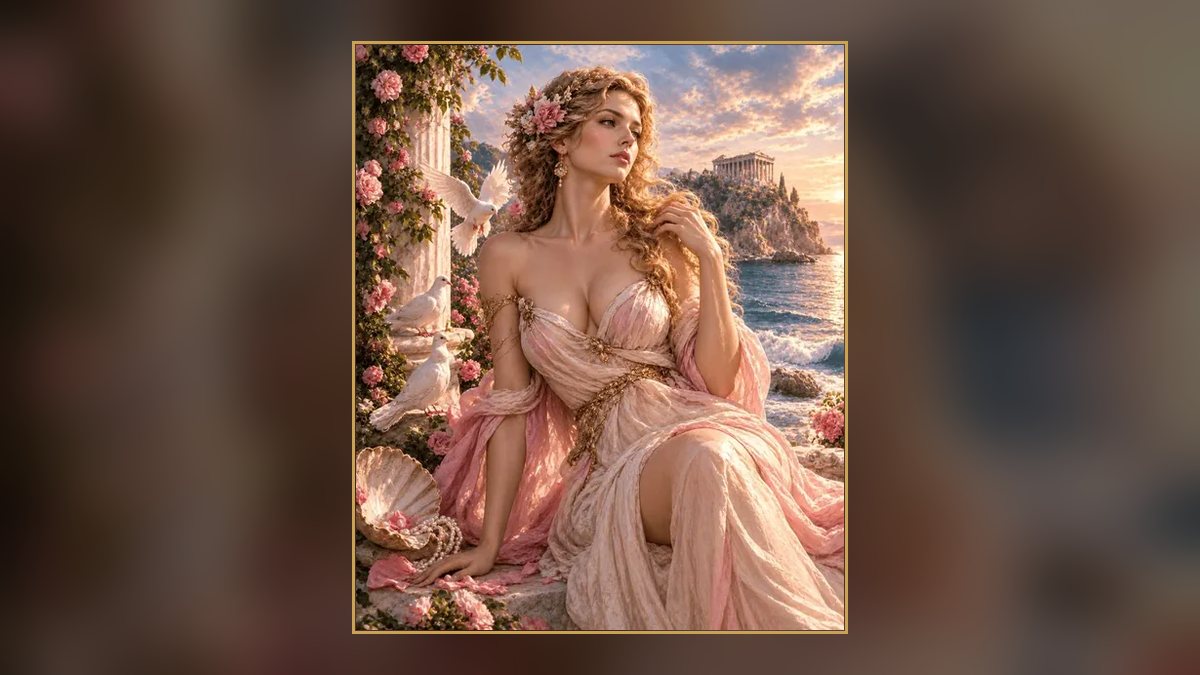
When most people think of Aphrodite they picture a smiling woman on a seashell, loved by poets and painters, a goddess of attraction and charm. The Greeks knew that figure well. But they also knew another one, an older and stranger Aphrodite whom they called by a different title: Ourania, in the Greek spelling, which we usually write as Urania. It means heavenly, or of the sky, and it points to a story of birth that is quite unlike the one on the seashell.
The story is told by Hesiod in the Theogony. The sky god Uranus, who covered the earth night after night, had been attacked by his youngest son Cronus, who cut off his father’s genitals with a sickle and threw them into the sea. They drifted on the water, and white foam gathered around them. Out of the foam grew a girl. She came ashore first at the island of Cythera, and then at Cyprus, and gods and mortals alike called her Aphrodite, a name Hesiod links with the word for foam. Eros and Desire came to attend her at once.
It is a violent beginning, and it makes her something rather unusual in Greek religion. She is the child of a father without a mother, born of the sky’s severed power and the sea. That origin is what the title Urania recalls. When people called her by it, they were naming the Aphrodite who came directly out of Uranus, the sky, before there was a family of Olympians and before Zeus was in charge.
Two goddesses, or one?
The Greeks themselves noticed there were two stories. Homer says nothing of the foam and the sickle. In the Iliad, Aphrodite is the daughter of Zeus and a goddess named Dione, and she is a more ordinary figure, wounded in battle by a mortal and sent crying to her mother. Two different pedigrees, from two different poems, for what was clearly the same goddess.
A solution to the puzzle appears in Plato’s dialogue the Symposium, a drinking party at which each guest gives a speech in praise of Love. A character named Pausanias argues that there must be two Aphrodites, and so two kinds of Love. One is the elder, daughter of Uranus, with no mother, called Ourania. The other is the younger, daughter of Zeus and Dione, called Pandemos, the common one. The first inspires a love that is lasting and directed toward the mind and character. The second inspires a love of the body, quick and shallow. Pausanias says both deserve honour, but only the heavenly one makes a person better.
Plato did not invent the two titles. They were already attached to real shrines and cults. What he did was fit them to a theory, and the result was enormously influential. For centuries, writers used Urania to mean the lofty side of love, and the word acquired a moral colour that the cult title may never have had.
Where her shrines were
In Athens there was a sanctuary of Aphrodite Urania in the agora, the old marketplace. Pausanias, who visited it in the second century CE, says it had a statue in Parian marble by Pheidias, and he adds that the Athenians believed the cult had been founded by their legendary king Aegeus. Another ancient writer tells us that the goddess’s shrine on the island of Cythera was very old and very holy, and that it contained an armed image of her, which is a surprise.
The most striking evidence comes from the historian Herodotus, writing in the fifth century BCE. He says that the oldest temple of Aphrodite Urania was at Ascalon, a city in Syria on the coast of what is now Israel, and that the temples at Cyprus and Cythera had been founded by Phoenicians who came from there. Whatever the truth of that chain, it is clear the Greeks themselves thought Urania was not originally Greek. Modern scholars agree that there are strong links to the great goddesses of the Near East, Astarte in the Levant and Ishtar in Mesopotamia, who were also connected with the heavens, with war, with the planet we call Venus, and with love.
This puts the title in a new light. Urania is not simply a flattering adjective. It may be a trace of the road the goddess took before she reached Greece, a sign that the Greeks recognised in her something borrowed and venerable.
The astral side
The word Ourania literally means of the sky, and the sky was where the ancients saw the brightest of the wandering stars, the one we now call Venus, shining at dawn and dusk. In the East this star was the goddess. The Greeks eventually gave it to Aphrodite. So when someone used the title Urania, they might be pointing to the heavens, to the evening star, and to a goddess whose domain was above, not in the bedroom.
It is worth noting that the Muse of astronomy is also called Urania, from the same root. She is a separate figure, daughter of Zeus and Memory. But the shared name shows how readily the Greeks linked the idea of heaven with order, beauty and a kind of high devotion.
A title with two lives
Over time Urania came to mean different things to different people. To a philosopher, she was the principle of a pure, intellectual love. To a poet, she was a way of praising a beloved who seemed unreachable. To a worshipper in Athens or Cyprus, she was an old goddess who had a place and a day and a set of rituals. Those uses did not cancel one another. They sat side by side, as the many layers of an old religion do.
What I find moving is the way the title preserves an argument about what love is. Is it a force that draws us toward what is good and lasting, or a force that simply pulls us toward what is near? The Greeks did not resolve this, but they gave each side a name and a goddess. Urania is the one who looks up. She is born out of a catastrophe, rises from the foam, and from the very beginning is pointed at the sky.