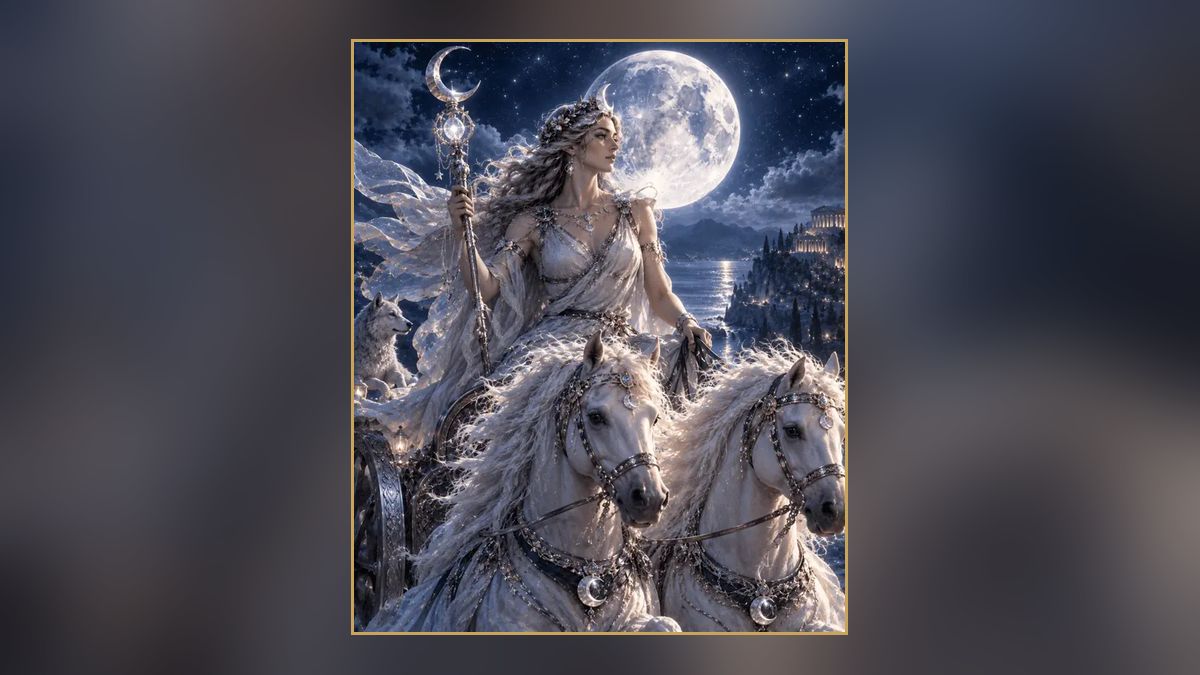
Helios, the sun god, is the one who sees everything. Selene, his sister, is the opposite. She is what everyone looks at. That difference, which I find fascinating, shapes her whole mythology. She is the moon, and in a world without clocks or electric light, the moon was the most watched object in the sky. People timed their festivals by it, their loans by it, their sacrifices and their battles. Selene is a goddess who is constantly checked. And I think the stories about her make the most sense if you read them as stories about being observed, rather than observing.
One sky, two siblings
Start with the family. According to Hesiod's Theogony, Hyperion and Theia, two of the Titans, had three radiant children: Helios, the sun, Selene, the moon, and Eos, the dawn. They are the three light-bringers, who divide the sky between them. Eos opens the day, Helios crosses it, and Selene takes over when the sun goes under the earth.
The Homeric Hymn to Selene gives a beautiful picture of her. It describes the goddess bathing her lovely body in the ocean, putting on shining clothes, yoking her bright-necked, long-maned horses, and driving them in full flight in the evening. Her light comes out from her head, and when she is full the air is lit from above. It is a hymn about the moon as an event, a thing that arrives.
The same hymn adds a little detail, that she had a daughter by Zeus, named Pandia, whose name means all-bright. There was an Athenian festival called the Pandia, and some ancient writers connected it with her. It is a faint trace of a lunar cult that has otherwise almost disappeared.
And that is the first puzzle about Selene. She is a major goddess in the family tree, but she has very little worship compared to her brother or her cousins. There are far fewer temples, far fewer stories. To understand why, I think you have to look at what happened to her role.
One object, three goddesses
The Greeks, over time, divided the moon among several goddesses, and each one took a different job. Selene is the moon itself, the body in the sky. Artemis, with her silver bow and her association with the wild, became tied to the moon by the fifth century, and poets began to speak of her as the moon goddess. And Hecate, the goddess of the crossroads and of witchcraft, took the dark side: the night, the new moon, the unseen.
So there was one object, and three different ways of relating to it. Selene is the thing you see. Artemis is the huntress who is out in its light. Hecate is the goddess you call on when it is gone.
I find this a very Greek way of handling the problem. Instead of one goddess with every power, they distributed the moon's meanings among specialists. The consequence for Selene was that she faded. She became the plain, physical goddess, the lamp, and the more interesting jobs went to her rivals. It is a bit like the way a person can be crowded out of their own story by their more colourful relatives.
The sleeper
The one great myth that belongs to Selene alone is the story of Endymion. He is a handsome young man, a shepherd or hunter or king, depending on the version, who lives on Mount Latmos in Caria, in southwest Anatolia. Selene sees him asleep one night, falls in love, and comes down to him.
According to the mythographer Apollodorus, Zeus offered Endymion any wish he wanted. Endymion chose to sleep forever, and remain deathless and ageless. Pausanias, reporting what the people of Elis said, adds that Selene bore him fifty daughters.
I have always found this story a little unsettling, and I think it is worth reading closely. Selene's one great love is a man who is permanently unconscious. It is the only way the relationship can work. A lover who is awake might age, or choose someone else, or ask to leave. A lover who sleeps forever stays exactly the same, and can be visited every night.
Here is my theory, which is only that. The story is a picture of the moon's relationship with the earth. She visits, she looks, she goes away and comes back, and the thing she watches never changes, because it is asleep. It suits a goddess whose whole identity is being a regular visitor. She is a cycle, and Endymion is the fixed point she returns to.
There is a lovely small detail from the Roman poet Virgil, who says that the god Pan once won the moon by giving her a gift of beautiful white wool. It is a story of the moon being tricked, or seduced, by a rustic god, and it shows how readily the Greek and Roman imagination made the moon into a character with moods.
The calendar
If Selene's myths are thin, her practical importance was huge. The Greeks used lunar months. The word for month in Greek, men, is closely related to the word for moon, and the old poetic name Mene is another name for Selene herself. A month was a moon cycle, and the calendar was a record of her phases.
This meant the moon organised everything. Festivals fell on certain days of the lunar month. The first of the month, the new moon, was a sacred day for offerings. Legal deadlines and religious dates were tied to her appearance. A man could not make plans without first knowing what the moon was doing.
There is a wonderful joke about this in Aristophanes' comedy The Clouds. A man named Strepsiades is crushed by debts, with interest due on the first of every month. He comes up with a scheme. Thessalian witches were famous for being able to draw down the moon, and Plato mentions the same belief. Strepsiades says he will hire one, bring the moon down, and shut her up in a round box, like a mirror case, so that the month can never come to an end and he will never have to pay.
I love that. It shows exactly how the moon worked in daily life. She was a clock, and a clock that determined when your debts fell due. A man in trouble might wish to lock the moon away. In a small way, Selene was the goddess of deadlines.
When the moon cost an army
The most serious example comes from the middle of the Peloponnesian War. In 413 BCE, the Athenian expedition to Sicily was in disaster. The army was trapped outside Syracuse, with its siege failing and sickness spreading. Their general, Nicias, finally agreed to retreat by sea. The ships were ready. And then, the night before the fleet was to sail, there was a lunar eclipse.
Thucydides says that most of the Athenians were deeply disturbed and urged the generals to wait. The seers said they should delay for twenty-seven days, three times nine. Nicias, who the historian says was rather too fond of divination, agreed. The delay gave the Syracusans time to block the harbour. The Athenian fleet was destroyed, the army was cut to pieces, and thousands of prisoners were left to die in the stone quarries.
Think about that. A goddess who passed in front of the earth's shadow for a few hours, and an army that read it as a message, and one of the most devastating defeats in Greek history. I am not saying the eclipse caused the defeat. The Athenians were in serious trouble anyway. But the story shows how seriously the moon was taken, and how she could change the course of events simply by being seen.
Some Greeks were already thinking differently. A philosopher named Anaxagoras, who lived in Athens a generation earlier, had argued that the moon was a body like the earth, which shone by reflecting the light of the sun. According to later biographers, he got into serious trouble for saying so. Plato mentions the idea in passing, as something that had become well known. In Nicias's time, there were people who understood an eclipse as a shadow. Nicias was not one of them.
What I take from her
So here is how I would sum her up. Selene is the goddess whose power comes from being looked at. Where her brother sees and reports, she appears and is read. Everyone in the ancient world looked up at her, and what they saw told them when to celebrate, when to pay, when to fight and when to wait.
That is a different kind of divinity from the usual Greek one. She does not intervene. She does not punish. She simply turns up, on schedule, and people arrange their lives around her. In that sense, she is perhaps the most reliable of the gods, and the one whose absence would be the most disruptive.
The stories are few, but the dependence was enormous. A goddess without a great cult, who nevertheless ran the calendar of an entire civilisation. I think that is the best argument for taking her seriously. She was the most watched god in the sky, and probably the most obeyed.
Comments
Sign in to join the conversation.