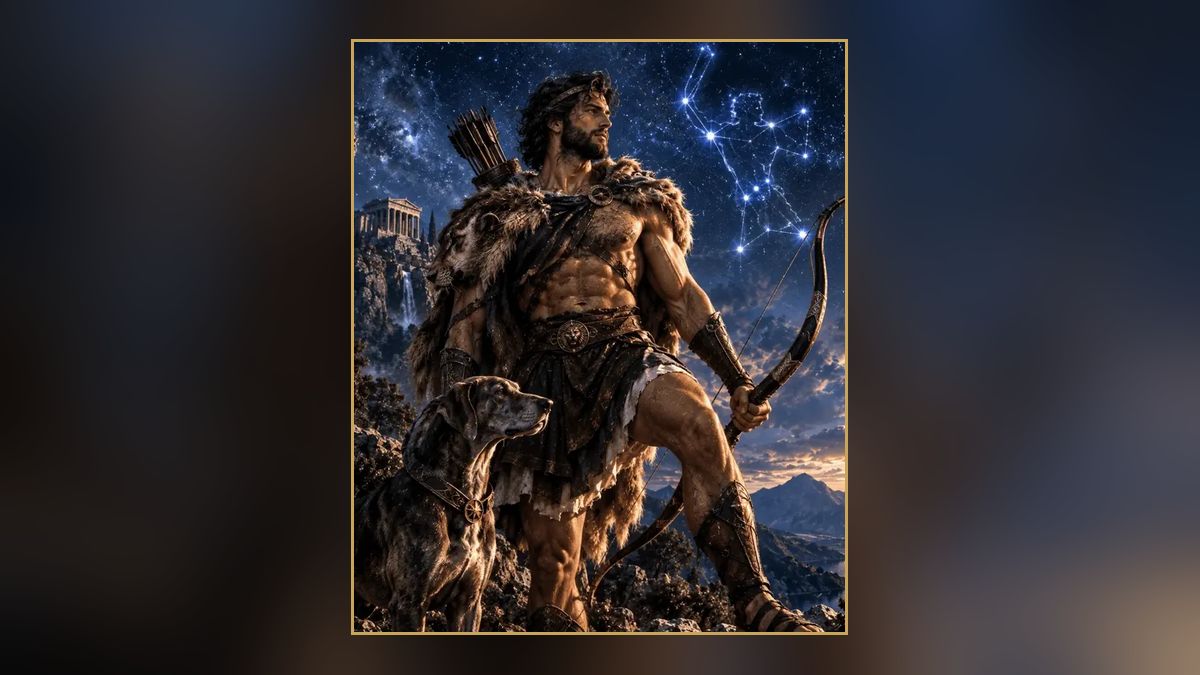
Orion is the most recognisable shape in the night sky, and he is also one of the most inconsistent characters in Greek myth. Ask how he died and you will get at least four answers. He was killed by the goddess Artemis. He was stung by a scorpion. He was tricked by her brother. He was struck down for boasting. Each source gives a different cause, and they hardly seem to notice that they are contradicting each other. I used to think this was just sloppiness, the usual mess of folklore. Now I think the contradictions are the point. Orion is a hunter, but he is also a set of stars that people used to tell the time, and each story about his death is a way of explaining something about the sky. He is a calendar that got a biography.
A strange start
The usual family is Poseidon as father and Euryale, a daughter of Minos, as mother. Apollodorus adds a magical detail: Poseidon gave his son the power to walk across the sea. So Orion is a giant hunter, huge and strong, who can stride over waves. That is already unusual. Most Greek heroes are bound to a place. Orion belongs to the horizon, wherever land meets water.
There is a second, rather comical origin story from the Roman poet Ovid. He says that a poor old farmer named Hyrieus once welcomed three gods who were travelling in disguise, Jupiter, Neptune and Mercury. Hyrieus wanted a child but had no wife, and the gods, in gratitude, asked him to sacrifice an ox and spread out its hide. Then, in Ovid's words, they all made water on it. Nine months later a boy was born from the hide, and since the Greek word for urine is similar to Orion's name, the name stuck.
It is an absurd etymology, but I like it for what it shows. Even the Romans could not decide where he came from. He seems to be a figure who arrived before a clear story, and had stories hung on him afterwards.
The first death
The oldest account of his end is in the Odyssey, and it is brief. In book five, the nymph Calypso complains about the gods' jealousy. She says that when the dawn goddess Eos took Orion as a lover, the gods grudged her, until Artemis, from her golden throne, came to the island of Ortygia and killed him with her gentle arrows.
Notice what is being said. Orion is killed because a goddess loved him, and the other gods did not like it. The reason is not his behaviour. It is the sort of interest he attracted. It is a classic Greek complaint, which Calypso immediately compares to her own situation: the gods resent it when a goddess takes a mortal man.
The Odyssey also gives us a strange afterlife. When Odysseus visits the Underworld, he sees the giant hunter Orion driving wild beasts across a meadow of asphodel, the ghosts of animals he killed on earth, with an unbreakable club of bronze in his hands. He is still hunting, in death, forever.
The scorpion
The more famous version comes later. In this story, Orion boasts that he will kill every animal on earth, or, in another telling, he tries to assault Artemis or her companion. Earth, Gaia, is angered, and sends a giant scorpion. It stings him, and he dies.
Both the scorpion story and the boast attach themselves to something real in the sky. Orion and the constellation Scorpius lie on opposite sides of the heavens. As one rises, the other sets. They are never above the horizon together. The Greeks noticed, and the ancient writers who described the constellations say so: Orion is set among the stars, and the Scorpion is placed opposite him, so that the hunter can flee for ever.
Think about how neat that is. A fact about the sky, that two star groups are never visible at once, is turned into a story. The scorpion killed the hunter, so the hunter runs away every time the scorpion appears. The myth explains the geometry.
The dare
A third version is told by the Roman writer Hyginus, and it is the darkest. In this account, Apollo is jealous of his sister's friendship with Orion, and tells her that she is not as good an archer as she thinks. He points to a speck far out at sea and dares her to hit it. She draws her bow and strikes it. It was Orion's head, as he waded far out into the water. She had killed him, unknowingly, on a trick.
That story shifts the moral completely. In the Odyssey, Orion dies because gods are jealous. In the scorpion story, he dies because he is arrogant. In Hyginus, he dies because a brother manipulates a sister, and neither of them is the real villain. Artemis, in particular, is turned from a killer into a victim of a joke. After the death, the story goes, she was so heartbroken that she placed him among the stars.
Whatever you believe about those stories, it is striking how different the moral logic is. A single death can be a punishment, a revenge or an accident, depending on who is telling it. The Greeks did not seem to feel the need to choose.
The healed hunter
There is one more story, and it is the one that I find most beautiful. Apollodorus tells that Orion, in some versions, fell in love with Merope, the daughter of King Oenopion of Chios. When he got drunk and tried to take her by force, Oenopion blinded him and threw him out onto the shore.
A blind Orion wandered along the coast until he heard the sound of a hammer from a smithy, and followed it. The smith god Hephaestus, at his forge, took pity and gave him a guide, a boy named Cedalion. Orion put the boy on his shoulders, and the boy directed him east, towards the dawn. When they reached the place where the sun rises, Helios, the sun god, healed him with his rays, and his sight returned.
I love this picture: a giant carrying a child on his shoulders, walking toward the sunrise, to have his eyes restored. It connects two of the other gods whose articles I have written, Helios, the one who sees everything, and Hephaestus, the craftsman. And it is a gentle counterweight to the violent stories. Orion is not just a hunter who gets killed. He is a man who loses everything, and is helped.
Why the stories do not agree
Here is where I come back to my theory. The Greeks did not think of the stars as an abstract field of lights. They used them. A farmer knew that when certain constellations rose or set, it was time to plough or harvest or sail. Hesiod, in his poem Works and Days, uses the risings and settings of the Pleiades, Sirius and Orion to tell his readers when to do their farm work.
Orion, in particular, was a marker. He is bright, distinctive and easy to find, and his appearance in the sky changes with the seasons. He rises before dawn in high summer, and dominates the evening sky in winter. When he is up, particular things happen: weather shifts, farm jobs change, sea travel becomes dangerous.
So when the Greeks told stories about him, I think they were doing something practical. The tales are like a mnemonic. The Scorpion story helps you remember that these two constellations never appear together. The story about Eos and the dawn helps you remember that Orion rises before the sun. The healing story, with its journey east toward the sunrise, links him to the dawn. Each version attaches a narrative to a fact about the sky, and the facts are different, so the stories are different.
That is why I think it would be a mistake to ask which death is the real one. They are not competing accounts of an event. They are labels on a map, and each one marks a different feature.
What I take from him
So here is my view. Orion is a hunter who became a calendar, and the stories grew up around him the way notes grow up around a table of dates. He is huge, strong, doomed and healed, because the sky he stands for has all of those faces. He is a winter giant, and a summer warning, and a figure who is always running away from the same enemy.
If you go outside on a clear winter evening and look south, you can find him by his belt, three bright stars in a straight line. The Greeks found him the same way. Whatever the story they told about his death, they knew exactly where he would be tomorrow night, which is, I suppose, a kind of immortality.
Comments
Sign in to join the conversation.