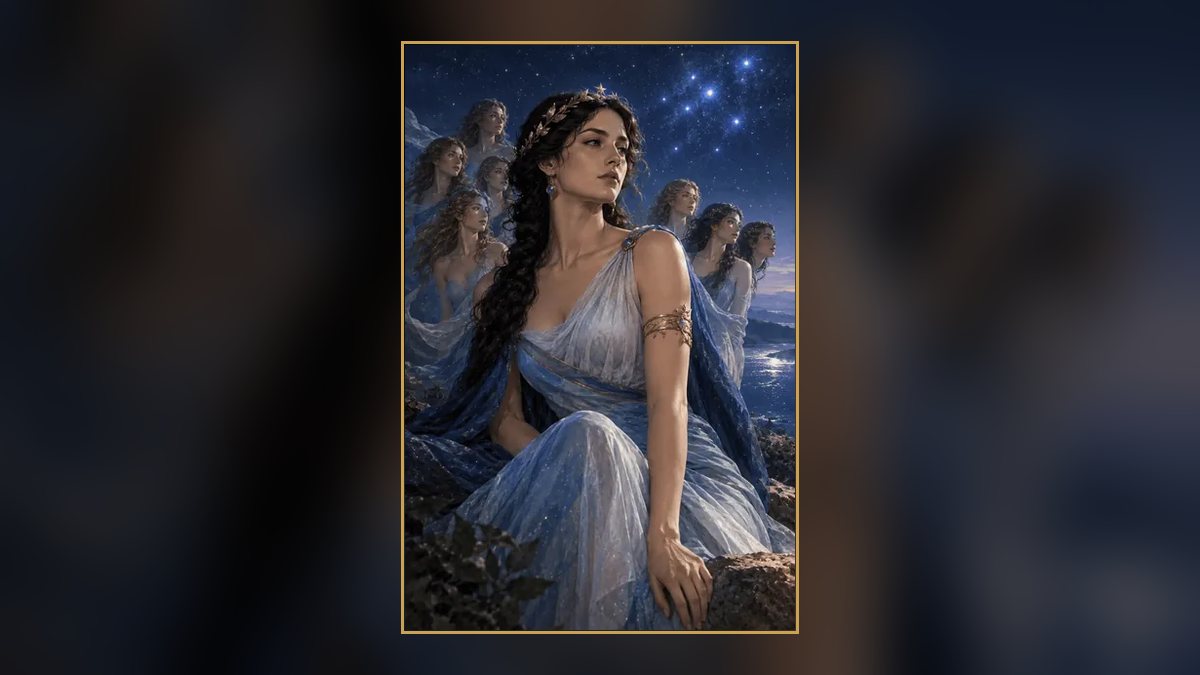
Hermes gets most of the attention in his own origin story, and honestly he earns it. On the day he is born he walks out of his cradle, builds a musical instrument from a dead tortoise, and steals fifty cows from his much more powerful half-brother. It is a fantastic piece of storytelling. But every time I read the Homeric Hymn that tells it, my eye keeps drifting to the woman standing in the background of the cave. Maia is the mother of this impossible child, and she spends the entire poem reacting to him with the weary patience of a parent who knows exactly what she has produced. She is the straight woman in a comedy. I want to argue that she is more than that, and that the quiet figure in the cave tells us as much about how the Greeks thought about mothers, mountains and the sky as her son does.
One of seven sisters
Maia is the eldest of the Pleiades, the seven daughters of the Titan Atlas and the sea-nymph Pleione. The other six are Electra, Taygete, Asterope, Celaeno, Alcyone and Merope. Atlas is the one who holds up the sky, so these girls are born into a household where the heavens are literally a family business. Eventually all seven end up as stars, the little cluster that you can still find with the naked eye in the northern winter sky.
The Pleiades also had a very practical job in Greek life. Hesiod, writing a farming manual in the Works and Days, tells his brother Perses that when the Pleiades rise at dawn it is time to start the harvest, and when they set it is time to plough. So the cluster that Maia belongs to was a calendar. Farmers looked up at the sisters to learn what to do with their hands. Hold that thought, because it gives Maia a different shade from the usual one. She is not just an ornament of the night. She belongs to a group that told ordinary people how to live.
The shy nymph on the mountain
In the Homeric Hymn to Hermes, Maia is called a shy or modest nymph, and the poet says she avoided the company of the blessed gods. She lived in a shadowy cave on Mount Cyllene, in the mountains of Arcadia, a high wild region of the Peloponnese that the Greeks pictured as old-fashioned and rustic. The setting is not an accident. Arcadia was where you went to find shepherds, pastures and a way of life untouched by the busy courts of Olympus.
The hymn also tells us how the relationship started. Zeus came to her at night, when Hera was asleep and the other gods were not watching. The poet puts it plainly: nobody saw, not the immortal gods and not mortal people. Then the months pass, and at the right moment a baby is born. The hymn gives us a touching bit of understatement here. Maia is not a seduced victim or a conquering queen. She is a woman who chose to stay out of sight and then found the sky come looking for her anyway.
I think it is worth noticing how different she is from the other women in Zeus's life. Hera is loud, public and furious. Semele wants to be seen. Leto is hunted across the world. Maia just wants a quiet cave, and she gets one, and it somehow produces the most famous trickster in the pantheon. The myth has a bit of dry humour about that. The most discreet mother has the least discreet son.
The baby who would not stay in the cradle
The hymn gives us the schedule of that famous first day. At dawn Hermes is born. By midday he has met a tortoise, killed it, and strung its shell with sheep gut to make the first lyre. By evening he has walked all the way to Pieria, driven off the cattle of Apollo, and made them walk backwards so the tracks would point the wrong way. He sacrifices two of them, divides the meat into twelve portions, and then, being a god, finds that he is not hungry. He slips back into the cave through the keyhole like mist, curls up in his swaddling clothes, and pretends to be asleep.
That is where Maia comes in, and she is wonderful. She sees right through the act. In the hymn she scolds him, asking where he has been all night and what kind of life he thinks he is starting. She tells him that his father had him so that he would cause trouble for gods and men, which is the sort of blunt remark parents usually save for much older children. Then comes my favourite moment. The baby answers back, calmly and at length, in a speech that would have done a lawyer credit. He says he does not plan to sit in a dark cave eating nothing and getting no respect. He wants the honours the other gods have, and if his father will not give them, he will become a prince of thieves and break into Apollo's temple at Delphi to take what he is owed.
Think about what the poem has Maia do next. She does not panic, and she does not punish him. The hymn does not report her answer, and the story moves on. I read that silence as exhaustion and a little pride. She has been outargued by a newborn, and there is nothing to do but let events take their course.
The mother who tells the truth
The next morning Apollo arrives, having traced the cattle by the prophetic sense that only he has. He storms into the cave, and the hymn gives Maia one more line worth quoting in spirit. She looks at him and basically asks why he is accusing a little baby wrapped in blankets. What does a newborn know about cows, she says. It is a brilliant piece of defence because it is simultaneously true and completely false. The baby did steal the cattle. The baby is also a baby.
I read that moment as protective instinct and a bit of mischief rather than a flat lie. She knows what her son did, and she knows the god in front of her is far more powerful than either of them. But she also knows that every child gets one clean defence, and she is going to use it. It is a very human instinct in the middle of a divine story. Apollo does not buy it, and the whole thing ends up in front of Zeus, who laughs and tells his two sons to make peace. Maia is not the one who solves the problem. She is the one who buys time for it to be solved.
What her name means
Here is a detail I did not know until I looked into it. In ordinary Greek, maia was a word used for a nurse, a midwife, or a respectful form of address to an older woman. In the Odyssey, as far as I recall, young Telemachus calls the old housekeeper Eurycleia by that word, a bit like saying mother or good nurse. So the name of the goddess is a common term of affection for a caretaking woman.
That changes how I hear the story. The mother of Hermes is not named after something grand like a mountain or a storm. She is named, more or less, Mother. And the god she raises is the patron of travellers, merchants, messengers and thieves, the god of everyone who is on the move and away from home. Where does a god like that come from? From a woman whose name means the one who stays and looks after you.
The nurse of other people's children
The cave on Cyllene turns up again in a second story. When Zeus fathered Arcas with the huntress Callisto, and Hera turned Callisto into a bear, the infant needed someone to take him in. In the tradition preserved by Apollodorus, Hermes carried the baby to his mother, and Maia raised him in Arcadia. Arcas grew up to be the ancestor of the Arcadians, the people who gave the region its name.
So Maia is not only the mother of one divine boy. She is the foster mother of a whole people, quietly handed a child that others could not protect. It matches the character in the hymn exactly. She is the one in the mountains who can be trusted with whatever the gods cannot deal with.
Maia in other places
The Romans took her over as well. Their month of May is generally connected with a goddess named Maia, a Roman figure of growth and spring who was sometimes identified with the Greek one. Since the Romans knew Hermes as Mercury, they also called Mercury the son of Maia, and the connection stuck. I would not push the details too far, because scholars disagree about how much the Roman Maia and the Greek Pleiad were ever the same person. But it is a pleasing bit of continuity that the mother of the god of travellers gave her name to the month when roads dry out and journeys begin.
Why she is worth a card
If you play her in this game, you will notice that her stats are modest, and that feels right to me. Maia does not fight Titans or defeat monsters. Her power is in what she holds and where she keeps it. She is the proof that Zeus's affairs were not all stories of disaster. Some of them produced a mother who got on with her life, raised an extraordinary child, and never needed anyone to notice.
I also like that her story pushes against the usual idea of what makes a mythological woman interesting. She is not cursed, not transformed, not punished, and not turned into a tree or a spring. Nothing terrible happens to her. She lives in her cave, deals with a son who is frankly too much, tells him off, covers for him, and eventually joins her sisters in the sky. After so many stories where being loved by Zeus ends in a catastrophe, Maia's survival is a small and welcome mercy.
The real lesson of her story might be the simplest one. A very loud life usually has a very quiet person behind it, someone who kept the cave warm and the secrets safe. Hermes got the fame. Maia got the star.
Comments
Sign in to join the conversation.