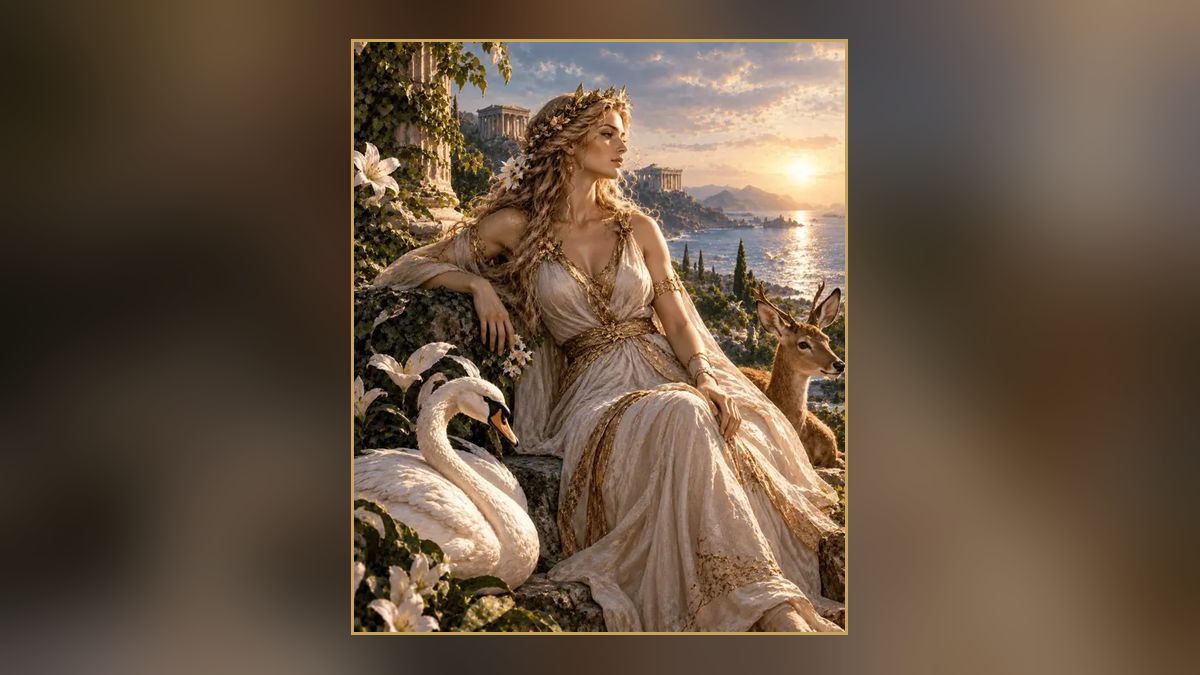
Leto is the mother of Apollo and Artemis, and that is nearly all most people know about her. She is a footnote to her own children, the quiet goddess in the background of two of the most glamorous Olympians. But if you read the story of how they were born, something else comes into focus. Leto's myth is, at its heart, a story about being turned away. A pregnant woman, chased by a powerful enemy, goes from land to land and is refused at every door. I think it is the first real refugee story in Greek myth, and I think it explains why the Greeks cared so deeply about the way you treat a stranger at your threshold.
The pregnancy that nobody wanted
Start with the problem. Leto is the daughter of two Titans, Coeus and Phoebe, and Zeus has taken a liking to her. She becomes pregnant by him with twins. That is the moment the trouble begins, because Zeus is married to Hera, and Hera does not forgive.
Hera's anger is the engine of the whole story. She cannot undo the pregnancy, so she does the next best thing: she makes it impossible for Leto to give birth. The Homeric Hymn to Apollo tells it most vividly. In that account, Leto goes searching for a place, and the hymn lists the lands she visits and what they say. Every one of them is terrified. They all know that the child she is carrying is going to be great, and they are afraid of the god who will be born, and more afraid of Hera.
So she wanders. She visits the islands and the mainland, and in each place a local power turns her away. The hymn is almost a travel itinerary of refusals. The tone is not cruel. The places are simply afraid. A goddess of enormous power, carrying twins who will become gods, cannot find anyone willing to risk Hera's anger by giving her shelter.
The island that said yes
The only place that finally agrees is Delos, a tiny, barren island in the middle of the Aegean. In the hymn, Delos is described as a poor place, rocky and unproductive, with no rich herds or vineyards. And the island is afraid too. Delos says she fears that the baby will be arrogant, will despise a small island, and will kick it into the sea.
Leto has to swear an oath, a great oath by the river Styx, that Apollo will build a temple there and that Delos will be honoured above all other places. That is the bargain. The poorest island in the Aegean takes in the goddess nobody else would host, and in return it gets the biggest deal in its history.
Hera does not give up. The goddess of childbirth, Eileithyia, is the one who must be present for a birth to happen, and Hera keeps her away on Olympus. Leto labours for nine days and nine nights in agony. The other goddesses gather around her, but without Eileithyia, nothing can happen. In the end, they send Iris, the messenger, to bribe Eileithyia with a huge necklace, nine cubits long, strung with gold. The trick works. Eileithyia arrives, and Leto, clutching a palm tree, finally gives birth. Apollo is born, and in other tellings Artemis is born beside him, or even before him.
Callimachus, a later poet, adds a lovely detail. When Apollo was born, swans circled the island seven times, and the island itself turned to gold. The roots grew gold, the lake glittered, even the olive tree on the shore bloomed with precious metal. The poorest island in the Aegean, for a moment, shines.
The part that makes me stop
Here is the thing that always strikes me. In Greek thought, the right way to treat a stranger was sacred. The word was xenia, guest-friendship, and the gods themselves, particularly Zeus, were thought to watch how people behaved toward travellers and suppliants. Turning away someone who asks for shelter was a breach of divine law.
Leto's story is a case study in what happens when the world fails that test. Almost everyone does, out of fear, not malice. The lands in the hymn are not villains. They are cautious, and the poem does not blame them, but it does make the reader feel the weight of each refusal. And the one place that does the right thing, Delos, is rewarded beyond measure.
If you were a Greek listening to that hymn at a festival on Delos, you would have been sitting on the very island it described, probably one of the most prosperous holy places in the Aegean, and you would have understood that its wealth was a gift from a goddess who was never forgotten for being taken in. It is a story that teaches by reward. Be kind to the refugee, because the refugee might be carrying the next god.
What Delos became
The reward was real. Delos did become one of the most important sanctuaries in Greece. A great festival was held there, and Ionian Greeks from all over the Aegean sailed to attend. After the Persian wars, in 478 BCE, a league of Greek city-states led by Athens chose Delos as the site of its common treasury. That is why it is called the Delian League. For a few decades, the tiny barren rock was literally the bank of the Greek world, until Athens moved the treasury to its own Acropolis in 454.
And then there is an irony that I find almost unbearable in its neatness. In 426 BCE, Thucydides tells us, the Athenians purified Delos. They dug up every grave on the island and moved the bodies to a neighbouring island called Rheneia. And they declared that from then on, nobody was allowed to die or to give birth on Delos. Women about to give birth, and the sick and dying, had to be taken across the water.
Stop for a moment on that. The island where the most famous birth in Greek myth took place was forbidden, by law, from allowing births. The sanctuary that had taken in a labouring woman when everyone else turned her away would not let any other woman labour there. You could read it as a sign of respect, keeping the sacred ground free of ordinary human pollution. But I cannot read it without feeling that the Greeks created a place where the original act of hospitality could never be repeated.
Wolves, frogs, and Lycia
Leto's wandering did not end at Delos. According to a later story, told most memorably by the Roman poet Ovid, after the twins were born, she travelled with them to the region of Lycia in southern Anatolia. Exhausted and thirsty, she came to a pond and knelt to drink. Some local peasants, who were gathering reeds, stopped her. They stirred up the mud and mocked her and refused to let her have water. Leto, furious, prayed that they should never leave the pond, and they were turned into frogs.
It is a funny, cruel little story, and it follows the same pattern as the main myth. A woman asks for the most basic thing, a drink of water, and is refused. The punishment is as petty as the crime.
But the Lycian connection goes further than a fable. Some writers say she was led to the river Xanthus by wolves, and that is how Lycia got its name, from the Greek word for wolf. And Leto was no side figure in Lycia. She was the chief goddess there. Archaeologists have excavated a great sanctuary of Leto, called the Letoon, near the city of Xanthos. In 1973, they found a stone slab there inscribed in three languages, Greek, Lycian and Aramaic, a decree from around 358 BCE. In that region, she was a mother goddess of the land, honoured with her children, with a standing far above anything she held in mainland Greece.
I love that detail. The goddess who was turned away by every place in the Aegean ended up with a major sanctuary and official decrees in one of the places she passed through. A story of rejection became the foundation of a cult.
The mother who does not fight
Once her children are born, Leto mostly steps out of the action, and the stories of her adult life are brief but telling. She is almost never the one who strikes. When Apollo and Artemis fight, she watches. In the Iliad, when Hera beats Artemis around the ears in the battle of the gods, it is Leto who quietly picks up the bow and arrows that have fallen in the dust, and carries them back to Olympus after her daughter.
That image is my favourite single moment of her. She does not retaliate. She collects the pieces. The mother who spent nine days in labour because of Hera's spite, who was refused by every country in the Aegean, does the small practical thing, and does not take the bait.
The one place where her anger does show is through her children. When Niobe, the queen of Thebes, boasts that she has far more children than Leto has, and that Leto is hardly worth honouring, Apollo and Artemis shoot Niobe's children with their arrows. Leto does not do the killing. She does not have to. Her pain turns into someone else's catastrophe, through the weapons she gave birth to.
What I take from her
So here is how I would sum her up. Leto is the goddess of being refused and surviving it. Her entire mythology starts at a closed door and ends with the door finally opening, in the place nobody expected. Her children are the most dazzling of all the gods, and she herself is, in a sense, the proof of what they cost.
I think the Greeks needed her. A culture that placed so much emphasis on hospitality needed a story to show what failing at it looked like, and a goddess to embody it. Leto is that story. She is a pregnant woman at a gate, and the poem asks every listener the same question: what would you have done?
Comments
Sign in to join the conversation.