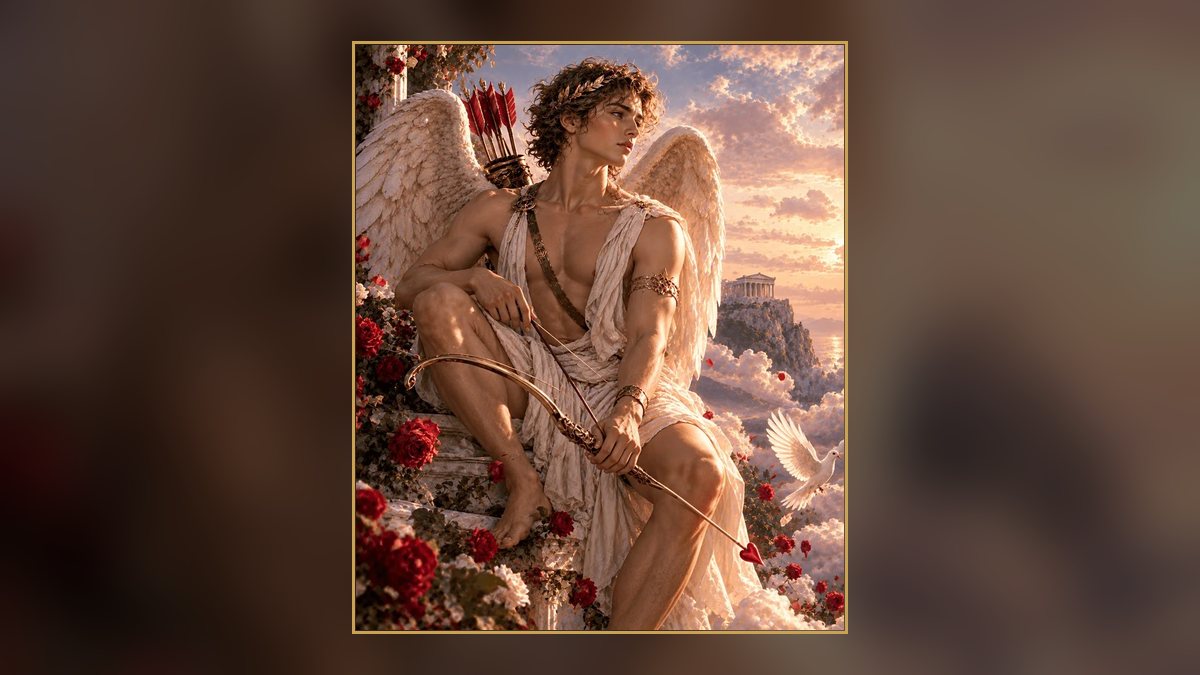
There are two Eroses, and one of them is much older and much stranger than the other. The one we know is a chubby child with wings and a bow, firing arrows at people who didn't ask for them. The older one is among the very first beings to exist, a force with no face at all. What interests me is not that the Greeks had both. It is that they swapped one for the other over a few hundred years, and I think the swap is a quiet confession.
The force with no face
In Hesiod's Theogony, the first things are Chaos, then broad-breasted Gaia, then Tartarus in the depths, and then Eros, whom he calls the most beautiful of the immortals. He has no parents and no story. Hesiod describes him as the one who loosens the limbs and overcomes the mind and wise counsel in the breasts of all gods and all men.
That is quite a job description for a baby. It's also an odd place to put him. Eros appears before there are any couples to desire each other. Before the sky and the sea, before any god has a body, there is already the pull that makes things join. In other words, Hesiod treats desire as part of the machinery of creation. Without it, nothing gets born.
Other writers took this further. A poet in Aristophanes' Birds, writing comedy but drawing on older cosmic songs, has Eros hatching from an egg laid by Night and then mating with Chaos to produce the birds. It's a joke, but it shows that people could easily imagine Eros as the first spark of life.
The boy appears
By the time of Sappho and the lyric poets, the picture is shifting. Sappho calls him bittersweet, a limb-loosening creature who attacks you like a wind falling on an oak. He's still a force, but he's become personal. He does things to individuals rather than to the cosmos.
Then he shrinks. In the Hellenistic period, he's a mischievous child, the son of Aphrodite, sometimes of Ares or Hermes as well. The finest example is in Apollonius's Argonautica, where Hera and Athena go to Aphrodite to ask for help getting Medea to fall in love with Jason. They find her combing her hair. Aphrodite calls her son, who is playing knucklebones with Ganymede in Zeus's own garden, and he's cheating. She bribes him with a golden ball that once belonged to the baby Zeus. He takes the bribe, flies down, and fires an arrow into Medea's heart.
I love this scene because it makes the cosmic pull of desire into a spoiled kid who does favours for sweets. And yet what he does to Medea is monstrous. A girl's whole life is overturned in an instant, and it's presented as a minor domestic errand.
The arrow as alibi
Here is the main idea I want to offer. The child with the bow is useful. He lets you say that it wasn't your fault. If desire is a boy with a quiver who can hit anyone he likes, then Medea didn't choose to betray her father. Dido didn't choose to love Aeneas. Phaedra didn't choose to love her stepson. They were shot.
That's a very comfortable way to think about love. You don't have to judge anybody. A force of nature, even a small one, takes the blame. And note how the story starts to appear exactly when poets are becoming interested in the private lives of individuals. Hesiod's Eros was a feature of the universe. The later one is a plot device for explaining why a sensible person did something awful.
Ovid gives the same idea a sharper edge. In the story of Apollo and Daphne, Apollo mocks Eros for playing with a bow, which is meant for serious gods. Eros, offended, takes two arrows from his quiver. One is gold and makes the target fall in love. One is lead and makes the target flee. He shoots Apollo with the gold one and Daphne with the lead, and we all know how that goes. It's a petty act of revenge, and it ruins two lives. And the lesson of it is that nobody, not even a god of prophecy and medicine, gets to be above desire.
Psyche and the long way round
The longest story about him is Apuleius's tale of Cupid and Psyche, written in Latin in the second century AD. A girl so beautiful that people stop worshipping Aphrodite is punished by the goddess, who sends her son to make her fall for a monster. Instead, he falls for her himself. He visits her only in the dark, forbids her to look at him, and she looks. After a series of impossible tasks set by his furious mother, she finally becomes immortal and marries him. Their daughter is called Voluptas, Pleasure.
It's a fairy tale, but the Greek word psyche means soul, and so I read it as the story of desire and the soul being forced to get to know each other. The god of love can only be loved properly if you can look at him, and that's precisely the thing that hurts. It's a very sophisticated reworking of the old idea that Eros is a force beyond us, now turned into something we can have a relationship with.
The stone at Thespiae
One of my favourite details comes from Pausanias. In the town of Thespiae in Boeotia, he says, the oldest cult object of Eros was not a statue at all but an unworked stone. The Thespians honoured him there long before they had a famous sculpture by Praxiteles, which later became one of the best-known works in Greece.
A rough stone as the first image of the god of desire. I think that's a lovely, slightly odd survival of the older view: a god too basic to have a face, just a presence you could hold and put offerings in front of. Compare it with the pretty child on the vases, and you see how far the image had travelled.
Eros also had a place in Athens's gymnasia, where an altar to him stood in the Academy. Plato's Symposium has one speaker, Socrates, report a different version from the priestess Diotima. In her telling, Eros is not a god at all but a spirit in between, born of Poros (Resource) and Penia (Poverty). He is always needy and always scheming, because he has his mother's emptiness and his father's cleverness. That may be the best definition anyone has given of wanting something.
What got lost
So the story moves from a cosmic force, to a bittersweet attacker, to a naughty child, to a philosopher's spirit of lack. Each change makes him easier to talk about and less frightening. My view is that the little boy with the bow is how we explained to ourselves something we couldn't control, and the oldest description, Hesiod's brief and bare line about the limbs and the mind, is still the most accurate. It doesn't give desire a face. It just says what it does.