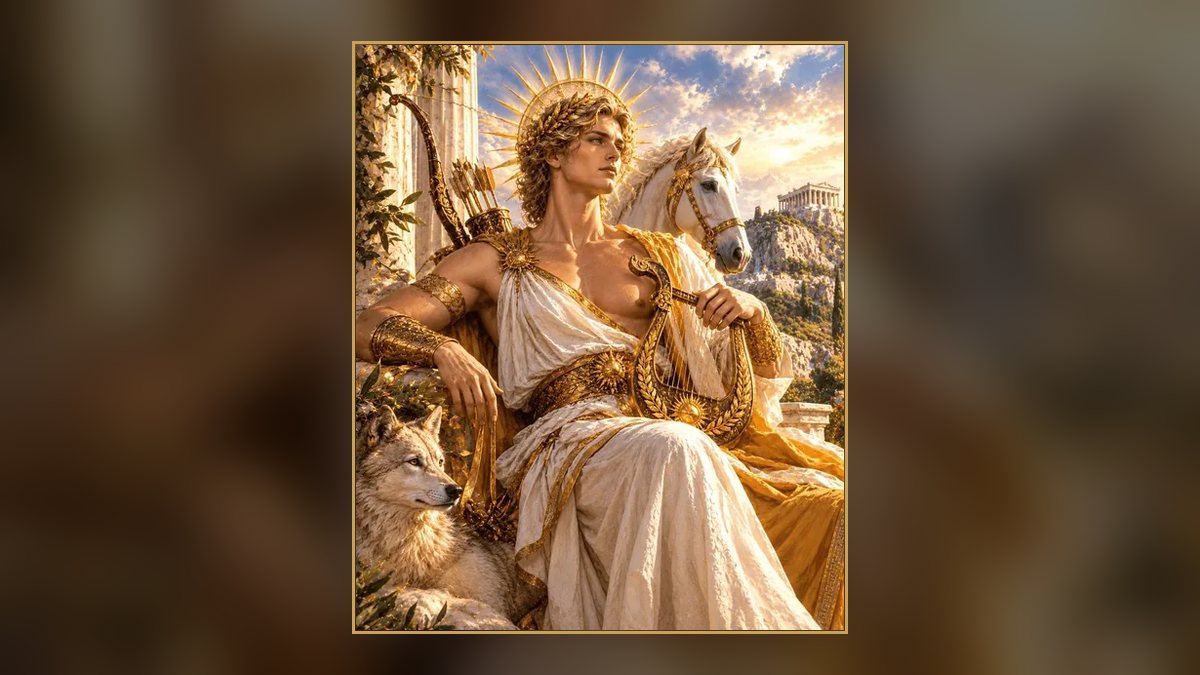
A great many Greek gods have powers that sound like jobs. Poseidon has the sea, Demeter has the grain, Hephaestus has the forge. Apollo has a very odd one, which is to lead a choir. The title Musagetes, leader of the Muses, describes him standing at the front of nine goddesses, holding a lyre, setting the tune. It is a surprising thing to find at the centre of a god’s identity, and it tells us how seriously the Greeks took their music.
The word is built from two parts. The Muses are the nine goddesses of the arts, and the second element comes from a verb meaning to lead. It is the same root as the word for a guide or a general. Apollo is the one who goes first, and the Muses follow. He is not their father, and he is not their master in the sense of giving orders. He is the conductor, the person who gives the beat and keeps the group together.
Who the Muses were
According to Hesiod, who tells the story in his Theogony, the Muses were the daughters of Zeus and Mnemosyne, the Titaness whose name means memory. Zeus lay with her for nine nights, and she bore nine daughters. It is a pleasing detail that the arts begin with memory. In a culture where poetry was recited and not read, a poet who could not remember his verses was nothing, and it made sense to imagine that the mother of song was the goddess of remembering.
Hesiod names them. Calliope is the Muse of epic poetry, and the oldest. Clio has history, Erato love poetry, Euterpe the flute, Melpomene tragedy, Polyhymnia hymns, Terpsichore dance, Thalia comedy and Urania the stars. The exact division of labour is a late and tidy invention, and earlier writers did not always keep to it. But the picture of nine sisters, each with a province of the arts, caught on, and it is still used today.
They lived on Mount Helicon in Boeotia, and on Mount Parnassus, close to Delphi, and in the north on Pieria, near Olympus. Their sacred springs were thought to give poetic power to anyone who drank from them. In the opening of the Theogony, Hesiod says the Muses appeared to him while he was looking after sheep on Helicon, and gave him a branch of laurel and a voice. In that account, the Muses are the ones who make a poet.
Where Apollo comes in
So where does the god fit? Apollo’s relationship with the Muses is the relationship between the player and the instrument. The Muses are the sources of song. Apollo is the one who puts it into form. His symbol is the lyre, and the poets liked to say that it was the first instrument to be played in heaven. In the Iliad, when the gods feast on Olympus after a day of quarrelling, Apollo plays the lyre while the Muses sing in turn, and everyone is soothed. It is the opposite of the war below.
The story of how he got that lyre is one of the best-loved in the Homeric Hymns. The baby Hermes, born at dawn, was out of his cradle by noon. He found a tortoise, killed it, and stretched strings across its shell. Then he stole fifty of Apollo’s cattle, walked them backwards so the tracks would confuse anyone following, and hid them in a cave. When Apollo tracked him down, Hermes began to play. The older god was so charmed that he forgave the theft in exchange for the lyre. Apollo has been its master ever since.
The first prize in music
The Greeks had a strong competitive streak, and music was no exception. There are two famous contests in which Apollo is the judge or the contestant. In the first, a satyr named Marsyas picked up a double flute that Athena had thrown away because it made her cheeks puff out. He played it so well that he challenged Apollo to a contest, with the winner free to do what he liked with the loser. The Muses judged. Apollo turned his lyre upside down and played it, then sang, and challenged Marsyas to do the same with the flute. It was impossible. Marsyas lost, and his fate is one of the grimmest in the stories.
In the second, King Midas, serving as a judge in a contest between Apollo and the god Pan, voted for Pan, and Apollo gave him a donkey’s ears for his bad taste. These stories are about more than pride. They are about the Greek conviction that the lyre, with its careful tuning, its measured intervals and its quiet voice, stood for civilisation, order and reason, while the flute and the pipe, which excite and enflame, stood for something wilder.
The singer in the cave
Apollo is also the father, in some versions, of Orpheus, the greatest musician among mortals. His mother was the Muse Calliope. When Orpheus played, the animals gathered around, and the trees bent their branches toward him. It is a fitting line of descent. A god who leads the Muses fathers a son who can calm a savage beast with a song.
At Delphi, the god’s great sanctuary, music was part of the ritual. Hymns were sung to the lyre, and there were musical contests at the Pythian Games, the festival held every four years in his honour. Two hymns to Apollo, carved on stone at Delphi in the second century BCE, with their musical notation, are among the best-preserved examples of Greek music we have. When pilgrims came to hear a prophecy, they heard it in a place that was also a school of song.
What the title is saying
Musagetes is a kind of philosophy in one word. The Greeks believed that beauty and knowledge came together, and that the same figure who spoke truth in oracles also kept the music in time. They did not see a gap between art and understanding. For them a good song was a form of knowing, because it held the past, the world and the heart in a single, repeatable shape.
That may be why the Muses followed Apollo and not Zeus or Athena. Wisdom, in the Greek picture, was not heavy or silent. It sang, and it needed someone at the front to give the first note.